- New
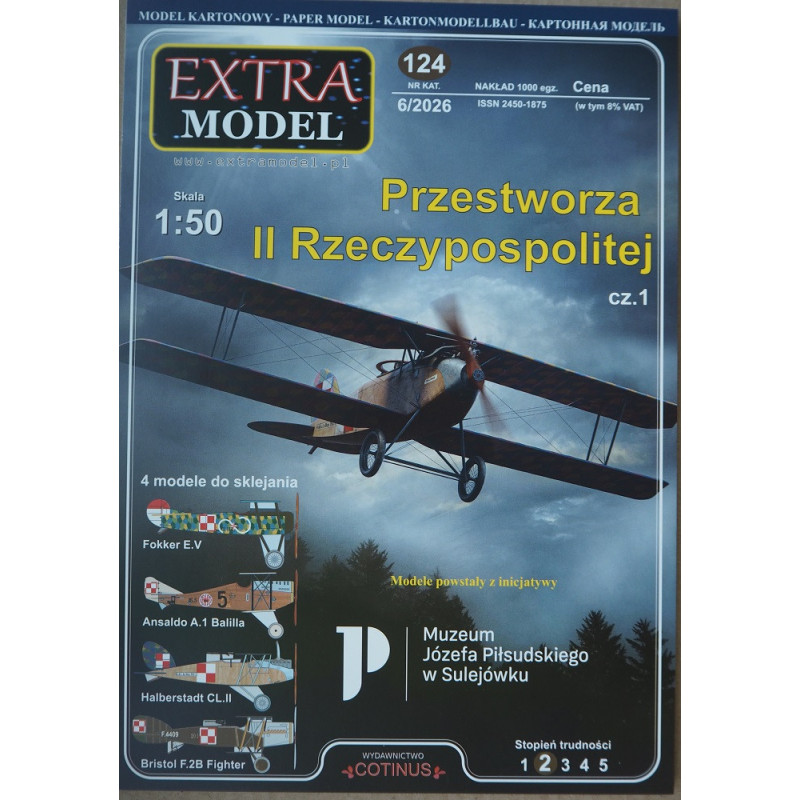


Publisher/ Manufacturer: "Extra Model" (Poland)
Scale: 1 : 50
Number of sheets: 10 x A4
Number of sheets with parts: 4
Number of assembly diagrams: 15
Difficulty level: For beginners and modelers with limited experience.
Models dimensions: 118 mm x 167 mm x 52 mm; 137 mm x 153.5 mm x 50.5 mm; 146 mm x 216 mm x 55.5 mm; and 154 mm x 239.5 mm x 59.5 mm.
 Security policy
(edit with the Customer Reassurance module)
 Delivery policy
(edit with the Customer Reassurance module)
 Return policy
(edit with the Customer Reassurance module)
When Poland regained its independence on November 11, 1918, it did not yet possess its own military aviation force. However, it did have pilots; many Poles had gained aviation experience, while serving in the armies of foreign nations. Almost immediately, a significant amount of equipment—including aircraft—was discovered at abandoned airfields, forming the basis of the first escadres. By November, these units were already engaged in the dramatic defense of Lwów. The fledgling air force was equipped with dozens of aircraft types, manufactured in various countries; some were captured or requisitioned, while others were purchased abroad. There was a shortage of spare parts, engines, and armament, yet mechanics were tasked with keeping a wide variety of aircraft types airworthy. The primary unit of the military aviation service was the escadre, which typically comprised only a few serviceable aircraft. Crews of two-seater aircraft consisted of a pilot and a observator, which conducted reconnaissance, took photographs, operated the rear machine gun and dropped bombs. During the war against Bolshevik Russia aviators served primarily as the eyes of the ground forces. They reconnoitered and photographed enemy positions, delivered orders and dispatches, bombed enemy convoys, trenches, armored trains, bridges, and camps, while also strafing targets from low altitudes. Aerial combat occurred relatively infrequently. The most difficult period was 1920. Pressured by the Red Army, escadres retreated alongside the ground forces, relocating personnel, aircraft, and support units to reserve field airfields. In August, aviation units supported troops, fighting for Warsaw near the Wkra and Wieprz rivers, and during the dramatic defense of Lwów, they repeatedly attacked units of Semyon Budyonny’s 1st Cavalry Army. Once the offensive had been repelled, the enemy had to be driven back to the east. In a period of less, than two years, the military aviation of a reborn Poland was formed from troops, trained abroad, and aircrafts, sourced from various countries. The parts for four aircraft models included in this publication — the Fokker E.V, Halberstadt CL.II, Ansaldo 1.A "Balilla," and Bristol F.2B "Fighter"—represent just a small fraction of that variety.
These are small, uncomplicated silhouette models, designed for beginners and modelers with little experience; assembling them requires no assistance from more experienced colleagues, though working in a group is always more fun. No reserves of colors. The textual instructions are in Polish consist of only a few general notes; the graphical instructions are also brief, but sufficient for assembly.

Publisher/ Manufacturer: "Extra Model" (Poland)
Scale: 1 : 50
Number of sheets: 10 x A4
Number of sheets with parts: 4
Number of assembly diagrams: 15
Difficulty level: For beginners and modelers with limited experience.
Models dimensions: 118 mm x 167 mm x 52 mm; 137 mm x 153.5 mm x 50.5 mm; 146 mm x 216 mm x 55.5 mm; and 154 mm x 239.5 mm x 59.5 mm.