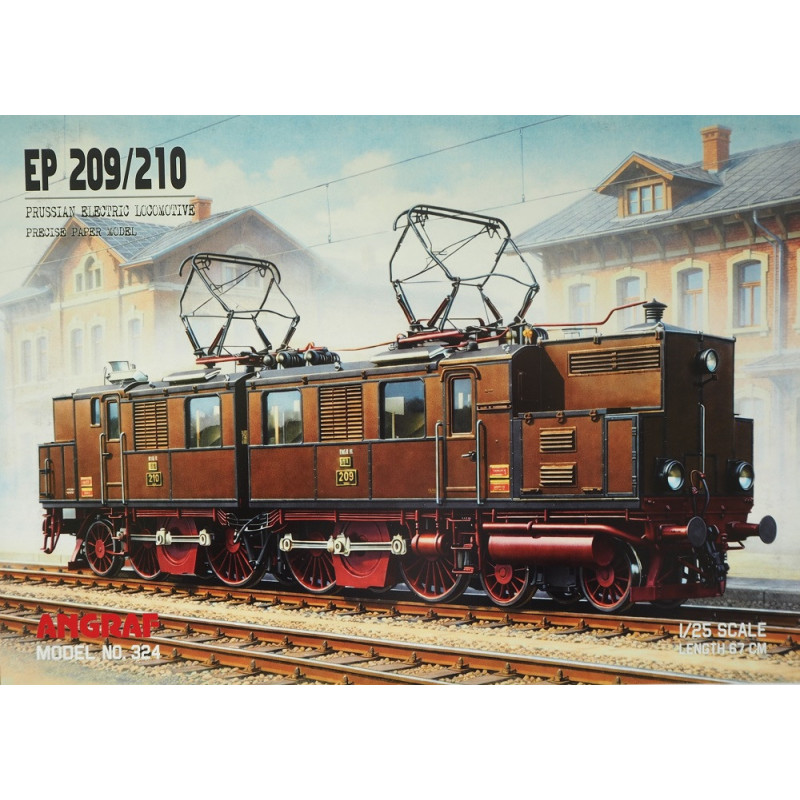


Manufacturer/ Publisher: "Angraf". Poland
Scale: 1 : 25
Number of sheets: 43 x A3
Number of sheets with details: 31 1/3
Number of assembly drawings: 99
Difficulty: For medium and experienced modelers.
Model dimensions: 659.5 mm x 120 mm x 185 mm
 Security policy
(edit with the Customer Reassurance module)
 Delivery policy
(edit with the Customer Reassurance module)
 Return policy
(edit with the Customer Reassurance module)
In 1913, 13 EP 209/210 class locomotives and 233/234 and 11 11 4-8-2 class locomotives from EP 235 to 246 were ordered. Due to the ongoing World War I, only the EP 235 locomotive was completed in 1917, and two twin-engine locomotives were put into service in 1922 and 1923. Due to the poor quality of production, which was determined by the conditions of World War I, they caused a lot of problems and required expenses, and they themselves were not used often. As a result, the EP 209/210 type locomotives were removed from the depot lists in 1925. These electric locomotives had to be able to pull heavy passenger and express trains at speeds of up to 90 km per hour on level sections of the track and had to be equal to the powerful steam locomotives of the time. They had to pull lighter trains at the same speed and on sections of the railway with a two percent gradient. In order to evenly distribute the loads, these locomotives had two connected axles: one driving one on one side and a two-axle bogie on the other. The transformer was installed under a hood in front of the driver's cab, on the longer side of the body. It supplied power to both engines, installed in the engine rooms behind the driver's cab. Under the hood, on the other side, were water and coal supply boxes. The longer side of the body box was 8.3 m long. The shorter side was only 6.8 m. The movement was transmitted to the wheels by two intermediate shafts with large flywheels, connected by links to the wheel assemblies. Although this design met the power requirements, it caused unwanted wobbles due to the too small distance between the axles on both sides of the body. The large number of movable joints often caused various problems. Since the manufactured locomotives EP 209/210 did not meet expectations, further execution of the order was discontinued and only the locomotive EP 211/212, which was already in production, was completed. Due to the long production time, these locomotives were already obsolete, when they entered service. For this reason and due to the bad experience from the operation of the manufactured units, the previously produced locomotive became obsolete in 1925. EP 211/212 lasted longer and was given the number E 49 00 "Reichsbahn", but it also ended its service in 1929. These locomotives worked on the Silesian Mountain Railway lines for almost the entire period of operation and were assigned to the Breslau (Wroclaw) locomotive depot.
A large, complex, well-designed and richly detailed (although without the driver's cab equipment, for which there was not enough data to restore) model for medium-experienced and experienced modelers. However, the fact, that there is no cab equipment, almost does not affect the deterioration of the appearance of this beautiful locomotive. There are a large color reserves, the textual instruction is quite solid in size and perfectly complements the exemplary graphic instruction, whose drawings are clear, large and perfectly readable, very informative.

You might also like
Manufacturer/ Publisher: "Angraf". Poland
Scale: 1 : 25
Number of sheets: 43 x A3
Number of sheets with details: 31 1/3
Number of assembly drawings: 99
Difficulty: For medium and experienced modelers.
Model dimensions: 659.5 mm x 120 mm x 185 mm