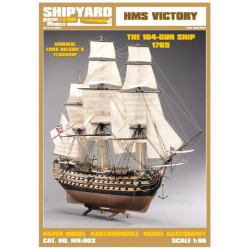
Publisher/ manufacturer: "Shipyard". Poland
Scale: 1 : 96
Number of sheets: 11 x A3 + flags
Number of pages with details: 7
Number of assembly drawings: 62
Difficulty: For modelers of any experience.
Model dimensions: 420 mm x 165 mm x 345 mm.
Number of laser cut detail sheets: 1 x A3, 1 x 62 mm x 274 mm, 1 x 102 mm x 94 mm
Number of laser cut parts: 31
Cardboard thickness: 0.5; 1 and 1.5 mm
 Security policy
(edit with the Customer Reassurance module)
 Delivery policy
(edit with the Customer Reassurance module)
 Return policy
(edit with the Customer Reassurance module)
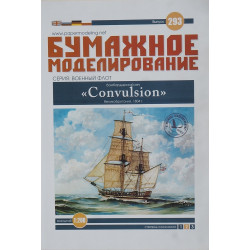
The British cutter HMS "Alert" was built on June 24, 1777. Ships of this type were used by the British navy for patrolling, mail transportation and fighting against smugglers and corsairs. Initially, the "Alert" protected merchant ships in the English Channel. Later sent to the western part of the strait, where on September 18, 1777 he noticed a small ship in the vicinity of the Quessant Peninsula. "Alert" commander John Bazel declared combat readiness and began to chase the ship. It turned out to be the American brig "Lexington", armed with 16 4-pounder guns and 12 falconettes with a crew of 84. By then, the ship had participated in the capture of 14 ships, so its supply of gunpowder and shells was running low. After a short battle, "Lexington" was taken. "Alert" sailed with the loot to England, where she carried out the necessary repairs and again began her routine patrols, only this time off the southern coast of Portugal, where she remained until early January 1778. The cutter's armament was changed at Plymouth that month, with the 4-pounder guns replaced by 6-pounders. In June the cutter was assigned to Admiral Kepel's escadre and, during a patrol with the frigate "Aretuza", encountered the French frigate "La Belle Poule" and the lugger "Le Courier". "Alert" spent the year 1778 in Kepel's escadre, on 17 July, while searching for other ships of the escadre, she was ambushed and captured by the French frigate "Junon".
The model is well designed and detailed, of medium complexity, so we recommend gluing it only to medium-experienced and experienced modelers, but, working under the supervision of a more experienced colleague, it can be glued by both an advanced beginner and a modeler with little experience, but it will not be an easy job. The flags are printed double-side on so called "fabric" paper. The publication is completed with laser-cut frame and thickening parts from a white cardboard of the required thickness, but there is also a set of "classic" of frame and thickening parts, printed on a thin paper. There are a "secondary" cladding parts.

Publisher/ manufacturer: "Shipyard". Poland
Scale: 1 : 96
Number of sheets: 11 x A3 + flags
Number of pages with details: 7
Number of assembly drawings: 62
Difficulty: For modelers of any experience.
Model dimensions: 420 mm x 165 mm x 345 mm.
Number of laser cut detail sheets: 1 x A3, 1 x 62 mm x 274 mm, 1 x 102 mm x 94 mm
Number of laser cut parts: 31
Cardboard thickness: 0.5; 1 and 1.5 mm