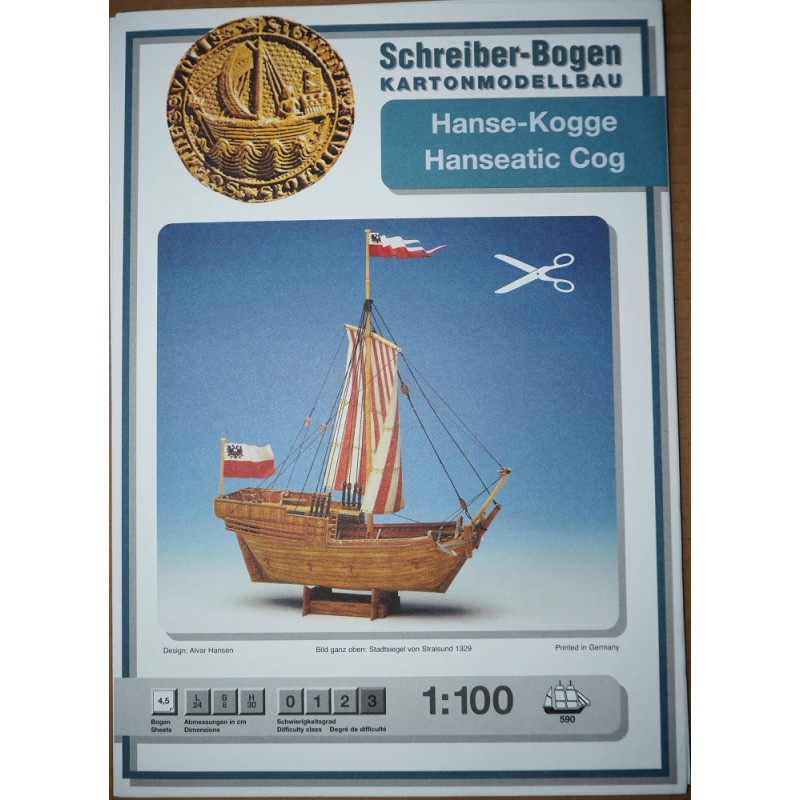


Publisher/ Manufacturer: "Schreiber-Bogen". Germany
Scale: 1 : 100
Number of sheets: 10 x A4 (1 x 1 mm cardboard)
Number of sheets with parts: 7
Number of assembly drawings: 23
Difficulty level: For modelers of any experience.
Dimensions of the model: 240 mm x 80 mm x 300 mm
 Security policy
(edit with the Customer Reassurance module)
 Delivery policy
(edit with the Customer Reassurance module)
 Return policy
(edit with the Customer Reassurance module)
The merchants of the Hanseatic League transported their goods by sea in cogs: wine, beer, grain, salt, furs, fish and many other goods. The alliance was very successful and its cities flourished and dominated the politics of Northern Europe for centuries. Some cities still pride themselves on being a “Hanseatic city”. However, these ships disappeared centuries ago. Their appearance was forgotten. It was not until 1962, that a wooden ship, identified as a Hanseatic cog was found during dredging work in Bremen. After 38 years of reconstruction (from 2000 separate parts!), research and conservation, it was presented to the public in May 2000 at the German Maritime Museum in Bremen. Not all, but many of the secrets of the wreck have been revealed: the Hanseatic cog was made of wood, cut in the Kassel area and was transported downstream on the Weser River in 1380. The Weser flood carried the almost finished ship away from its building site, capsized and sank. For almost 600 years, the cog lay at the site of the sinking. At 23 meters long, the ship was certainly not the largest ship of its type at that time. Its main features are a spacious, blown hull, clinkered (overlapping planks), a raised platform at the stern (the so-called castle deck), a steering plate already attached to the stern, and a large main (usually the only) mast with a rectangular sail. Based on the measurements of this sensational find, exact copies of the cog were built in Bremerhaven and Kiel, which are now used for tourist trips.
A small, not very complicated, well-designed model, that will suit modelers of any experience, except for complete beginners. And for beginners and modelers with little experience, who have assembled several models, we advise them to work carefully, thoroughly, to use all their patience, and, if possible, to work under the supervision of a more experienced colleague. Where necessary, double-sided printing has been used. The textual instructions are quite large for such a small model, quite detailed in German, the graphic instructions are somewhat smaller, but quite detailed and sufficient for the correct assembly of the model. This beautiful model, designed by Alvar Hansen, like the original, is constructed on the basis of spans. Many details, two different sails and six sets of flags and heraldic shields allow You to create many different variations. The model is also ideal for a diorama. By the way, with a little additional work with the sail, flags and shields, You can also make a replica of the cog, built in Memel (Klaipeda).

Publisher/ Manufacturer: "Schreiber-Bogen". Germany
Scale: 1 : 100
Number of sheets: 10 x A4 (1 x 1 mm cardboard)
Number of sheets with parts: 7
Number of assembly drawings: 23
Difficulty level: For modelers of any experience.
Dimensions of the model: 240 mm x 80 mm x 300 mm