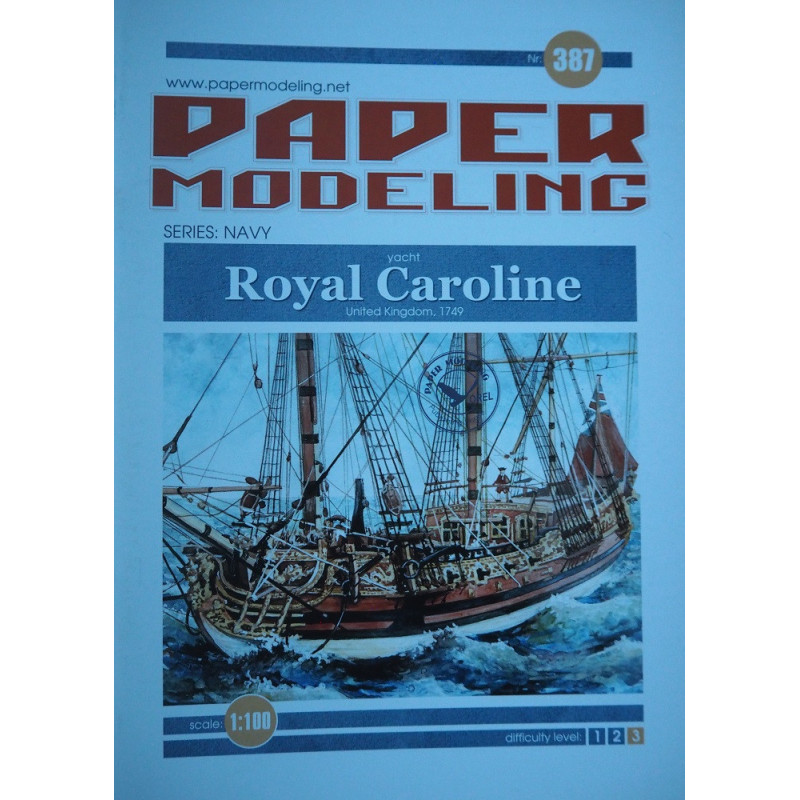


Publisher/ Manufacturer: "Paper Modeling". Ukraine
Scale: 1 : 100
Number of sheets: 26 x A4
Number of sheets with details: 17
Number of assembly drawings: 48
Difficulty: For medium and experienced modelers.
Model dimensions: 415 mm x 168 mm x 300 mm
 Security policy
(edit with the Customer Reassurance module)
 Delivery policy
(edit with the Customer Reassurance module)
 Return policy
(edit with the Customer Reassurance module)
HMY “Royal Caroline” - Royal yacht with frigate sailing equipment. She was to replace HMY ‘Carolina” in 1749 as the main Royal yacht of Great Britain. Built at the Deptford shipyard under the supervision of shipbuilder John Holland according to the project of the naval surveyor Joseph Allin. Launched on 29 January 1750 and dismantled 70 years later, in 1820. “Royal Caroline’ was first commanded by Captain Sir Charles Molloy, who commanded her until 1753. Captain Sir Piercy Brett took command in 1754, and in August 1761 she became the flagship of Admiral of the Fleet Lord Anson, with Captain Peter Dennis as his flagship. Anson was ordered to convey Princess Charlotte of Mecklenburg-Strelitz from Cuxhaven to Kiel, where she was to marry George III. The yacht, renamed HMY “Royal Charlotte” for the occasion, was accompanied by an escadre of warships and four other royal yachts: HMY “Mary”, “Katherine”, “Augusta” and “Fubbs”. On the return voyage, the escadre was blown three times by westerly winds to the Norwegian coast and took ten days to reach Harwich, arriving on 6 September 1761. Peter Denis was appointed captain of “Royal Charlotte’ in December 1763 and remained in command until 1770. Denis was succeeded that year by Captain John Campbell, who commanded her until his promotion to rear admiral in 1777. Captain William Cornwall was reappointed in command of “Royal Charlotte” in March 1783, who was in turn succeeded by Captain Sir Hyde Parker in 1788. The yacht was briefly placed in reserve in December 1792, but was re-paid for its upkeep the following year. She continued to be used for official occasions during the French Revolution and the Napoleonic Wars, and King George III often sailed his yachts to greet returning fleets and to inspect the fleet. In 1797 the King sailed “Royal Charlotte” to visit the fleet on the River Nore after the Battle of Camperdown and to pay tribute to Admiral Adam Duncan. However, contrary winds prevented the ship from reaching the Thames Estuary, and the royal yacht was forced back into the River Greenwich. “Royal Charlotte” was re-commissioned in May 1801 under Captain Sir Harry Neale, although in February 1804 she was commanded by Captain George Grey. Later in 1804 Grey was succeeded by Captain George Henry Towry, who in turn was succeeded by Captain Edward Foote in 1805. “Royal Charlotte” then became the principal royal yacht, and remained so until 1804, when the slightly larger HMY “Royal Sovereign” was built. Captain Foote commanded the yacht until 1812, when Captain Thomas Eyles took over, and in June 1814 Captain George Scott became her commander. “Royal Charlotte” continued in service until 1820. July, when it was finally dismantled.
A small and very complex model of a small and beautiful sailing ship, intended only for medium-experienced and experienced modelers. The model is well designed and richly detailed, with a lot of colors and ornaments, deck equipment. There is a fairly large reserve of colors and textures, textual instruction in Ukrainian, Polish, English and German - not very large, but illuminating the entire process of assembling the model and perfectly complementing the rather large, detailed, informative graphical instructions. Several details of the model and sails are printed double-sided, and the sails are also on thin tinted paper.

Publisher/ Manufacturer: "Paper Modeling". Ukraine
Scale: 1 : 100
Number of sheets: 26 x A4
Number of sheets with details: 17
Number of assembly drawings: 48
Difficulty: For medium and experienced modelers.
Model dimensions: 415 mm x 168 mm x 300 mm