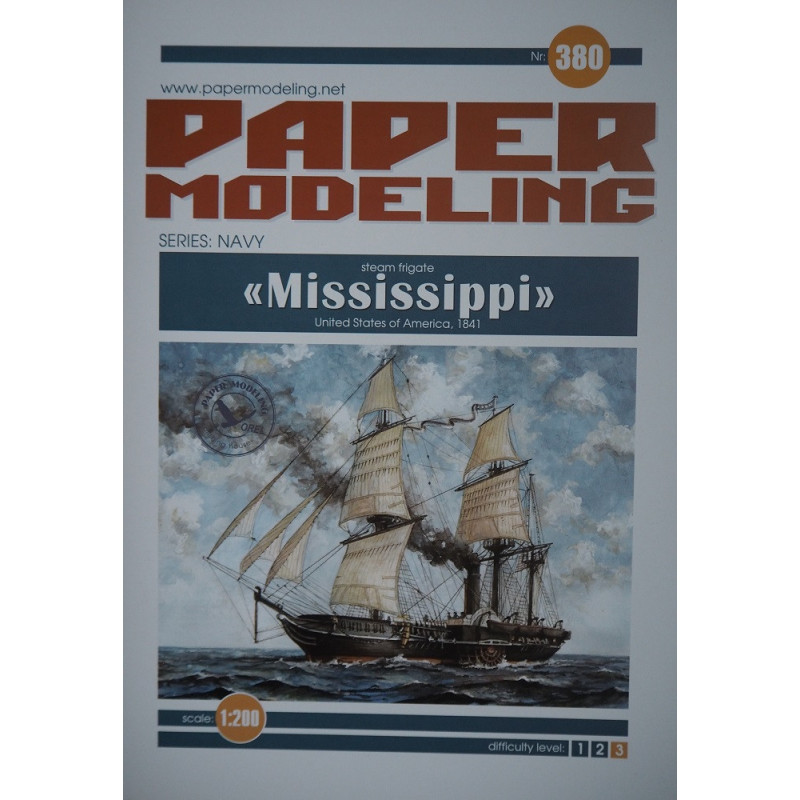


Publisher/ Manufacturer: "Paper Modeling". Ukraine
Scale: 1 : 200
Number of sheets: 18 x A4
Number of sheets with details: 8
Number of assembly drawings: 12
Difficulty: for medium and experienced modelers.
Model dimensions: 350 mm x 134 mm x 269 mm
 Security policy
(edit with the Customer Reassurance module)
 Delivery policy
(edit with the Customer Reassurance module)
 Return policy
(edit with the Customer Reassurance module)
USS “Mississippi” – the American steam-powered frigate with side wheels, which entered service in 1841. It was the first US Navy paddle-wheel frigate, designed to operate on the ocean. The ship was named after the Mississippi River. The building of USS “Mississippi” began at the Philadelphia Naval Shipyard in 1839, where it was supervised by Commodore Matthew Perry. The ship entered service on December 22, 1841. The 70-meter-long ship had a barque-type sailing rig and two steam engines, driving two wheels, mounted on the sides of the ship. After entering service, the “Mississippi” served until 1845 as a test ship to study the operation of steam engines on ships, and then joined the West India Escadre and became its flagship. From 1846 he actively participated in the Mexican-American War. The ship's main task at that time was to ensure control of the east coast of Mexico by blocking Mexican shipping and military supply routes. In March 1847 the “Mississippi” participated in the siege of Veracruz, delivering supplies and troops ashore. A successful landing operation contributed to the capture of this city. From 1849 the ship spent two years in the Mediterranean. In 1853 he participated in three trips to Asian ports, visiting Tokyo Bay and Shanghai, among other places. With the outbreak of the Civil War in 1861, it was returned to active service. It participated in battles with Confederate forces in the Mississippi River region. In 1863, while trying to take control of the Confederate base at Port Hudson, it was badly damaged by shore battery fire, ran aground and burned, set ablaze by its crew, avoiding Confederate capture.
A small ship model, but quite complex, intended only for medium-experienced and experienced modelers. The model is well designed and richly detailed. There is a large reserve of colors and textures, textual instruction in Ukrainian, Polish, English and German - small, only a few general notes and an explanation of conventional designations, which is JUST A MUST READ, because in this model the usual designations often mean completely different things, than we are used to. The graphical instructions are not large, but very chaotic and do not explain everything, although the drawings are beautiful, but that "arrow hedgehog" will drive any modeler out of patience - each detail with its number needs to be "reconciled" with almost help from a ruler, a pen and a magnifying glass. And also - the lines of the drawing are almost the same in color and thickness, as the arrows or rigging lines. Many details are printed double-sided (sails, beds and some other details - even on thin paper), where necessary, the details are printed with copper and bronze-color "Metallic" type paints, but the printing is not very successful. But, if all this did not scare You, You assemble the model, then it will definitely decorate Your table, shelf or collection.

Publisher/ Manufacturer: "Paper Modeling". Ukraine
Scale: 1 : 200
Number of sheets: 18 x A4
Number of sheets with details: 8
Number of assembly drawings: 12
Difficulty: for medium and experienced modelers.
Model dimensions: 350 mm x 134 mm x 269 mm