

Publisher/ Manufacturer: "Paper Modeling". Ukraine
Scale: 1 : 25
Number of sheets: 15 x A3
Number of sheets with details: 11
Number of assembly drawings: 46
Difficulty: For modelers of any experience.
Model dimensions: 477 mm x 119 mm x 688 mm
 Security policy
(edit with the Customer Reassurance module)
 Delivery policy
(edit with the Customer Reassurance module)
 Return policy
(edit with the Customer Reassurance module)
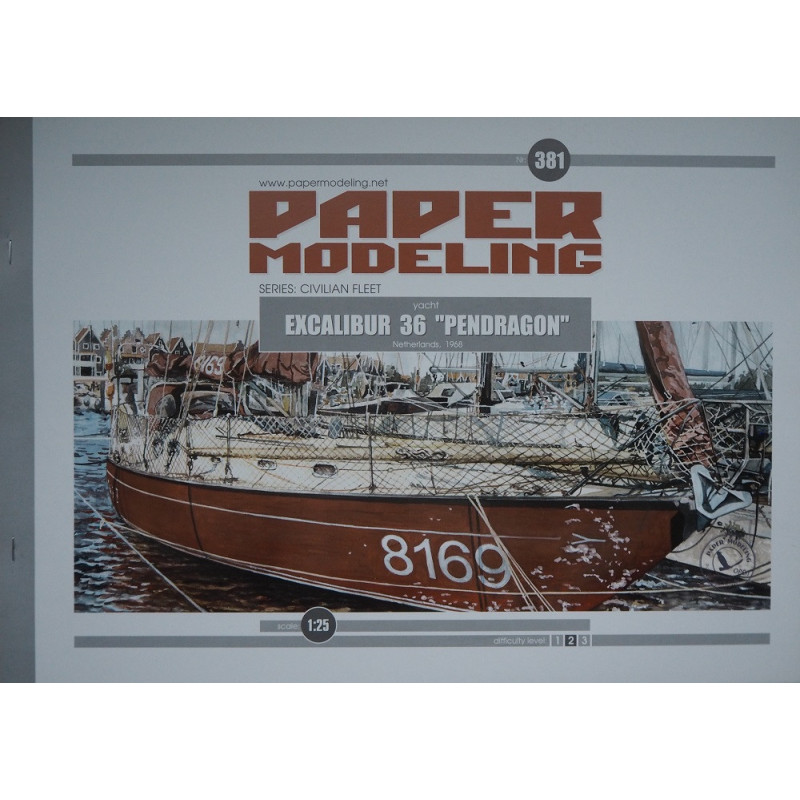
E. G. van de Stadt designed “Excalibur” in 1962. This design closely resembled a scaled-up version of his already very successful “Pionier” construction – early examples of cruising yachts with separate rudder plates at a time, when most cruising yachts still had long keels with rudders, suspended at the end. All hulls of “Excalibur’s” were cast by “Tylers”, with integrated lead ballast and were formed from fiberglass composites. The hulls were mainly built at “Southern Ocean Shipyard” in Poole, where about 50 of these yachts were built, but some were also built in Holland by various shipyards. Very few later examples are reported to have had a modified underwater profile with a fin and keel rudder. “Excalibur” won the RORC Class II championship in 1963, 1964 and 1965, but as racing developed towards wider constructions with smaller keels, they were no longer competitive, except in stormy weather. It is now a fine example of the classic cruiser racing yacht - a very comfortable and robustly built yacht, designed for offshore or coastal sailing. Such yachts are still available.
This edition contains parts, from which You can make a model of the 1968-looking yacht “Pendragon”. A large model of a small yacht, but not very complicated, intended for modelers of any experience. The model is well designed and richly detailed; there is even a detailing of the cabin equipment. True, for beginners and modelers with little experience, we recommend to work under the supervision of a more experienced colleague, don’t rush, use all the reserves of diligence, patience and attentiveness and do not do the cabin detailing and simplify something. There is a large reserves of colors, textual instructions in Ukrainian, Polish, English and German - small, but quite detailed, covering all stages of model assembly and perfectly complementing the small, informative and easy-to-read graphical instructions. Several details are printed double-sided (sails - even on thin paper.)

Publisher/ Manufacturer: "Paper Modeling". Ukraine
Scale: 1 : 25
Number of sheets: 15 x A3
Number of sheets with details: 11
Number of assembly drawings: 46
Difficulty: For modelers of any experience.
Model dimensions: 477 mm x 119 mm x 688 mm