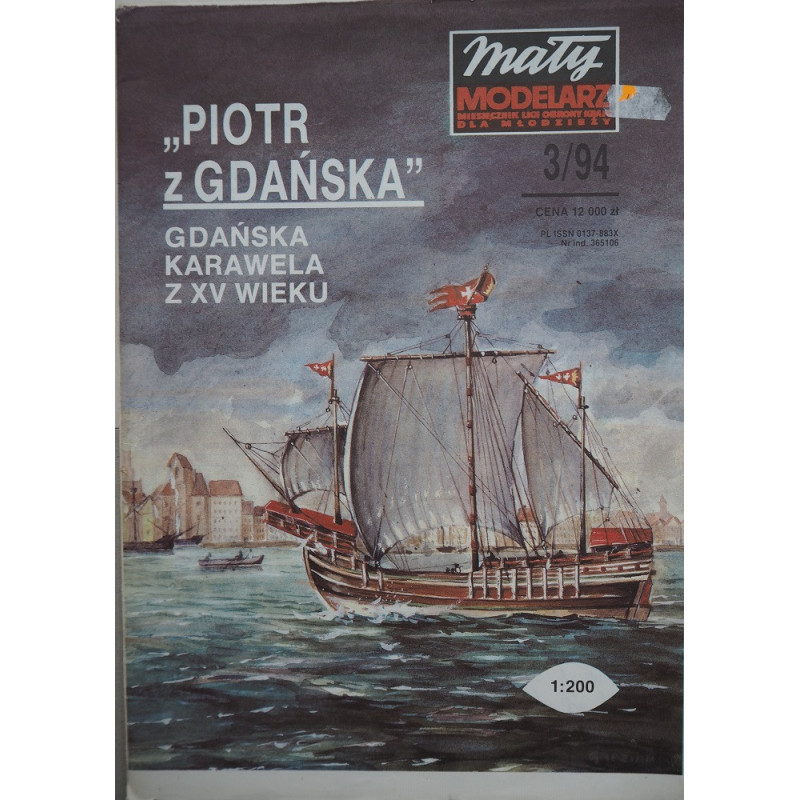


Publisher/ manufacturer: "Maly Modelarz". Poland
Scale: 1 : 200
Number of sheets: 10 x A4
Number of sheets with parts: 6
Number of assembly drawings: 6
Difficulty level: For modelers of all experience.
Dimensions of the model: 261 mm x 61 mm x 217,5 mm
 Security policy
(edit with the Customer Reassurance module)
 Delivery policy
(edit with the Customer Reassurance module)
 Return policy
(edit with the Customer Reassurance module)
Until the construction of the caravel "Peter von Rassel" (as this caravel was originally called) began, similar ships were built in the clinker method - like cogs and most hulks. This ship used a smooth plank-to-plank cladding for the hull. The caravel sailed from 1462 to 1475. In June 1462, it set sail from the French port of Brouage and its destination was Gdansk. While standing in the road-stead of the port of Gdansk, the ship was struck by lightning and destroyed its mainmast, which was 41 meters high and 1 meter thick. The mast, falling on the deck, severely damaged the ship. The ship needed major repairs. It was towed from the road-stead to the Motława River, where it was unloaded on the quay of the Warehouse Island - it brought salt. This very large ship for its time made a considerable impression on the city's residents and shipbuilders. The ship's owner was the Frenchman Peter Cosimot (apparently, from this the ship got its name), and the ship's captain was Marot Boeff. After the incident, he left the ship in Gdansk and went to France himself. Another Frenchman, who was supposed to supervise the repair work on site, fell seriously ill and died. Before his death, he managed to hand over the affairs to the Breton Peter de Nantes, who was in Gdansk, and appoint him as trustee. The damage was extensive, the repairs were prolonged, and the money from France was severely delayed or did not reach the port at all. On May 19, 1464, the caravel was seized due to the owner's insolvency. The trustees were Gdansk merchants Rolof Weltsted and Jaspae Lange. When the owner agreed to take the ship back at the end of 1464, the trustees refused to hand it over. A court was held and he, together with representatives of the city authorities, recognized the caravel as the property of Gdańsk merchants and the ship remained in the port for several more years. At the turn of 1469 and 1470, it was recognized, that after several alterations the ship could become a warship. The final repairs were carried out by Gdańsk shipbuilders under the supervision of Hans Pale. In 1471, the mainmast was anchored in the Motlawa with the help of a winch and from that moment the caravel was called "Peter von Danzig". On August 19, 1471, the ship was taken out of the port by the Gdańsk sailor Michael Erthmann and the caravel sailed west. At the end of September, it reached Berschwitz, where Erthmann was replaced by Corporal Pawel Benek. The caravel participated in a number of sea battles, mainly with the crews of British ships (then there was a war between the Hanseatic League and England), and it also fought with neutral ships. Thus, on April 27, 1473, at the mouth of the Thames, "Peter" fought with the Florentine "Saint Thomas", from which the painting "The Last Judgment" by the artist Hans Memling was taken as a booty, which is still exhibited in the Gdansk Folk Museum. The success of "Piotr z Gdansku" was determined by excellent construction, experienced captains and a well-trained crew. In the summer of 1473, the caravel returned to Gdansk for repairs, and the mercenaries were released. The ship set off on its last voyage with 27 other ships - the destination was Brouage. Only 21 ships returned from this voyage. Old documents testify, that "the great caravel from Gdansk, due to its unsuitability for use, was left in Brouage due to its age". Thus, the old ship ended its life, where it had set sail on its first voyage.
A not very complicated, but well-designed and sufficiently precisely detailed sailship model, which, under the supervision of a more experienced colleague, will be perfectly assembled even by a advanced novice modeler and little experienced modeler. There are no color stocks, the text instructions are extensive, quite detailed and explain the all gluing process, the graphical - are small and cover only the most important assembly stages. Antiquarian publication.

Publisher/ manufacturer: "Maly Modelarz". Poland
Scale: 1 : 200
Number of sheets: 10 x A4
Number of sheets with parts: 6
Number of assembly drawings: 6
Difficulty level: For modelers of all experience.
Dimensions of the model: 261 mm x 61 mm x 217,5 mm