

Publisher/ manufacturer: “Avangard". Ukraine
Scale: 1 : 200
Number of sheets: 26 1/3 x A3
Number of pages with details: 16 1/3
Number of assembly drawings: 126
Difficulty: For intermediate to advanced modelers.
Model dimensions: 605 mm x 116 mm x 305 mm
 Security policy
(edit with the Customer Reassurance module)
 Delivery policy
(edit with the Customer Reassurance module)
 Return policy
(edit with the Customer Reassurance module)
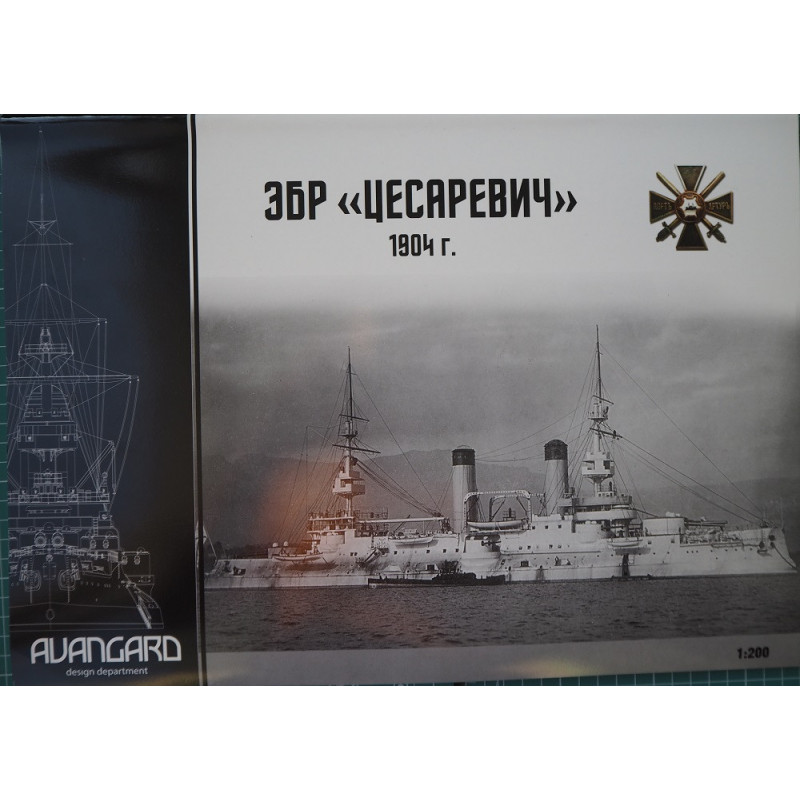
"Tsesarevich" (Russian: «Цесаревич») - a Russian pre-dreadnought battleship of the early 20th century, built in France and renamed "Grazhdanin" («Гражданин») in 1917. It participated in the battles for the defense of Port Arthur during the Russo-Japanese War, was one of the two most powerful ships of the Russian escadre, and later in World War I. In general, "Tsesarevich" was not inferior to other modern warships of the time, including the Japanese "Mikasa". However, some authors believe, that it would have been more rational to create a standard battleship, based on the American-made "Retvizan" or the Russian-built "Potemkin" for the Black Sea Fleet, using more powerful engines. These projects were distinguished by balanced characteristics and good armor, and in addition, they could be built in a shorter time. During the first evening of the battle, on February 8/9, 1904 (January 26/27) during an attack by Japanese destroyers on Russian ships, anchored in the outer roadstead of Port Arthur, "Tsesarevich" was hit by a torpedo and required repairs. After the death of Admiral Makarov and the sinking of the battleship "Petropavlovsk", "Tsesarevich" became the flagship of the new commander of the Pacific Escadre, William Wittengeft. During an attempt to escape from Port Arthur, which ended in the Battle of the Yellow Sea on July 28 (August 10), 1904, "Tsesarevich" was fired upon by the battleship "Asahi", but, since the Japanese shells exploded on first contact with the ship and did not penetrate the armor, the battleship was only slightly damaged. However, in the second phase of the battle, at 18:40, a 305 mm "Asahi" shell exploded on the comand bridge, killing Lieutenant General Witgieft, two of his staff officers, and wounding the ship's Commander Ivanov. A few minutes later, a second shell damaged the bridge, killing the helmsman and damaging the steering gear. The ship turned to starboard, slowing down at times and eventually stopping. This unexpected maneuver caused chaos among the Russian ships. The deputy commander, Rear Admiral Prince Pavel Ukhtomsky, finally regained control of the remaining ships and returned to Port Arthur. After partially repairing the ship's steering, the crew directed her to the German port of Qingdao in China, where she was interned for the rest of the war (thus becoming the only surviving Russian warship of the war with Japan). In 1906 it arrived in the Baltic Sea, where it was repaired and modernized in St. Petersburg, was included in the Baltic Fleet and, together with the battleship "Slava" ("Слава"), formed the basis of this fleet until the inclusion of new warships. With the outbreak of World War I, it took part in many operations of the Russian Navy in the Baltic Sea against the German fleet. On March 31, 1917, after the February Revolution, the ship was renamed "Graždanin" ("Гражданин", engl. "Citizen"). In October 1917, it took part in a clash with German warships, repelling an attack by the German fleet in the Muhu Strait (Operation "Albion"). On October 17, 1917, during a battle in the Muhu Strait with the German battleships SMS "König" and SMS "Kronprinz", the ship was damaged and sent to Helsinki for repairs. He participated in the "ice campaign" - the winter evacuation of the Russian fleet to the east. Due to the collapse of the Russian state, the ship's technical condition deteriorated and it was not included in the newly formed Red Fleet. After the end of the Civil War, in 1925 it was sold for scrap.
A medium-sized, well-designed and richly detailed model of one of the Russian ships of the Russo-Japanese War for medium-experienced and experienced modelers. It perfectly details all the deck equipment, superstructures, hull, armament, rigging and rangout, rescue equipment and other ship details. There is no textual instruction, but it is not necessary, when the graphic one is simply excellent, consistently arranged and perfectly readable, explaining the gluing of each detail and its stages. Some sheets and details are printed double-sided, some details are printed on thin paper (not just the frame), there is not reserve of colors, but white ones are even wheelbarrows.

You might also like
Publisher/ manufacturer: “Avangard". Ukraine
Scale: 1 : 200
Number of sheets: 26 1/3 x A3
Number of pages with details: 16 1/3
Number of assembly drawings: 126
Difficulty: For intermediate to advanced modelers.
Model dimensions: 605 mm x 116 mm x 305 mm