

Manufacturer/ Publisher: "WAK". Poland
Scale: 1:200
Number of sheets: 14 x A4
Number of sheets with details: 11 1/8
Number of assembly drawings: 44
Difficulty: For intermediate and experienced modelers
Model dimensions: 653 mm x 64 mm x 214 mm
 Security policy
(edit with the Customer Reassurance module)
 Delivery policy
(edit with the Customer Reassurance module)
 Return policy
(edit with the Customer Reassurance module)
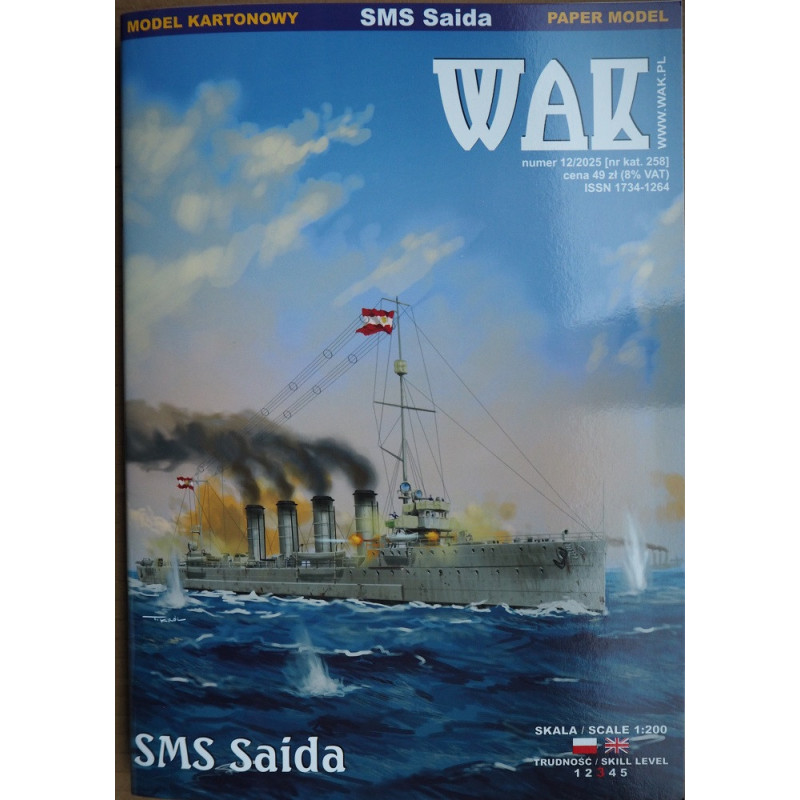
SMS "Saida" was an Austro-Hungarian armored light cruiser. The ship building begun in 1911 and entered service on 1 August 1914. Along with the ships of the same type, "Novara" and "Helgoland", it was designed as a reconnaissance and destroyer ship. The most famous event in the ship's life was the Battle of Otranto, which took place on May 15, 1917. Austro-Hungarian warships (“Saida’, “Novara”, “Helgoland” and 2 anti-destroyer ships) were supposed to destroy the barriers, protecting against submarine attacks. During the attack, two anti-destroyer ships (Italian “Borea” and French “Boutefeu”), the transport ship “Carraccio”, and 14 trawlers (drifters) were sunk. The ships, that participated in the attac,k were barely damaged - only a few hits. After the end of World War I, SMS “Saida” was transferred to Italy as a reparation, where the ship was renamed “Venezia” and served until 1937.
Relatively simple for a cruiser, a well-designed and maximally detailed model for modelers with average experience and advanced modelers. But the model is not one, that a modeler with little experience, working under the supervision of a more experienced colleague, could not assemble. Although the model is maximally detailed, it is not overloaded with complex assemblies, the superstructures and deck equipment are also not complex, the decks, unlike other Fernando Perez Yuste projects, are quite light and have a natural wood color. The textual instructions are not very large and only contain general provisions with an explanation of the assembly of several assemblies in Polish and English, the graphic instructions are quite large, informative and quite readable. There are no color stocks, but they can be "combined" from the gluing sectors of the reverse sides of the details, using them sparingly.

You might also like
Manufacturer/ Publisher: "WAK". Poland
Scale: 1:200
Number of sheets: 14 x A4
Number of sheets with details: 11 1/8
Number of assembly drawings: 44
Difficulty: For intermediate and experienced modelers
Model dimensions: 653 mm x 64 mm x 214 mm