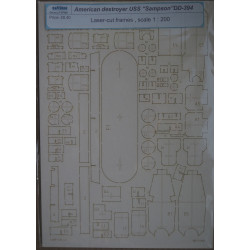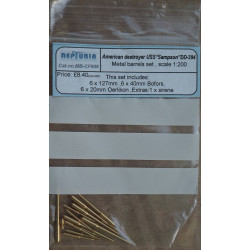


Manufacturer/ Publisher: “Neptunia-Card Fleet“. United Kingdom
Scale: 1 : 200
Number of sheets: 32 x A4
Number of sheets with details: 21 1/6
Number of assembly drawings: 126
Difficulty: For intermediate to advanced modelers.
Model dimensions: 581 mm x 56,5 mm x 178,5 mm
 Security policy
(edit with the Customer Reassurance module)
 Delivery policy
(edit with the Customer Reassurance module)
 Return policy
(edit with the Customer Reassurance module)
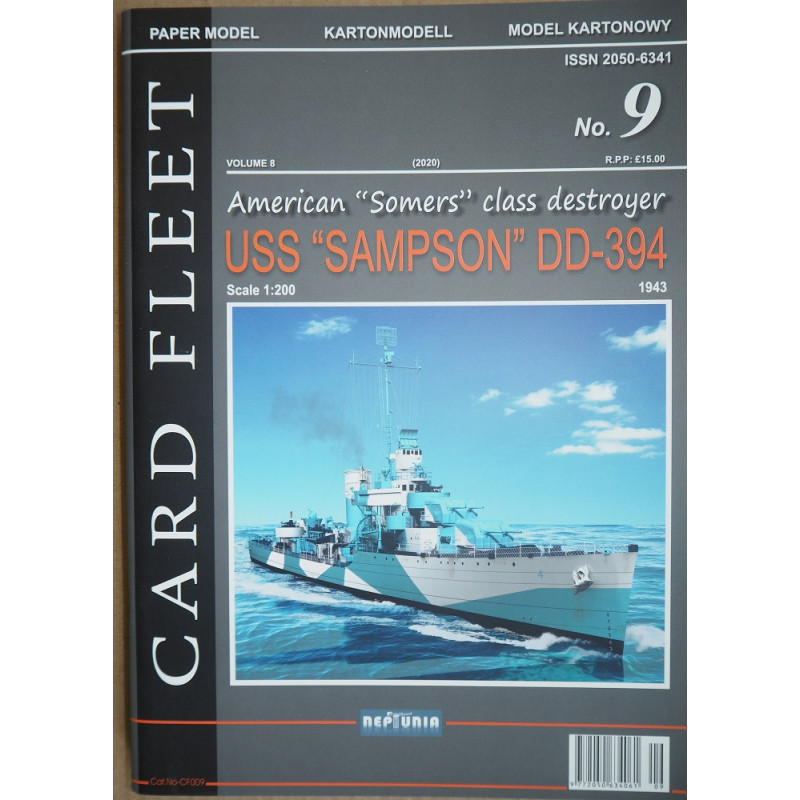
USS “Sampson” was built on the east coast of the United States at the “Bath Iron Works” shipyard in Bath, Maine. The keel was laid down on 8 April 1936, launched on 16 April 1938, and commissioned on 18 August of the same year. Before the outbreak of World War II, he made several long voyages, including - in European waters, then visited the Caribbean and continued his service on the west coast of the United States. In mid-1940, he returned to the Atlantic waters, where escorted convoys HX-153 and ON-28 as part of the Mine Neutrality Patrol. When the Japanese attacked Pearl Harbor, “Sampson”, along with the same type of warship “Warrington”, was patrolling off Rhode Island. Later, he was directed to the Panama Canal, where he participated in the search operation for the submarine S-26 (SS-131), which sank in the Gulf of Panama after a collision with the patrol ship USS “Sturdy”. After escorting several troop transports, “Sampson” was transferred to the Pacific, where he continued his service off the west coast of the both Americas. In mid-1943, he visited the South Pacific, where performed escort duties. On the night of 2–3 October 1943, he fired on a disembarked submarine and then attacked it with depth charges. As a result of these attacks, a large oil and fuel spill surfaced. On 15 March 1944, he was assigned to a small Tactical Force group, consisting of the escort carriers “Natoma Bay” and “Manila Bay”, four battleships and several destroyers. This group attacked Kavieng, New Ireland. After this operation, “Sampson” again performed escort duties. On 22 May 1944, as flagship of Admiral Fletcher, participated in the landing of TF 77 on Biak Island. On the evening of May 27, he was attacked by 4 Japanese aircraft. One G4M “Betty” narrowly missed “Sampson”, flew just above her command bridge, and hit the patrol ship SC-699, sailing behind him, which caught fire. The destroyer later returned to the east coast, where escorted several convoys to the Mediterranean. At the end of the war served as a training ship in the Atlantic. Decommissioned on November 1, 1945, and scrapped on March 26, 1946.
A fairly large, complex, well-designed, and very detailed model of a warship, painted in colorful camouflage (1943) for only intermediate and experienced modelers. The color range is quite large, the text assembly instructions are large and detailed in Polish and English, the graphic ones are simply huge, informative, easy to read, and both of them will really help a lot in the process of gluing the model. Excellent print quality.

You might also like
Manufacturer/ Publisher: “Neptunia-Card Fleet“. United Kingdom
Scale: 1 : 200
Number of sheets: 32 x A4
Number of sheets with details: 21 1/6
Number of assembly drawings: 126
Difficulty: For intermediate to advanced modelers.
Model dimensions: 581 mm x 56,5 mm x 178,5 mm