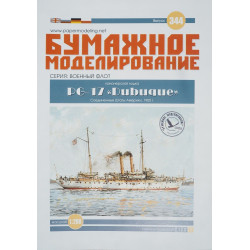


Publisher/ Manufacturer: "Paper Modeling". Ukraine
Scale: 1 : 200
Number of sheets: 27 x A3
Number of sheets with details: 16
Number of assembly drawings: 148
Difficulty: For intermediate and experienced modelers.
Model dimensions: 612 mm x 107 mm x 246 mm
 Security policy
(edit with the Customer Reassurance module)
 Delivery policy
(edit with the Customer Reassurance module)
 Return policy
(edit with the Customer Reassurance module)
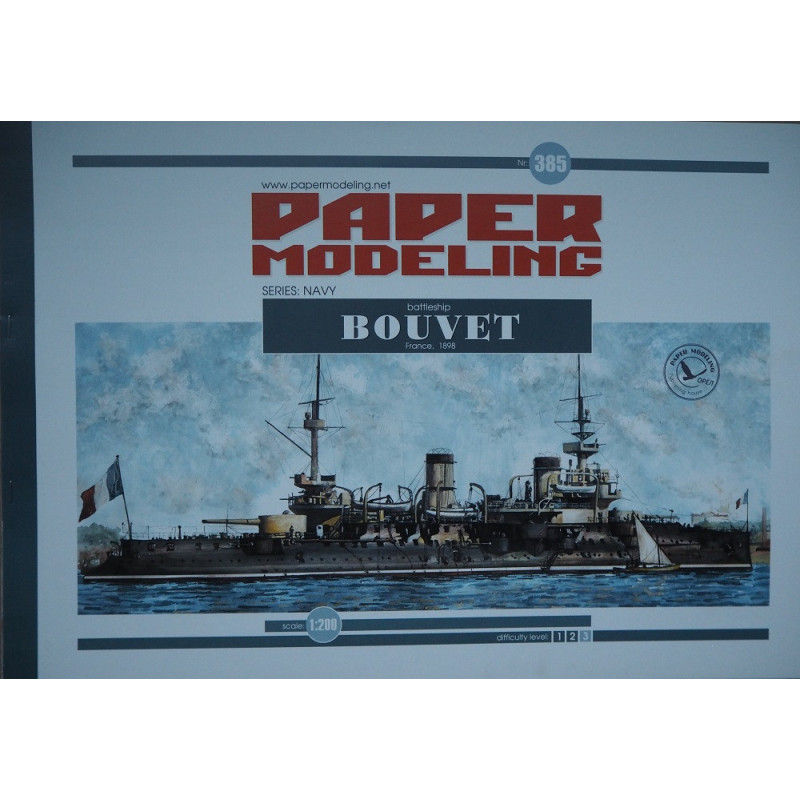
"Bouvet" – the French Navy escadre battleship. The fifth and last escadre battleship of the "Charles Martel" type, named after French Admiral François-Joseph Bouvet, who fought in the Revolutionary and Napoleonic Wars. The keel of the ship was laid in July 1891, launched in July 1894 and entered service in July 1897. The class included the “Charles Martel”, “Carnot”, “Massena”, “Jauréguiberry” and “Bouvet”, but differed greatly in construction details, all built for the French Navy in 1890. “Bouvet” spent most of her service in the Mediterranean and Northern Divisions of the French Navy, regularly participating in annual large-scale maneuvers. At the beginning of World War I the battleship escorted convoys from North Africa to France. He soon joined the Allied escadre in the Dardanelles Campaign. On 18 March 1915, while firing on Turkish forts, “Bouvet” was hit several times by Turkish shells during an artillery barrage, destroying some of the casemates and damaging the forward turret tube purge system. Fires broke out on board the battleship. At around 13:54 the “Bouvet” was hit by a 356 mm shell, which caused an explosion in the gunpowder stores, and the ship sank within two minutes. 639 crew members were killed, including the commander, Captain First Rank De la Touche. The destroyers, that rushed to the rescue, saved only 48 crew members. According to another version, the ship sank after entering a minefield, which was secretly laid by the Turkish minelayer “Nusret” on the night of March 7-8. Two British warships were also sunk that day. These losses convinced the Allies, that the invasion of the Dardanelles by the Marines was impossible without ground support, so it was decided to launch an amphibious landing and conduct a land operation on the Gallipoli Peninsula. From the details in this edition You can assemble a model of the “Bouvet” in 1898 appearance.
A medium-size and very complex model of a medium-size battleship, intended only for medium-experienced and experienced modelers. The model is well designed and richly detailed. There is a fairly large stock of colors and textures, textual instructions in Ukrainian, Polish, English and German - not very extensive, but covering the entire process of assembling the model and perfectly complementing the huge, detailed, informative and easy-to-read graphical instructions. True, the graphical instructions, although excellent, "smell" of a slight chaos. There are details, printed double-sided.

You might also like
Publisher/ Manufacturer: "Paper Modeling". Ukraine
Scale: 1 : 200
Number of sheets: 27 x A3
Number of sheets with details: 16
Number of assembly drawings: 148
Difficulty: For intermediate and experienced modelers.
Model dimensions: 612 mm x 107 mm x 246 mm