

Publisher/ Manufacturer: "Paper Modeling". Ukraine
Scale: 1 : 100
Number of sheets: 28 x A4
Number of sheets with details: 14
Number of assembly drawings: 94
Complexity: for medium and experienced modelers.
Model dimensions: 333 mm x 53 mm x 115 mm
 Security policy
(edit with the Customer Reassurance module)
 Delivery policy
(edit with the Customer Reassurance module)
 Return policy
(edit with the Customer Reassurance module)
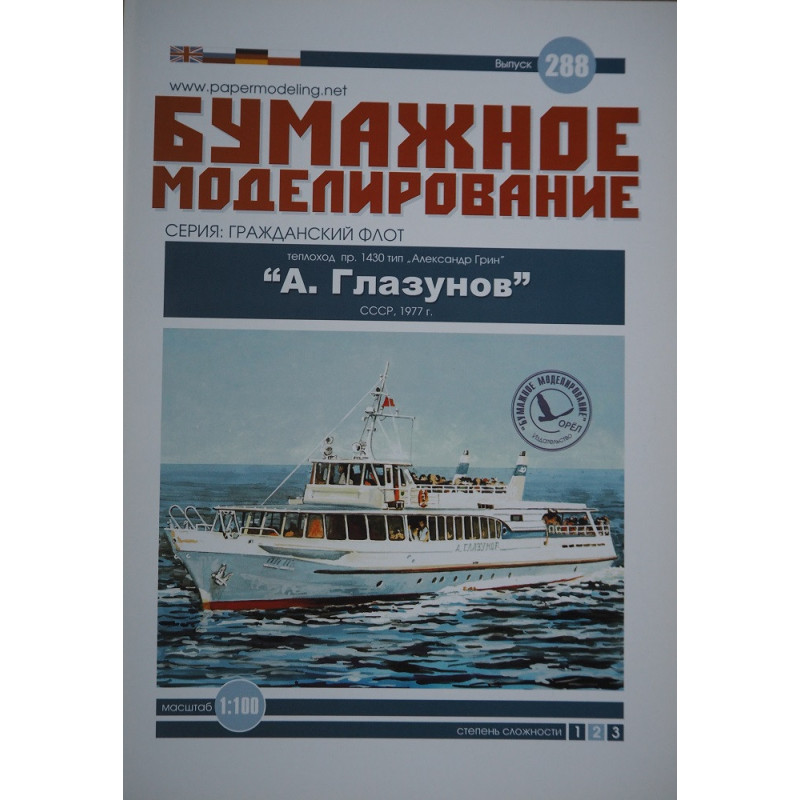
A series of large passenger cutters or small diesel-ships according to the 1430 project, called the "Aleksandr Grin" type, began to be built at the Kherson, Ilyichevsk and Baku shipyards in 1970. The first ships of this series were operated in the ports of Yalta, Odessa and Evpatoria respectively. The most successful series of passenger diesel-ships, combining a large passenger capacity, good speed and relative comfort (especially after the glazing of the middle salon began). These ships were used in all sea basins of the USSR, inland waters (rivers and lakes), and were also exported abroad. The project was developed by the Black Sea CKPB in Odessa. In total, 160 ships of this series were built in four shipyards in 1969-1984 and 1995: “Komintern” SBRF (Kherson) - 44 units in 1970-1984 + 1 - in 1995, Ilyichevsk SRF - 74 ships in 1970-1979, Baku “Paris Commune” SRF - 6 ships (1970-1975) and Baku “Van Sturua” SRF - 36 units (1971-1975). The diesel-ship has three passenger compartments: an open deck in the stern and two salons in the bow and middle of the ship. The engine room with two main engines - diesel 3D12A with installed remote control - is located in the stern under the passenger salon. The aluminum alloy steering house is installed on the upper deck in the bow of the diesel-ship. The hull is welded from steel sheets, with a rounded transition from side to bottom. The ship is propelled by two 4-blade propellers with a diameter of 1120 mm. The parts in the magazine are intended for assembling a model of the diesel-ship "A. Glazunov", built by the Kherson SBRF "Komintern" in 1977, serial number 23. One ship of this project (at least) transported tourists both in the port of Klaipėda and around it at sea. It was named "Baršauskas" and outwardly almost did not differ from the one, reproduced in the publication model. Its fate after the restoration of independence could not be traced. But its model can be easily rebuilt from these tiles.
A small model of a small ship. The model is well designed and richly detailed, intended only for medium-experienced and experienced modelers. The model is detailed not only visible equipment, but also the interior of the passenger salons and control cabin. Of course, You can leave them out, make the windows opaque, then this model will also suit modelers with little experience, working under the supervision of a more experienced colleague. But it will not be an easy job. There is a considerable reserve of colors and textures, textual instructions in Russian, Polish, English and German - large and quite well explaining the entire process of gluing the model and complementing the excellent, informative and easy-to-read graphical instruction at the right time and place. There are details, printed double-sided.

Publisher/ Manufacturer: "Paper Modeling". Ukraine
Scale: 1 : 100
Number of sheets: 28 x A4
Number of sheets with details: 14
Number of assembly drawings: 94
Complexity: for medium and experienced modelers.
Model dimensions: 333 mm x 53 mm x 115 mm