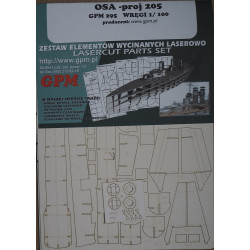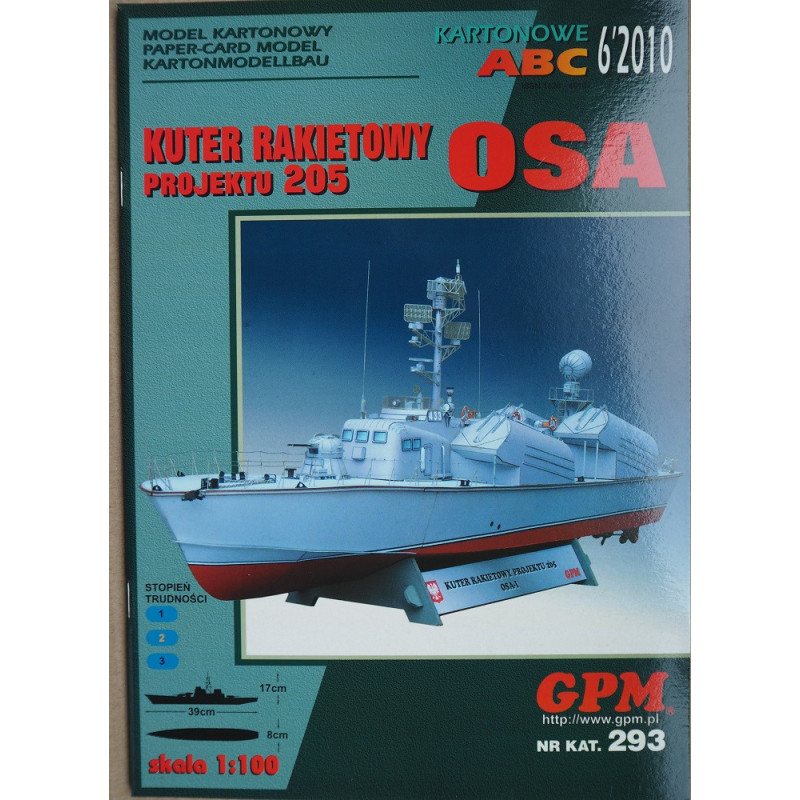


Publisher/ Manufacturer: "GPM". Poland
Scale: 1 : 100
Number of sheets: 16 x A4
Number of sheets with details: 12
Number of assembly drawings: 35
Difficulty: For modelers of any experience.
Model dimensions: 386 mm x 76.5 mm x 170 mm
 Security policy
(edit with the Customer Reassurance module)
 Delivery policy
(edit with the Customer Reassurance module)
 Return policy
(edit with the Customer Reassurance module)
"Osa" (also known as project 205) - the name of a class of rocket cutters of the USSR of the Cold War era, built in 1960-1973. It is estimated, that a total of over 400 ships of this type were built! Length - 38.6 meters, width - 7.64 meters, full displacement of the "Osa II" subtype ship - about 240 tons. Maximum speed - about 40-42 knots. The ship's armament consists of two 30 mm AK-630 twin-barreled turrets and four single P-15 “Termit” water-to-water missile launchers (SS-N-2 “Stich’). Work on the “Osa’-class cutters began in the second half of the 1950s and was aimed at creating a successor to the cheap, simple-to-manufacture, but effective “Komar”-class cutter. Ultimately, compared to their predecessors, the “Osa I”-class ships had an enhanced artillery armament, an additional two SS-N-2 missile launchers, and also had better electronic equipment with similar characteristics, had a greater range and maximum speed. During production, the “Osa II” variant appeared, which differed from the “Osa I” subtype in a slightly larger water capacity and cylindrical missile launchers for P-15U missiles. These quite successful rocket cutters were used by the fleets of many Warsaw Pact and Third World countries, including Algeria, Angola, Egypt, Bulgaria, Yugoslavia, Poland and the GDR. It is worth adding, that in 1999 there were still 100 “Osa I” and “Osa II” type ships in operation. Two ships of this type, but without armament, were transferred by the unified Germany to the re-establishing Lithuanian, Latvian and Estonian Navy fleets, but they did not stay with us for long. About a year and a half later, both were transferred to Latvia (according to other data, one each to Latvia and Estonia). I have not yet seen any visual material on how they looked in the Lithuanian Coast Guard Fleet, but I have found a few photos of the "Latvians" - the image is quite poor, since most of the photos are from the last days of these ships, before being cut up.
A small and well-detailed model of a small ship, but also designed for modelers of any experience. Only beginners and modelers with little experience should work under the supervision of a more experienced colleague and simplify some nodes. The model has a perfectly designed full detail: hull, underwater parts, superstructures, armament, deck and control equipment. There are no color reserves. The textual instruction in Polish is not very large, but quite detailed and will certainly help in the process of assembling the model. The graphical instruction is quite large and is certainly sufficient for good gluing of the model, informative and easy to read. The model recreates the appearance of the cutter, which served in the Polish Navy as early as 2008.

You might also like
Publisher/ Manufacturer: "GPM". Poland
Scale: 1 : 100
Number of sheets: 16 x A4
Number of sheets with details: 12
Number of assembly drawings: 35
Difficulty: For modelers of any experience.
Model dimensions: 386 mm x 76.5 mm x 170 mm