

Publisher/ Manufacturer: "Answer" – "Angraf". Poland
Scale: 1 : 200
Number of sheets: 18 x A3
Number of sheets with details: 13 1/6
Number of assembly drawings: 35
Difficulty: For intermediate and advanced modelers.
Model dimensions: 930 mm x 101 mm x 241.5 mm
 Security policy
(edit with the Customer Reassurance module)
 Delivery policy
(edit with the Customer Reassurance module)
 Return policy
(edit with the Customer Reassurance module)
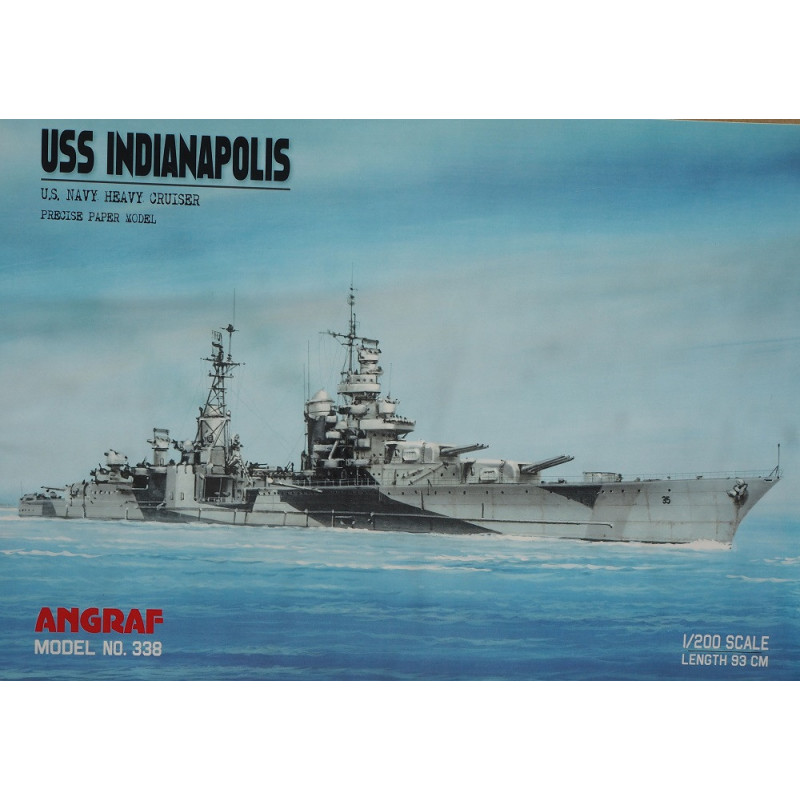
USS “Indianapolis” was launched on July 1, 1931, at the “New York Shipbuilding Co.” in Camden, New Jersey. He entered service on November 15, 1932. A year later he became the flagship of the US Navy. In 1936 President F. D. Roosevelt sailed on his deck on a visit to South American countries. In February 1941, after minor repairs and conservation work, the ship became the flagship of Task Force III. On December 7, 1941 “Indianapolis” was not at Pearl Harbor - it was carrying out a training mission near Jonson Island. Upon receiving information of the attack on the US Navy base in Hawaii, the ship was included in Task Force 12 and tried to catch up Japanese forces, but was unsuccessful. During World War II the ship served only in the Pacific Ocean. In 1942 it was briefly repaired twice, during which anti-aircraft artillery was strengthened and radars were installed. On February 19, 1943 in the area of Atlu Island, it sank the Japanese transport ship “Akagane Maru”. In April–May 1943 the cruiser was extensively modernized, this modernization quite significantly changed the appearance of the ship. The aft mast was moved forward of the second funnel, the aft superstructure and command post construction were changed, the anti-aircraft artillery was further strengthened and the radars were updated. After the repair, it became the flagship of the V Fleet. In November 1943 the ship participated in the shelling of Tarawa and Makin Islands, during which it shot down a Japanese aircraft. It performed the same actions in the Kwajalein Island area in February 1944. Until the end of 1944, it participated in almost all US Navy operations in the Pacific Ocean, supporting the Marines with its artillery fire, thanks to which the sequence of islands were liberated. During the repair in May 1944, the camouflage was changed to Ms 32 "Crazy Guilt" and the armament was strengthened again. The ship, which was used intensively in 1944, was repaired again. In February 1945 he joined Task Force 58 and covered the American landings on Iwo Jima, and in April, in Okinawa, where cruiser was hit by an aerial bomb. With damaged propeller shafts, the ship sailed to base on his own. During the repair at Mare Island, the ship's electronic equipment and anti-aircraft artillery were significantly upgraded (20 mm caliber cannons were installed). The ship's last mission was the transport of enriched uranium-235, intended for the installation of the first atomic bomb on Tinian Island. And from this island the B-29 bomber picked it up for dropping on Hiroshima. On the return voyage, sailing towards Leyte without any escort, the cruiser was torpedoed by the Japanese submarine I-58, after which the ship sank on July 30, 1945. The SOS signal sent, was not received correctly, and only 4 days later the crew of PV-1 "Ventura", patrolling this ocean zone, found the surviving 316 wounded and exhausted crew members. 863 officers and sailors died. After the war ship’s commander, Commander C. B. Mc Vay, became the only ship commander, accused of losing a warship in combat conditions. He was punished for not sailing in zigzags, which would not have saved the ship from sinking anyway, since the Japanese I-58 had taken a very favorable position for the attack. Only on December 20, 2018 the actions of the “Indianapolis” crew were properly assessed - the entire crew was awarded the Congressional Gold Medal.
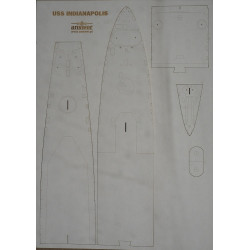
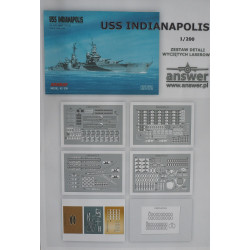
A complex, large, colorful, well-designed and perfectly detailed model of a large heavy cruiser, which will suit only medium-experienced and experienced modelers. The model perfectly recreates the hull, propulsion - control complex, superstructures, rescue and other equipment, weapons, aircraft, everything is designed perfectly, accurately. There are quite a large colors reserve, beautiful, colorful camouflage. The textual instruction in Polish is not very large, covering only the most difficult moments of assembling the model. It perfectly complements the medium-size, informative and easy-to-read graphical instruction.

You might also like
Publisher/ Manufacturer: "Answer" – "Angraf". Poland
Scale: 1 : 200
Number of sheets: 18 x A3
Number of sheets with details: 13 1/6
Number of assembly drawings: 35
Difficulty: For intermediate and advanced modelers.
Model dimensions: 930 mm x 101 mm x 241.5 mm