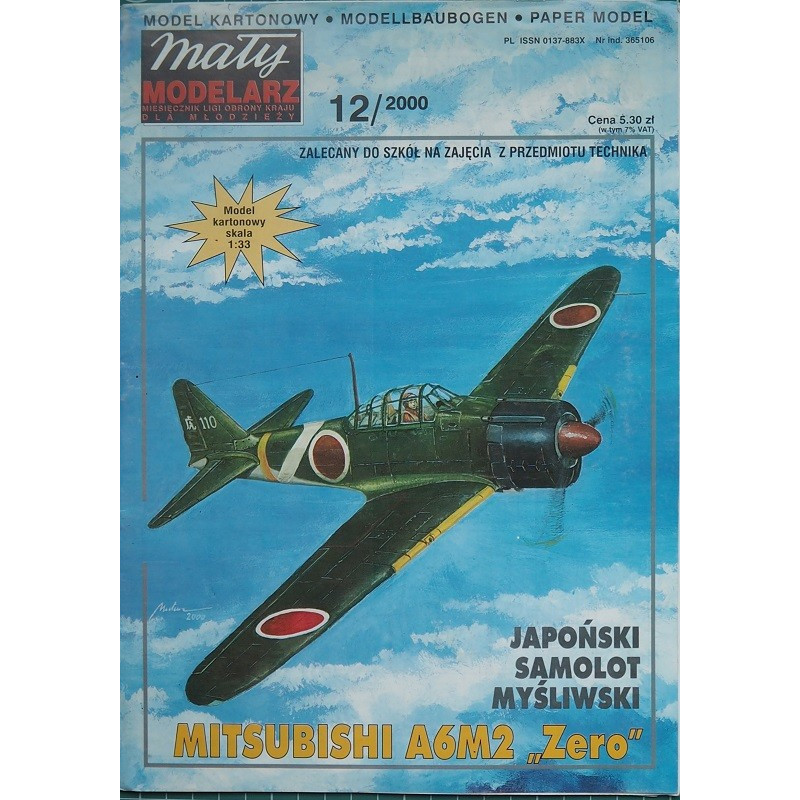


Publisher/ manufacturer: "Maly Modelarz". Poland
Scale: 1 : 33
Number of sheets: 8 x A4
Number of pages with details: 4 1/2
Number of assembly drawings: 13
Difficulty: For modelers of any experience.
Model dimensions: 274 mm x 363.5 mm x 92.5 mm
 Security policy
(edit with the Customer Reassurance module)
 Delivery policy
(edit with the Customer Reassurance module)
 Return policy
(edit with the Customer Reassurance module)
The A6M2 "Zero" deck fighter is Japan's most famous World War II aircraft. It earned its fame for its excellent flight characteristics and design innovation, which, together with the excellent qualifications of the pilots, allowed the Japanese military aviation to achieve numerous victories in the first half of the war. This special plane was built in the design office of the Mitsubishi company, which was headed by engineer Hiro Horikoshi. 1937 Imperial Navy Command submitted design requirements for a new deck destroyer. The machine has high requirements, but their fulfillment guaranteed, that the future plane will be comprehensive, innovative, surpassing in many characteristics all previous and existing fighters in the world. The first aircraft prototype (A6M1) was installed in early 1939. After fixing it, serial production started. The new planes were used for the first time in July 1940 in China. By the end of the year, pilots, flying these fighters, had shot down 45 Chinese aircraft in the air and destroyed another 101 on the ground without losing a single aircraft of their own. After these achievements, the plane began to be surrounded by myths, which became even more true after the Pearl Harbor attack on December 7, 1941. The "Zero's" streak ended in mid-1942, when the Japanese lost the Battle of Midway. With the arrival of the new American fighters "Corsair" and "Hellcat", the legend of the "Zero's" invincibility disappeared, like smoke, but the fighter continued to be developed and used until the end of the war. Since 1944, older versions of airplanes have been used for kamikaze flights.
From the publication, you can make a plane, that was based on the island of Saipan in the Marianas in February 1944. The model is simple, quite well designed and detailed, but not overloaded. Therefore, even modelers with little experience should be able to glue it perfectly. Beginners working under the supervision of a more experienced colleague can also model this airplane, but it is recommended that they do it without the cockpit equipment, with the opaque cockpit canopy and the landing gear retracted - in the flight phase. Antiquarian publication.

Publisher/ manufacturer: "Maly Modelarz". Poland
Scale: 1 : 33
Number of sheets: 8 x A4
Number of pages with details: 4 1/2
Number of assembly drawings: 13
Difficulty: For modelers of any experience.
Model dimensions: 274 mm x 363.5 mm x 92.5 mm