

Publisher/ Manufacturer: "Maly Modelarz". Poland
Scale: 1 : 33
Number of sheets: 8 x A4
Number of sheets with details: 4
Number of assembly drawings: 5
Difficulty: For modelers of any experience.
Model dimensions: 386.5 mm x 363.55 mm x 85 x mm
 Security policy
(edit with the Customer Reassurance module)
 Delivery policy
(edit with the Customer Reassurance module)
 Return policy
(edit with the Customer Reassurance module)
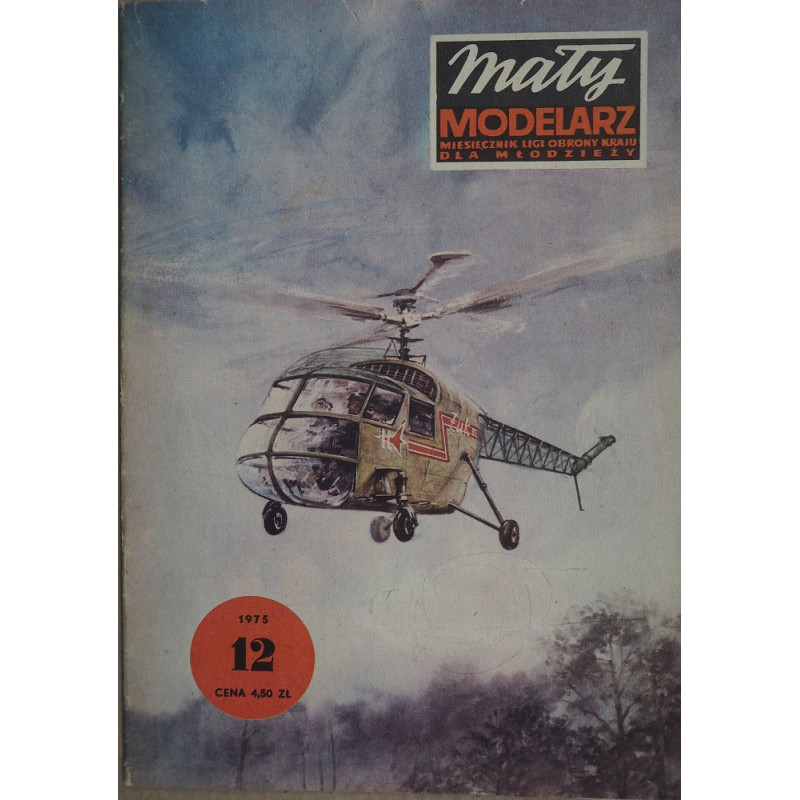
BŻ-4 “Żuk" (Polish: "beetle"), also known as "GIL-4", is a Polish four-seat light helicopter, created in the 1950s. Although it was a pioneer of a new rotor and transmission system, it was never serialy-produced. The development of the “GIL-4” began in 1953 at the Main Institute of Aviation (Główny Instytut Lotnictwa) in Warsaw, under the leadership of dipl. ing. Bronisław Żurakowski, who had previously designed the experimental BŻ-1 “GIL” helicopter, the first aircraft of this type, successfully constructed in Poland. Progress was slow. The main goal was to produce a simple and inexpensive general-purpose light helicopter and to further develop the new rotor and transmission system in order to eliminate vibrations and improve handling. The BŻ-4 "Żuk" was equipped with a three-blade main rotor, powered by a domestic 240 kW (320 h. p.) Narkiewicz WN-4 piston engine, with a steel tube frame, which passed behind the cabin into a frame-like welded tube tail beam, the landing gear was not retractable on four wheels. The main rotor was atypical, as it had a smaller upper steering rotor and an automatic stabilization system, based on the Hiller principle. The cabin had four doors with two front seats and a rear sofa. Two fuel tanks were installed, with a total capacity of 220 l. Four main variants were planned: a passenger version, which could accommodate a pilot and three passengers, an ambulance version, which could accommodate a pilot, a stretcher with a patient and a medic, an agricultural version, which could accommodate a pilot and spraying equipment, and a training version - for training with dual controls. The first prototype of the four-seat BŻ-4 “Żuk” helicopter was built and publicly displayed at the Polish Aviation Day exhibition in August 1956. Due to a long program of ground testing and troubleshooting, it first flew on February 10, 1959. It made a total of 17 flights, with a total flight time of 3 hours and 40 minutes. The “Żuk” was still in the development stage, when further work was canceled and licensed production of the Mil “Mi-1” began at the WSK PZL-Świdnik factory. The prototype was damaged during landing on August 31, 1959 and, despite repairs, was no longer used. Two more prototypes were not completed. One damaged and incomplete prototype is kept in the Polish Aviation Museum in Kraków.
A small model of a small helicopter, quite well designed for those times and well detailed, intended for truly "little modelers". The exterior of the helicopter is not badly detailed, the cockpit equipment is moderately detailed, the landing gear is moderately detailed, the tail boom can be made from a cut-out simplified cardboard part or assembled from wires of the required diameter and length. The rotors are perfectly reproduced. The textual instruction is considerable, quite detailed and informative in Polish, the graphical ones are quite tiny, but sufficient for assembling the model. Antiquarian publication.

Publisher/ Manufacturer: "Maly Modelarz". Poland
Scale: 1 : 33
Number of sheets: 8 x A4
Number of sheets with details: 4
Number of assembly drawings: 5
Difficulty: For modelers of any experience.
Model dimensions: 386.5 mm x 363.55 mm x 85 x mm