

Publisher/ manufacturer: "Maly Modelarz". Poland
Scale: 1 : 33
Number of sheets: 8 x A4
Number of sheets with parts: 4
Number of assembly drawings: 9
Difficulty level: For modelers of any experience.
Dimensions of the model: 172,5 mm x 282,5 mm x 83 mm
 Security policy
(edit with the Customer Reassurance module)
 Delivery policy
(edit with the Customer Reassurance module)
 Return policy
(edit with the Customer Reassurance module)
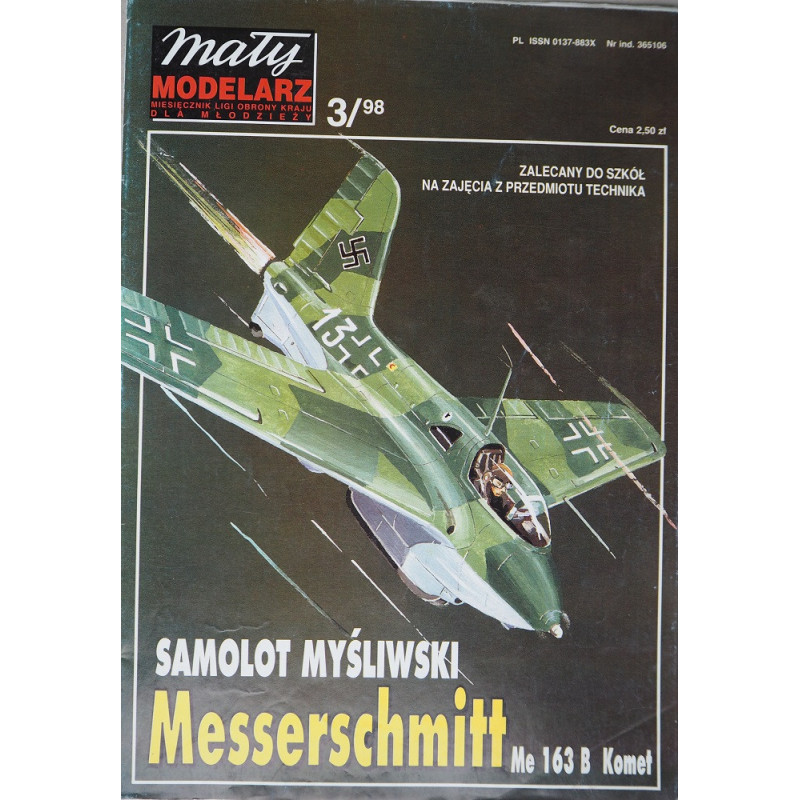
Messerschmitt Me-163B-0 “Komet” - German World War II rocket fighter - interceptor. It made its first flight on September 1, 1941. Produced in a small series. By the end of 1944, 470 aircraft of all modifications of this brand were produced, including prototypes (one of which is represented by the model from this publication). The first combat flight took place only on May 14, 1944. At the beginning of production, serial Me-163s were equipped with HWK 109-509-A1 liquid-fueled rocket engines with an adjustable thrust of 15.7 KN (1600 force KG) to 0.98 KN (100 force KG). They used two types of fuel: T-Stoff - 80% stabilized hydrogen peroxide and C-Stoff - a mixture of 57% methanol, 30% hydrazine hydrate and 13% water. The ignition system was unnecessary - after the two liquids came into contact, a chemical reaction started immediately. Both parts of the fuel were fed to the combustion chamber by turbine pumps, which allowed the engine to be stopped and restarted. Due to the small amount of fuel, the plane could attack the targets only once. Later production "Komets" installed engine HWK 109-509А-2 with two combustion chambers: starting 1.68 - 1.96 KN and marching constant thrust 2.95 KN. After take-off, the plane would drop the landing gear and land on the release ski. Three groups were armed with this type of aircraft, but due to a constant lack of fuel, only one of them could participate in combat operations. These aircraft flew very few sorties, during which 11 fighters were lost and only 9 Allied aircraft were shot down. According to other sources, 16 planes were shot down, while only 10 “Comets” were lost.
A small and simple, but quite well-designed and quite well-detailed model of a small airplane for modelers of any experience. It is recommended for modelers with little experience and beginners, who worked under the supervision of a more experienced colleague, and not to rush. You can also not detail the interior of the cabin (although it is worth trying - and, maybe, You will be able to do it well) and make the cabin canopy opaque. There is a small supply of colors, the text instructions are not large, but quite detailed and well explaining the entire process of gluing the model, the graphic instructions could be better. Antiquarian publication.

Publisher/ manufacturer: "Maly Modelarz". Poland
Scale: 1 : 33
Number of sheets: 8 x A4
Number of sheets with parts: 4
Number of assembly drawings: 9
Difficulty level: For modelers of any experience.
Dimensions of the model: 172,5 mm x 282,5 mm x 83 mm