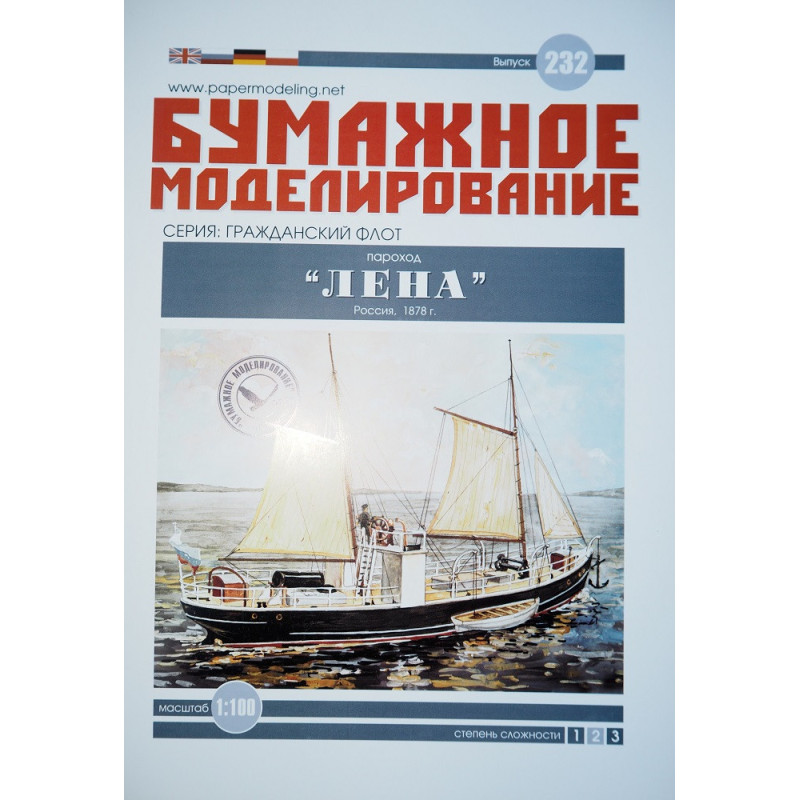


Publisher/ Manufacturer: "Paper Modeling". Ukraine
Scale: 1 : 100
Number of sheets: 12 x A4
Number of sheets with details: 8 1/3
Number of assembly drawings: 32
Difficulty: For modelers of any experience.
Model dimensions: 268 mm x 49.5 mm x 165 mm
 Security policy
(edit with the Customer Reassurance module)
 Delivery policy
(edit with the Customer Reassurance module)
 Return policy
(edit with the Customer Reassurance module)
In 1878 the iron screw steamer "Lena" was specially built in Sweden by order of the gold mining industrialist and Siberian explorer A. Sibiryakov, suitable for sailing both on rivers and seas. Sibiryakov hired the Swede Johansson to command it, and Nordenskiöld on the schooner "Vega" joined to reis. Maybe it happened this way, or maybe a little differently, but the "Lena" was the first to round Cape Chelyuskin, and only after her - the wooden Nordenskiöld schooner "Vega". On August 28, 1878, both ships arrived in Tiksi, at the mouth of the Lena River. Then the "Lena" sailed to the upper reaches of the Lena, and the "Vega" - to the east. On September 27, the "Vega" was trapped by ice in the Gulf of Kluchi, 222 km from the Bering Strait. The "Vega" wintered for 11 months and was freed only on July 18, 1879. And the "Lena" sailed on the Lena River for another three years under the command of Johansen, and later often sailed to the Arctic Ocean, reaching even the mouth of the Yana River. The steamer was destined for a long service. After Sibiryakov, the steamer was owned by several more owners until it was nationalized in 1919, participated in the Civil War in Siberia, and later worked in the Lena shipping industry until 1959. The steamer was repaired several times, in 1938 the superstructure construction was changed, in 1906 the steam engine was replaced with a more powerful 140 h. p., which worked on the ship until the last day of its service.
A small model of a small ship. The model is perfectly designed and richly detailed, intended for modelers of any experience. Even modelers, who have learned a few secrets of paper modeling, can assemble this model almost without any help from more experienced colleagues, only the rigging will cause a few problems (but minor ones). There is a considerable reserve of colors and textures, textual instruction in Russian, Polish, English and German - small, but quite well explaining the entire process of gluing the model and perfectly complementing the excellent, informative and easy-to-read graphical instructions. The sails and some details are printed double-sided (the sails are also on colored thin paper).

Publisher/ Manufacturer: "Paper Modeling". Ukraine
Scale: 1 : 100
Number of sheets: 12 x A4
Number of sheets with details: 8 1/3
Number of assembly drawings: 32
Difficulty: For modelers of any experience.
Model dimensions: 268 mm x 49.5 mm x 165 mm