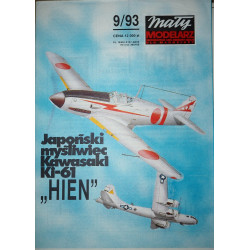
Publisher/ Manufacturer: "Maly Modelarz". Poland
Scale: 1 : 33
Number of sheets: 8 x A4
Number of sheets with details: 4
Number of assembly drawings: 8
Difficulty: For modelers of any experience.
Model dimensions: 177.5 mm x 256.5 mm x 85.5 mm
 Security policy
(edit with the Customer Reassurance module)
 Delivery policy
(edit with the Customer Reassurance module)
 Return policy
(edit with the Customer Reassurance module)
The "Fokker" E. V (D. VIII) was the last fighter, designed, manufactured and used by Kaiser Germany in World War I. Entering service shortly before the end of armed operations, it did not have time to demonstrate its good qualities. It was highly appreciated by Polish pilots, who fought in the wars of 1919 and 1920 with Soviet Russia. For the first time the pilot Stefan Stec painted a white-red "checkerboard" on this type of aircraft, which was later adopted as the official emblem of the Polish Air Force. This excellent aircraft was designed by engineer Reinhold Platz in 1917. It was also armed, like its predecessor, the “Fokker” D. VII biplane, but was smaller and had better flight characteristics. In 1918 it began to be mass-produced and was designated "Fokker" E. V. Initially, several disasters occurred with the serial machines, adopted for service, caused by a wing construction error. Flights were stopped and the factory began to produce a series of wings of a new construction. The aircraft with the changed wing was already designated "Fokker" D. VIII, but the previous designation was often used. These aircraft were highly appreciated even by Allied pilots, who nicknamed them "Flying Razor". After the war, a dozen machines remained on Polish territory. The emerging Polish Air Force then had various types of aircraft at its disposal, most of which were German machines, taken over at the Lovitz airfield. Among them were 17 “Fokker” E.V. They were armed with 5 Polish squadrons, where they were used in combat until the end of 1920.
A moderately detailed, but perfectly designed model with full cockpit equipment, armament, chassis, propeller and exterior detailing. The model is not complicated and can be assembled perfectly by modelers of any experience. There are no color stocks. The textual instruction is small, but clear, informative, explaining a lot in Polish, the graphical ones are medium in size, but also comprehensive and informative, and also - perfectly readable. The model recreates the appearance of the fighter, used in the war with Soviet Russia in 1920, which Stefan Stec flew and fought on. Antiquarian publication.

Publisher/ Manufacturer: "Maly Modelarz". Poland
Scale: 1 : 33
Number of sheets: 8 x A4
Number of sheets with details: 4
Number of assembly drawings: 8
Difficulty: For modelers of any experience.
Model dimensions: 177.5 mm x 256.5 mm x 85.5 mm