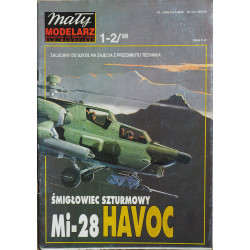
Publisher/ Manufacturer: "Maly Modelarz". Poland
Scale: 1 : 33
Number of sheets: 18 x A4
Number of sheets with details: 11.5
Number of assembly drawings: 18
Difficulty: For modelers of any experience.
Model’s dimensions: 257.5 mm x 295 mm x 91 mm and 276 mm x 119.5 x mm
 Security policy
(edit with the Customer Reassurance module)
 Delivery policy
(edit with the Customer Reassurance module)
 Return policy
(edit with the Customer Reassurance module)
The FW-190 was designed in 1937 by engineer Kurt Tank. These fighters were to supplement the German fighter fleet, which until then, consisted only of Bf-109 (Me-109) type machines. This, which later became one of the best fighters of World War II, first entered air combat in 1941 over the English Channel and became the terror of Allied aircraft until 1944, when the P-51 “Mustang” entered combat on the Western Front and the Yak-9 on the Eastern Front. The FW-190 also proved itself as an attack aircraft, often replacing the famous “Stukas” in tank-destroying missions. The FW-190A-8 was based on the A-7 version, which added the MW-50 methanol-water injection system and a new FuG 16 radio station. The FW-190A (including the A-8 - the most produced version) was also produced in what is now Poland: in Poznań and Malbork. This publication contains details of a fighter from the Stab/JG51 group, based at the Kroczew airfield near Modlin in the autumn of 1944. This fighter was flown and fought by the pilot Unteroffizer Helmut Johne.
In 1942 a shorter wing with a different construction of winglets was installed on one of the Yak-7B fighters, and the wooden longeron was replaced with a metal one. Serial production was started on its basis, in which the aircraft was to be designated as the Yak-7DI. Finally, it was recognized that, having changed the wing construction, a new aircraft had been constructed and the designation was changed to the Yak-9. The new fighter turned out to be very successful and its preparation for serial production proceeded at an accelerated pace. The first Yak-9s reached combat units in September 1942. A total of 16,759 Yak-9s were produced during the years 1942–1945. They were widely used during World War II. They were praised for their exceptional maneuverability, but their characteristics, especially in the first series, were significantly impaired by the poor quality of assembly. After the war, these fighters were armed the Warsaw Pact Air Forces, including Poland. They were also widely used in the Korean War. In many of the countries, which used them, they remained in service until the acceptance of jet fighters into service. The last Yak-9s were removed from the lists of the Polish Air Force in 1956. This publication contains details of a fighter of the Yak-9M fighter from the 1st Warsaw Fighter Regiment, 1st Squadron in April 1945 combat operations. While fighting on it, the pilot, Podporuczyk Viktor Kalinovsky, shot down two FW-190s on April 19 and 25, adding them to the 10 enemy aircraft, shot down by his in USSR Air Force.
Small models of small fighters, quite well designed and well detailed, intended for truly "little modelers". The exterior of the aircraft is not badly detailed, the cockpit equipment is moderately detailed, the chassis is moderately detailed, its niches are minimal detailization, there are details of the hanging armament (FW-190 - only an additional fuel tank, JAk-9M - 6 unguided missiles RS-132). There is a considerable supply of colors, the textual instruction is considerable, quite detailed and informative in Polish, the graphical one is perhaps a bit too small, but sufficient for assembling the model and this applies to both models, since the instructions are separate for each. Antiquarian publication.

Publisher/ Manufacturer: "Maly Modelarz". Poland
Scale: 1 : 33
Number of sheets: 18 x A4
Number of sheets with details: 11.5
Number of assembly drawings: 18
Difficulty: For modelers of any experience.
Model’s dimensions: 257.5 mm x 295 mm x 91 mm and 276 mm x 119.5 x mm