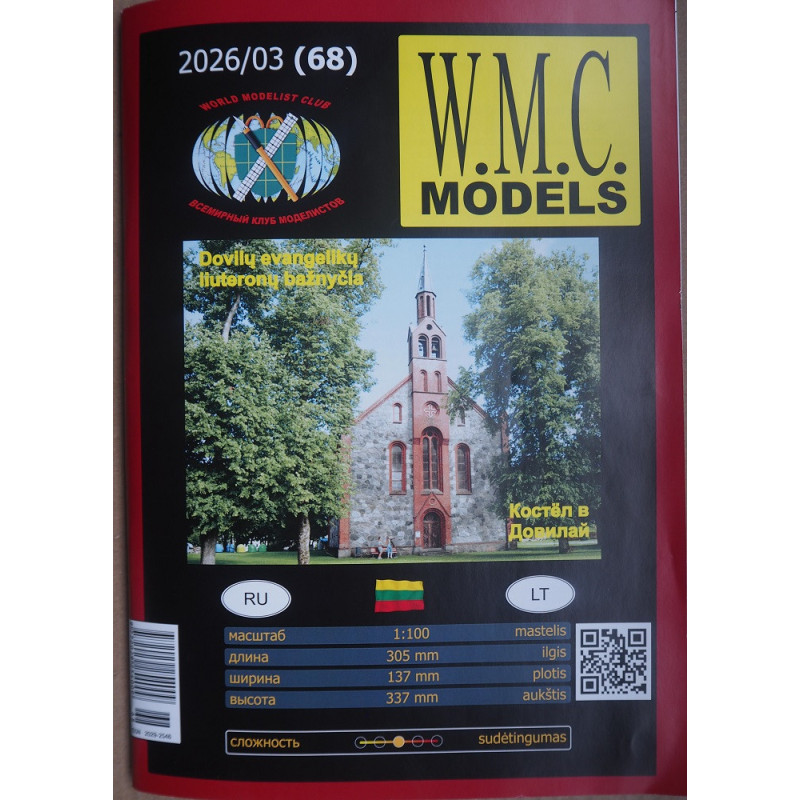


Manufacturer/ Publisher: "W. M. C. Models". Lithuania
Scale: 1 : 100
Number of sheets: 22 x A4
Number of sheets with details: 14
Number of assembly drawings: 40 photos
Difficulty: For medium and experienced modelers
Model dimensions: 305 mm x 137 mm x 337 mm
 Security policy
(edit with the Customer Reassurance module)
 Delivery policy
(edit with the Customer Reassurance module)
 Return policy
(edit with the Customer Reassurance module)
The farmers of these villages in the region, located in present-day Western Lithuania, have long been famous for their good grain harvests and neat homesteads. There were no settled farmers here at all. The church in Dovilai was ordered to be built by Frederick William I, "because the Lithuanians are still very poorly educated, not matured for Christianity". Unfortunately, the King's order was not carried out at that time, and he himself died soon after (in 1740). Evangelical services in Dovilai began to be held only in 1784 in a small school chapel, built with money, collected by Lithuanians. They were held by the Schuilmistr (teacher). The church authorities, appreciating such people's piety, established the so-called "auxiliary spiritual district" and obliged the priests of the Klaipėda Laukinė and Priekulė parishes to take care of it. They obeyed and in 1846 sent deacon Herman Hahn to do pastoral work. However, the residents of Dovilai and the surrounding villages were not satisfied with the indefinite status of the auxiliary spiritual district, because only the independence of the parish would have allowed them to build their own houses of worship. The parish was legalized in 1854 and H. Hahn was obliged to undertake church building work. Apparently, he did not do this diligently enough, because in 1859 a new clergyman, Augustas Herneris, was brought to Dovilai. Dovilai Church – a rectangular building of field stones and red bricks with a small tower on the west side – was built in almost one year: the cornerstone was laid on July 17, 1861, and the consecration ceremony was celebrated on September 18, 1862. The church was built in a beautiful place – next to the slow Minija River, overgrown with brambles and sedges, on a small hill. The tower, gable roof, and precise proportions of the building make the church attractive and pleasing to the eye. The church has a good 12-register organ, and the altar is decorated with a painting of the Blessed Christ. Sacred vessels were obtained or purchased from the Nida community. Two medium-size bells called people of the large parish (which included as many as 24 villages) to services. The following priests worked in this church as pastors: A. Harneris, Gustavas Juozapaitis, Traugotas Gečiūnas, E. Endriulaitis; Fricas Moseris. In 1902, Ferdinandas Radtkė, who had worked here the longest, began serving in Dovilai. When World War I began, the Russian authorities, who invaded the Klaipėda region, exiled him to Siberia for some unknown reason. Radtkė returned to the parish after the October Revolution, exhausted and sick, but resumed his work as a pastor, from which he retired in 1937, handing over the community to the last interwar priest, Gustavas Reisgis. The events of the late 1930s and early 1940s radically changed the life of the community: on March 22, 1939, the Nazis were already in power here, and in 1941, the decisive war with the USSR began. G. Reisgys was mobilized into the army and sent to the front, from where he never returned. At the end of 1944 the people of Dovilai, together with other residents of the Klaipėda region, fled from the approaching Soviet Army. They spread throughout East Prussia; some even made it to South Germany. When peace came, some of them returned to their homeland. They found the church intact, but robbed and disfigured. In the autumn of 1944 a Red Army unit had set up a stable there, the soldiers overturned the altar, broke the organ and benches, burned them to protect themselves from the cold, and broke the windows as they retreated. Soon, preachers Jokūbas Karalius and Jonas Krežis began organizing pastoral meetings. The recovering community, having arranged all the papers and recommendations, was submitted to the Commissioner of the Council for Religious Cults for registration on June 6, 1948. After all the requirements were met, the authorities no longer objected - on August 5, 1948, the Commissioner of Religious Cults registered the post-war Dovilai parish. This fact is evidenced by the issued certificate. The Dovilai community existed for perhaps ten years. Unfortunately, the number of its members was constantly decreasing: some left for Siberia, others emigrated to the Federal Republic of Germany, and still others distanced themselves from the Church. However, the parish did not die - about four decades later, on December 14, 1989, an initiative group of Dovilai residents - G. Pūkienė, G. Šeškas and others - addressed the leaders of the Klaipėda District Executive Committee, asking to register the revived Evangelical community. The Religious Affairs Council registered the Dovilai parish on January 29, 1990. The first service was held on December 20, 1992 in the district council hall. They were held by the priest L. Fetingis of the neighboring Plikiai parish. After that, the difficult work of rebuilding the church was undertaken - the local authorities had turned it into a warehouse and a mill. On May 28, 1995, the old Dovilai prayer house was re-consecrated. The community, led by priest L. Fetingis, opened a new page in its history.
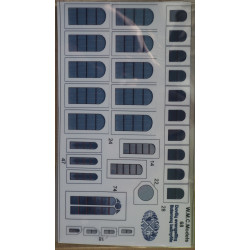
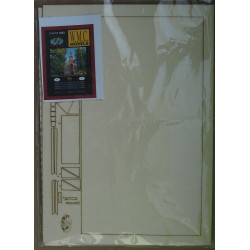
Although, it looks quite simple in appearance, this model is not, it is richly detailed and almost all the original details have been restored - even the broken and boarded-up upper left window of the eastern wall, the lightning rod, the stump of a cut tree. Most of the elements in other models (cornices, relief window details) would only be drawn in relief, here they are depicted realistically raised and as they are in the real building. The model is very colorful, bright, suitable only for medium-experienced and experienced modelers. There is a not very large reserve of colors and textures. The textual instruction in Lithuanian and Russian is quite extensive and detailed. The graphical instruction is medium-size, consisting of photos of the test model with markings of details, informative, clear and quite easy to read.

You might also like
Manufacturer/ Publisher: "W. M. C. Models". Lithuania
Scale: 1 : 100
Number of sheets: 22 x A4
Number of sheets with details: 14
Number of assembly drawings: 40 photos
Difficulty: For medium and experienced modelers
Model dimensions: 305 mm x 137 mm x 337 mm