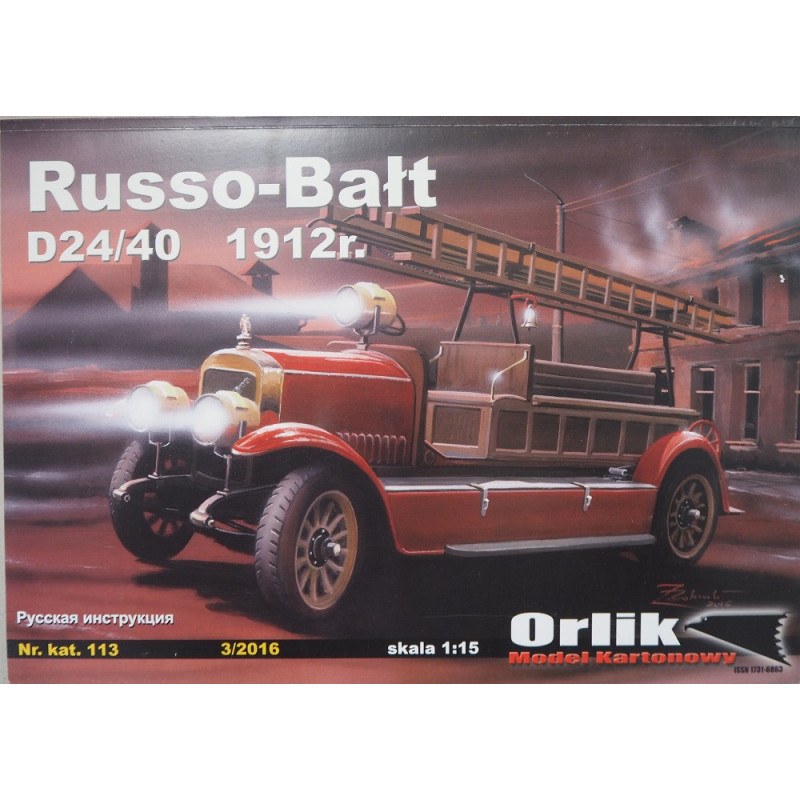


Publisher/ Manufacturer: “Orlik”. Poland
Scale: 1 : 15
Number of sheets: 15 x A3
Number of detail sheets: 10
Number of assembly drawings: 47
Difficulty: For medium experience and experienced modelers.
Model dimensions: 225 mm x 83 mm x 102 mm
 Security policy
(edit with the Customer Reassurance module)
 Delivery policy
(edit with the Customer Reassurance module)
 Return policy
(edit with the Customer Reassurance module)
"Russo-Bałt" D24 / 40 - a Russian fire truck of the early 20th century and the First World War. It was equipped with a single 4-cylinder, with a capacity 4.5-liter and of 40 h. p. power engine. The maximum speed of the car was 65 km/h, and the maximum load capacity did not exceed 1000 kilograms. The "Russo-Bałt" company, sometimes also called "Russo-Baltique", was founded in 1869 in the city of Riga, which was then part of Tsarist Russia, and now in Latvia. Initially, the factory produced railway carriages for the needs of the expanding Russian railway network in the second half of the 19th century, but in 1908-1923 it was engaged in the production of various types of cars - often these were luxury limousines, produced before the overthrow of the Tsar, as well as fire engines. The latter type of model, the “Russo-Bałt” D24/40, was commissioned by the Riga City Fire Department and its production began shortly before the start of World War I. One of the surviving exemplars of this unique car, which somehow survived both world wars, the chaos of the October Revolution and the Russian Civil War, was found in 1976 and has been on display at the Riga Motor Museum since 1978.
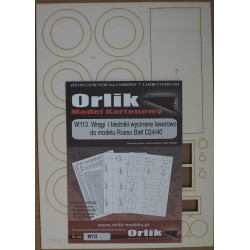
A small, medium-complexity, well-designed and fairly richly detailed model. The full version (with interior, full engine, transmission, chassis and suspension, fire equipment, external components and details) is recommended only for medium-experienced and experienced modelers. It is possible to make a retractable ladder, opening doors and hoods, a full set of firefighting tools. Two sheets with car body cladding details, silver and copper details are printed on chalk paper and give the model greater realism. But, at the same time, it requires greater care, when gluing: glue, applied in the wrong place and... the realism of the model is drastically reduced. There is a large reserve of colors and textures. The textual instructions are not very large, but quite detailed (in Polish and Russian), the graphic ones are large and will serve yYou well in the model production process.

You might also like
Publisher/ Manufacturer: “Orlik”. Poland
Scale: 1 : 15
Number of sheets: 15 x A3
Number of detail sheets: 10
Number of assembly drawings: 47
Difficulty: For medium experience and experienced modelers.
Model dimensions: 225 mm x 83 mm x 102 mm