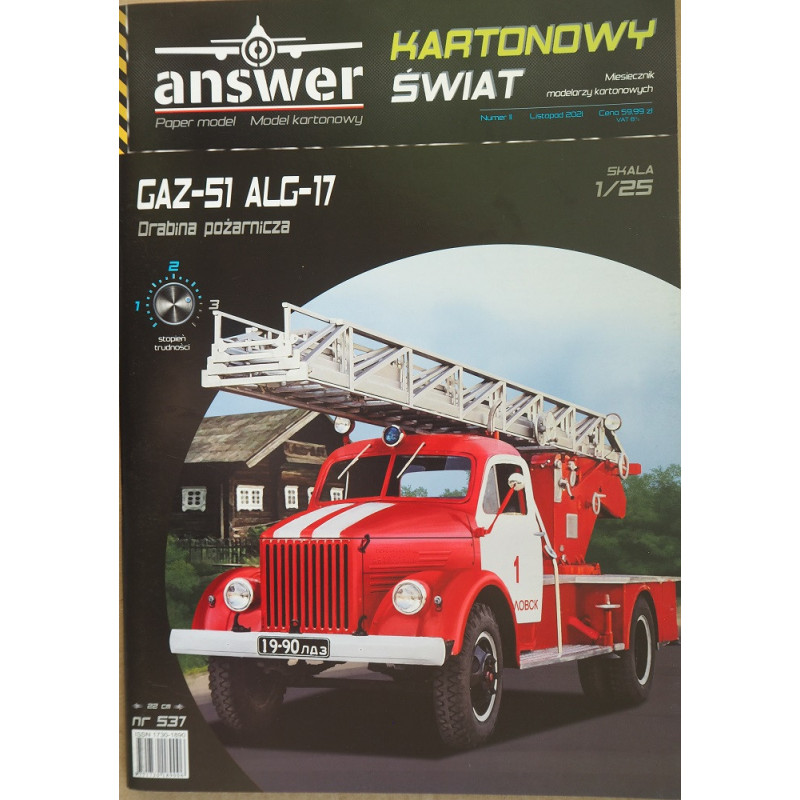


Publisher/ manufacturer: "Answer – Kartonowe Hobby". Poland
Scale: 1 : 25
Number of sheets: 20 x B4
Number of sheets with parts: 15
Number of assembly drawings: 87
Difficulty level: For intermediate and experienced modelers.
Dimensions of the model: 252 mm x 86 mm x 155 mm
 Security policy
(edit with the Customer Reassurance module)
 Delivery policy
(edit with the Customer Reassurance module)
 Return policy
(edit with the Customer Reassurance module)
GAZ-51 is a light truck, manufactured by the Gorky Automobile Plant of the USSR. The vehicle was conceived before World War II and, together with the all-wheel drive GAZ-63, began mass production after the war. The GAZ-93 dump truck was also produced on the basis of the GAZ-51. The ideas for the creation of the GAZ-51 arose back in the mid-1930s. The GAZ-AA was becoming increasingly outdated, even by Soviet standards. Production of its American counterpart, the Ford AA, was ended back in 1931. Therefore, from February 1937, the GAZ-11-51 was designed: a light truck with a more powerful engine and a completely redesigned cab. The latter was visually similar to the later UralZIS-355M. The six-cylinder gasoline engine was a copy of the “Dodge” design. The Soviet Union already in 1936 had purchased a large number of these engines and adapted them to production in its factory lines. Production of GAZ-11 engines at GAZ began in 1937. Before the war, they were initially used only in passenger cars, such as the GAZ-11-73 and GAZ-61. Only after the war did it begin to be used in serial trucks, as originally planned. By 1939, two prototypes of the GAZ-11-51 were completed. During the war, work on this project was interrupted and resumed only in 1943. More prototypes were produced, using, among other things, the experience, gained from using Lend-Lease trucks, such as the “Studebaker” US6. Pre-series production began in June 1945. On July 19, 1945, a presentation took place in the Moscow Kremlin, after which mass production was approved. It began on January 6, 1946. Models from this early stage can be identified by the fact, that the side windows do not yet have the later, characteristic rounded upper edge. A modernized version, the GAZ-51A, was produced from 1955. In the summer of 1957, Molotov's name was removed from the factory name, which was noticeable in that "Gorkovsky Avtozavod" was now embossed on the fenders instead of "Avtozavod imeni Molotova" (Molotov name automobile plant). Annual production peaked in 1958 at 173,000 units. Production of its successor, the GAZ-53, began in 1961, and the GAZ-52 was introduced a few years later. Nevertheless, the GAZ-51 was produced until 2 April 1975, and some special versions, such as the GAZ-93 dump truck, until 1976. In total, 3,481,033 GAZ-51 trucks rolled off the assembly line over almost 30 years. As in many countries of the former Eastern Bloc, the GAZ-51 also reached East Germany. These cars were widely used in the Lithuanian SSR, a significant number of them reached independent Lithuania, but time took its toll - now You can meet this antiquarian car only at Retromobile or reconstructionist gatherings, see it in several Lithuanian technical museums.
A small, complex, maximally detailed and perfectly designed model of a fairly simple-looking car, intended only for medium-experienced and experienced modelers. The model recreates the ALG-17 version of the GAZ-51. This is a fire department retractable self-propelled ladder; the model recreates a car, used by the Sverdlovsk fire department. But, I think, that such were also used in the LSSR, You just need to find photos, confirming this and You can make a great "Lithuanian" model. The model has a perfectly restored chassis, engine compartment, transmission, cabin equipment, and a ladder mechanism, which can also be rotated, the ladder is movable and retractable. The exterior detailing is perfectly restored. There is no stock of colors, but they can be perfectly "combined" to some extent by sparingly using the gluing fields of the other sides of the double-sided painting details. Where necessary, the parts are printed with double-sided printing, unpainted metal parts in the original car are printed with "Metallic" type silver paint. There is almost no textual instruction in Polish - just a few notes, but the graphic instruction - the fulfillment of all wishes!!!

You might also like
Publisher/ manufacturer: "Answer – Kartonowe Hobby". Poland
Scale: 1 : 25
Number of sheets: 20 x B4
Number of sheets with parts: 15
Number of assembly drawings: 87
Difficulty level: For intermediate and experienced modelers.
Dimensions of the model: 252 mm x 86 mm x 155 mm