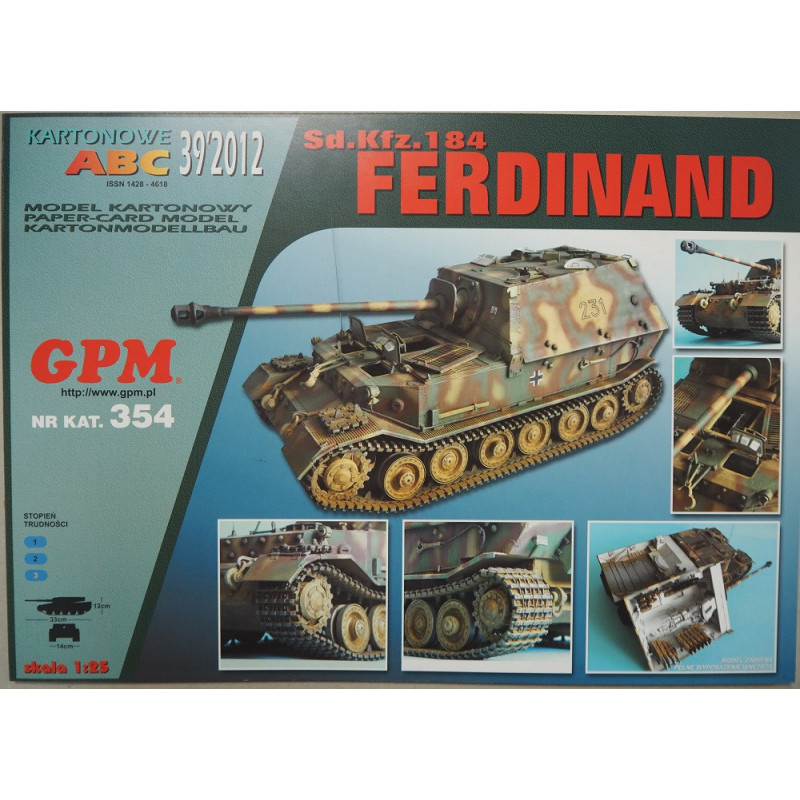


Publisher/ manufacturer: “GPM". Poland
Scale: 1 : 25
Number of sheets: 21 x A3
Number of sheets with parts: 17 1/4
Number of assembly drawings: 73
Difficulty level: For medium experience and experienced modellers
Dimensions of the model: 325,5 mm x 135 mm x 119 mm
 Security policy
(edit with the Customer Reassurance module)
 Delivery policy
(edit with the Customer Reassurance module)
 Return policy
(edit with the Customer Reassurance module)
Sd. Kfz. 184 "Ferdinand" - German World War II heavy artillery gun, designed to destroy enemy armored vehicles. It is directly related to the prototype of the heavy tank VK 4501 (P), which in the struggle for the production of a new German heavy tank was defeated by the prototype of the "Henschel" company VK 4501 (H), which later became the famous "Tiger". Installation work on the first new gun at the "Nibelungwerk" factory in St. Valentin began on February 16, 1943. A total of 90 units were produced. The main SPAG weapon was the anti-tank 8.8 cm gun PAK 43/2 L/71 with a combat stock of 50 - 55 rounds. The barrel had 32 rifled grooves. The ammunition consisted of armor-piercing shells Pa Gr 39/1 or Pz Gr 40/43, fragmentation shells Sp Gr L/4, 7 and super-caliber shells Gr 39 HL. As additional weapons, the crew used MP 38/40 machine guns, pistols, carbines and grenades. All this was transported in the fighting compartment. In the spring of 1943, two divisions armed with "Ferdinand", were formed: 653 and 654 Heavy Armored Artillery Divisions. Both of them took part in the offensive operation on the Kursk Bulge (Operation "Zitadelle"). According to the OKH communique of August 7, 1943, in this battle, 89 "Ferdinand", which participated in combat operations, destroyed a total of 502 tanks, 20 anti-tank guns and 100 other artillery pieces. The Battle of Kursk revealed not only the good (excellent armor, good armament), but also the bad (weakness of the side armor, poor generator layout, failing internal communication, low resistance to mine damage). The "Ferdinand's", that were not destroyed in the Battle of Kursk, were sent back to Germany, where they were modernized. They were coated with "Zimmerit", a machine gun was added, and armor was strengthened. From February 1943 to March 1944, 47 guns were reworked, the name of which was changed to "Elefant".
A complex, well-designed and richly detailed (there is even a full supply of shells) model with full internal equipment for medium-experienced and experienced modelers. Even the version without detailed internal equipment is too complicated for less experienced modelers (even those, working under the supervision of more experienced colleagues). From the publication You can glue together SPAG No. 231 (commander - Senior Lieutenant Friedrich Meigen) from the 2nd company of the 653rd Heavy Armored Artillery Division, which participated in the Battle of Kursk in July 1943. Excellent graphic instruction, consisting of a large number of clear, easy-to-read and informative drawings, the text instruction in Polish is small and only supplements the graphic one. There is a considerable reserve of colors.

You might also like
Publisher/ manufacturer: “GPM". Poland
Scale: 1 : 25
Number of sheets: 21 x A3
Number of sheets with parts: 17 1/4
Number of assembly drawings: 73
Difficulty level: For medium experience and experienced modellers
Dimensions of the model: 325,5 mm x 135 mm x 119 mm