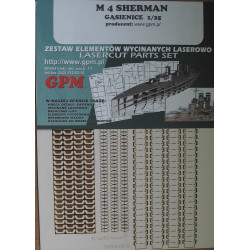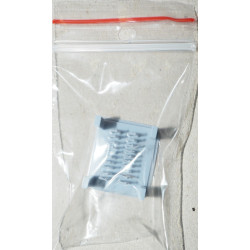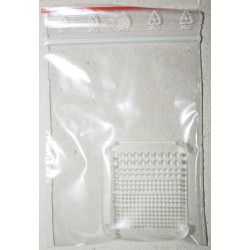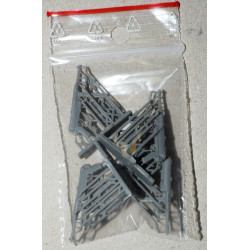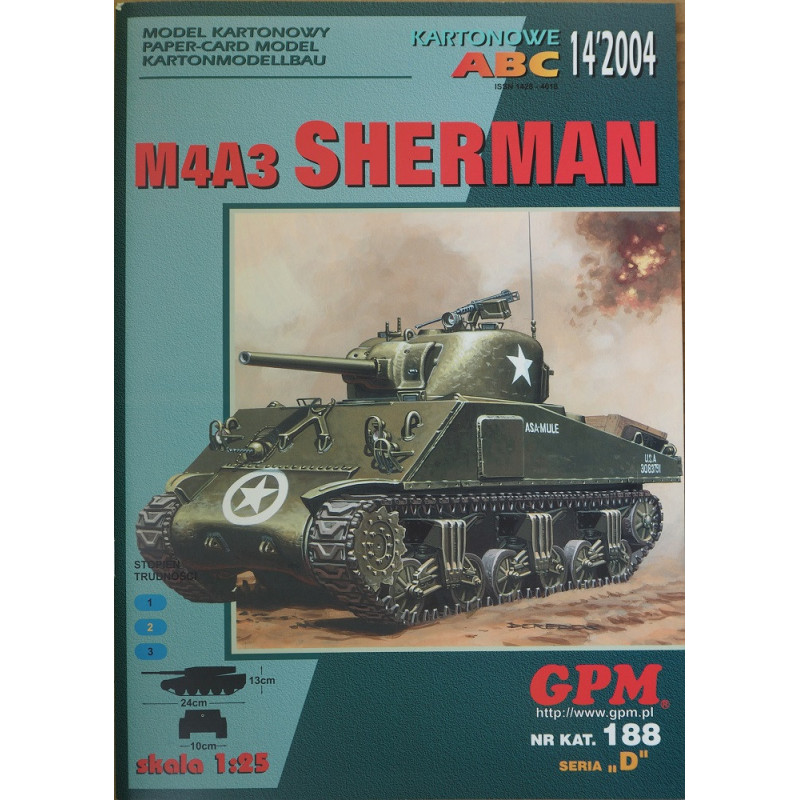


Manufacturer/ Publisher: "GPM". Poland
Scale: 1 : 25
Number of sheets: 20 x A4
Number of sheets with details: 15 3/4
Number of assembly drawings: 24
Difficulty: For medium and experienced modelers.
Model dimensions: 247.5 mm x 118.5 mm x 108.5 mm
 Security policy
(edit with the Customer Reassurance module)
 Delivery policy
(edit with the Customer Reassurance module)
 Return policy
(edit with the Customer Reassurance module)
M4 "Sherman" - American medium tank of the Second World War. The first prototypes were produced in 1941, serial production in 1942-1945. About 49,000 copies of all versions of this tank were produced, making it one of the most massive tanks of the Second World War and the most important tank in the armament of the Allied armies during this war. The M4 “Sherman” was powered by a single M4A1 "Continental” R 975 C4 engine, producing 400 h. p. Depending on the version, the combat vehicle was armed with one 75 mm M3, or 76 mm M1 cannon, or 105 mm M4 howitzer and two 7.62 mm “Browning” 1919A machine guns. The M4 “Sherman” was designed as a successor to the M2 and M3 tanks, although many of these tank’s components were used. In particular, it used only a slightly modified chassis of the M3 “Lee” tank. When developing the M4 “Sherman”, the primary emphasis was on the role of the tank in supporting infantry with fire, rather than fighting enemy tanks - this was the purpose of American tank destroyers, to which the “Sherman” does not belong. It was assumed that only clashes with enemy tanks Pz.Kpfw III and Pz.Kpfw IV. The mass production of the new combat vehicle and the lowest possible production costs also played a big role. The result was a tank with good armament in 1942 and early 1943, medium armor, with a sloping frontal armor plate, but its maneuverability was not the best and - especially in the first versions - very vulnerable to hits in the engine compartment. However, at the same time, a tank was created, that was produced in really large quantities and had a great potential for modernization. During serial production, many versions were created. Chronologically, the first was the M4A1 version, which already had rain armor. The next - the M4A2 - had welded armor and a new "General Motors" 6460 engine with a power of 375-410 h. p., but much less prone to fire. The M4A3 version also appeared, armed with a 105 mm howitzer and powered by a "Ford" GAA engine with a power of 450 h. p. According to The M4A3 version was followed by two sub-versions: the M4A3E2 "Jumbo" with reinforced armor and the M4A3E8 with HVSS and a 76 mm cannon. An interesting version was also the T34 "Calliope" with mounted missiles. The M4 "Sherman" was supplied to the British and Red Armies. The former developed the "Firefly" version with an excellent 17-pound anti-tank gun on its basis. During World War II, M4 "Sherman" tanks fought in North Africa (1942-1943), Italy (1943-1945), in the battles in Normandy, France and West Germany (1944-1945), but also in the Pacific theaters of operations, the Red Army on the Eastern Front. After World War II, the M4 "Sherman" was used by many countries, including Argentina, Belgium, India, Israel, Japan, Pakistan and Turkey. It also participated in many conflicts after 1945, including the 1965 Indo-Pakistani War and the 1967 Six-Day War.
Very complex due to the hull and turret shapes and many additional details, the model is suitable for medium-experienced and experienced modelers. The chassis with tracks and exterior detailing are no less complex. There is no detailing of the engine and fighting compartment, but this well-designed and quite richly detailed model is really a "tough nut" for any modeler. The camouflage is standard - combat green, well-worn in battles, a lot of additional details, that can be placed on the tank in a small diorama. There is no color reserves, but they can be "combined" a little by sparingly using the adhesive areas on the other sides of parts. The graphic instructions are not large, but clear and perfectly readable and informative, the textual is considerable and perfectly complements the drawings, in Polish and English.

You might also like
Manufacturer/ Publisher: "GPM". Poland
Scale: 1 : 25
Number of sheets: 20 x A4
Number of sheets with details: 15 3/4
Number of assembly drawings: 24
Difficulty: For medium and experienced modelers.
Model dimensions: 247.5 mm x 118.5 mm x 108.5 mm