

Publisher/ manufacturer: “GPM”. Poland
Scale: 1 : 33
Number of sheets: 10 x A4
Number of sheets with parts: 5
Number of assembly drawings: 32
Difficulty level: For average experience and experienced modelers
Dimensions of the model: 342,5 mm x 454,5 mm x 117,5 mm
 Security policy
(edit with the Customer Reassurance module)
 Delivery policy
(edit with the Customer Reassurance module)
 Return policy
(edit with the Customer Reassurance module)
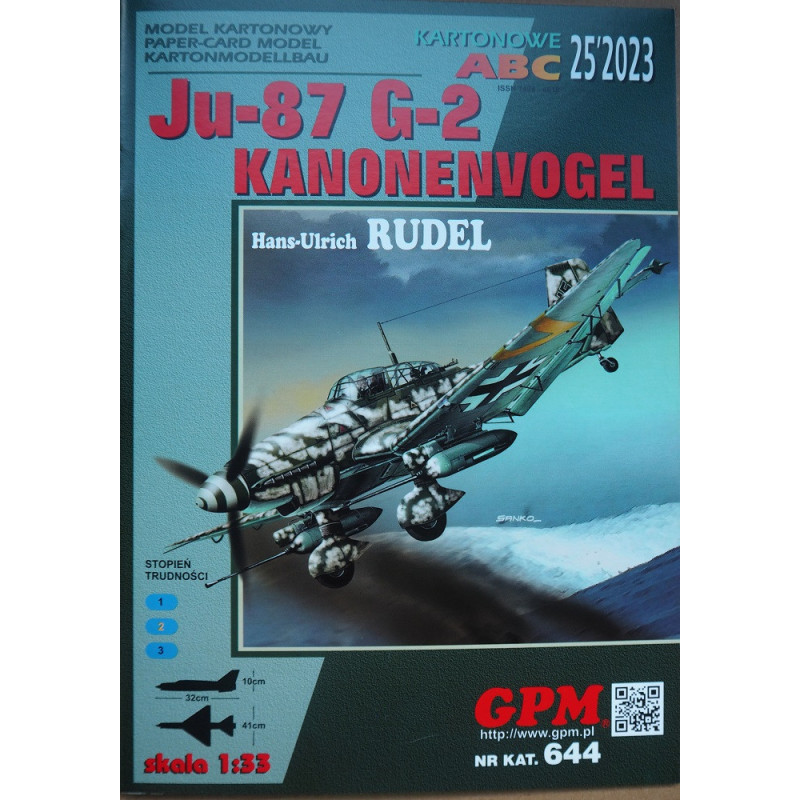
Ju 87G ("Gustav") - anti-tank attack aircraft. Armed with two 37 mm BK 37 cannons. As the war continued, the use of the Ju-87 as a dive bomber decreased. The new main mission of the aircraft was to attack from low and very low altitudes against armored fighting vehicles, which posed the greatest threat to ground forces, and supply units. Given the very effective armor of the new Soviet T-34 tanks, the Ju-87's bomb load was completely insufficient to destroy them. The solution was to use the 37 mm BK 37 aircraft cannon, modeled after the 3.7 cm FlaK 18. In the summer of 1942, two cannons were installed under the wing of the Ju-87. Its combat reserve was six 1.46 kg (3.3 lb) tungsten carbide-cored subcaliber shells. In the spring of 1943 the conversion of existing Ju 87 D-3 and D-5 aircraft into tank hunters (G-1 and G-2 models) began. The first unit, to receive the new Ju 87 G, was the 4th Group of the 2nd Geschwader "Immelmann" under Colonel Hans-Ulrich Rudel. While other groups switched from the Ju-87 to the Fw 190, the 4th Group continued to fly the Ju-87 and claimed 519 Soviet armored fighting vehicles. On 7 March 1944, this group was renamed the 10th Anti-Tank Group and transferred to Jakobstad and Liepaja to support the 18th Army during the Baltic operation. The Ju 87 G variant became known as the "tank hunter" (Kanonenvogel - cannon bird). Low flight speed, good stability and the ability to attack armored targets from the least protected side - from above - contributed to its success in attacking armored combat vehicles. German ace Hans-Ulrich Rudel piloted the Ju 87G, a model of which You can make from this publication.
An excellent old model transfer with improvements and new camouflage. Excellent detailing, good design and beautiful camouflage - the pluses of this model. They can also be attributed to a large and detailed graphic instruction. Minuses two: text instructions - just a few notes, no color reserves. The model has complex shapes and rich detailization, so it will suit only for medium-experienced and experienced modelers.

You might also like
Publisher/ manufacturer: “GPM”. Poland
Scale: 1 : 33
Number of sheets: 10 x A4
Number of sheets with parts: 5
Number of assembly drawings: 32
Difficulty level: For average experience and experienced modelers
Dimensions of the model: 342,5 mm x 454,5 mm x 117,5 mm