- New
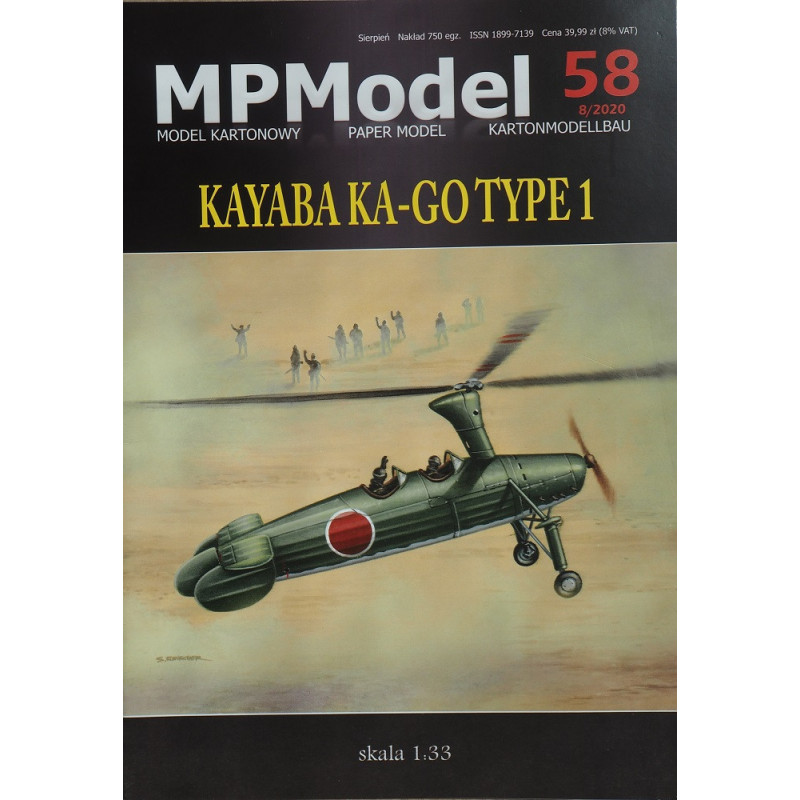


Publisher/ Manufacturer: "Answer" – "MP Model". Poland
Scale: 1 : 33
Number of sheets: 6 x B4
Number of sheets with details: 3
Number of assembly drawings: 9
Difficulty: For modelers of any experience.
Model dimensions: 279 mm x 369.5 mm x 94 mm
 Security policy
(edit with the Customer Reassurance module)
 Delivery policy
(edit with the Customer Reassurance module)
 Return policy
(edit with the Customer Reassurance module)
The Kayaba Ka-1 was created based on the American-made two-seat helicopter "Kellett KD-1A". The single-seat American autogyro was delivered to Japan in 1939 and soon suffered a serious accident. The machine was badly damaged and it was no longer possible to repair it. The wreckage was transferred to the small company "Kayaba" to create a military-grade equivalent. The first Kayaba Ka-1 was manufactured at the Sendai plant and made its first flight on May 26, 1941. It differed from its predecessor mainly in the engine - instead of the radial Jacobs R-755, an Argus AS 10 was used, developing 240 h. p. power. The prototype was successfully tested. The autogyro could take off from a 30-meter platform and hover over one place, while simultaneously making a full turn. Serial production began in 1941, and the aircraft began to be supplied to artillery units, where it was used for fire correction. Only 20 Kayaba Ka-1s were produced, and later - the Ka-2 modification, which used the same engine, which was used in the “Kellett”. By the end of the war, 98 Ka-1 and Ka-2 fuselages had been built, 12 of which were destroyed, before being delivered to the troops, and the remaining 30 were missing engines. Eventually, 50 autogiros were delivered to the IJA, of which about 30 were used. Initially, the Ka-1 was planned to be used to correct the fire of artillery units, stationed in China, but the changing course of the war forced the strengthening of the defenses of the Philippines, where Ka-1s were sent as communications aircraft to replace the Kokusai Ki-76s. Ultimately, the Japanese army command felt, that a better use had been found, and most of the Ka-1s and Ka-2s were adapted for patrol and anti-submarine warfare. Several Ka-1s were deployed on the escort aircraft carrier “Akitsu maru” from August to November 1944 and, along with the Ki-76, were the only aircrafts, capable of landing on the carrier's short launch deck. The twin-seat Ka-1 could carry only a small payload, so the carrier-based aircraft were converted to single-seat ones to carry two 60 kg (130 lb) depth charges. From 17 January 1945, the Ka-1s conducted anti-submarine patrols from the Iki Island airfield, with their maintenance base at Gannosu Airfield in Fukuoka Prefecture. From May 1945 patrols of the Korea and Tsushima Straits were conducted from Tsushima Island. After some time, the range of aircraft, deployed on US aircraft carriers, reached the Tsushima Strait, and in June 1945, the remaining Ka-1s and Ka-2s were transferred to a base on the Noto Peninsula, where they remained until the end of the war. During the war, helicopters failed to sink a single submarine, but they played an important role in detecting them.
A small model of a small autogyro, well designed and richly detailed, medium complexity model, painted in Japanese Navy aviation camouflage. The model is suitable for modelers of any experience. Only beginners and modelers with little experience should work under the supervision of a more experienced colleague, do not rush, and simplifying here will not work much - the cockpits are open, the landing gear is stationary. The model perfectly reproduces all visible external details, the landing gear, cockpit equipment, and the control plates can be made both together with the main plates and separated from them. There is a small supply of colors, the text instruction in Polish is small and only describes the process of gluing the model in general terms, but it perfectly complements the not very large, but quite informative and easy-to-read graphical instruction.

Publisher/ Manufacturer: "Answer" – "MP Model". Poland
Scale: 1 : 33
Number of sheets: 6 x B4
Number of sheets with details: 3
Number of assembly drawings: 9
Difficulty: For modelers of any experience.
Model dimensions: 279 mm x 369.5 mm x 94 mm