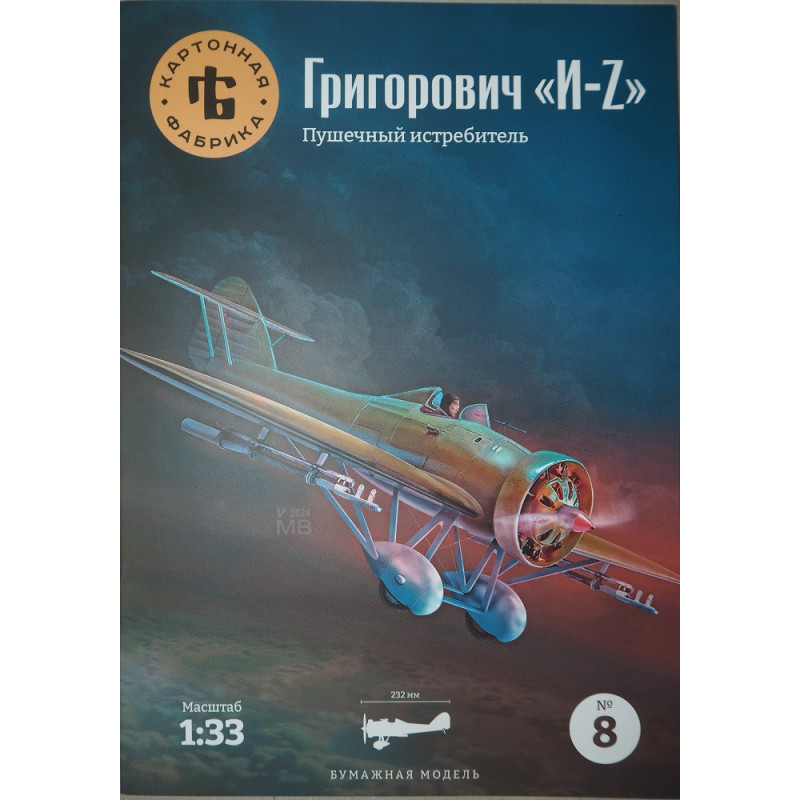


Publisher/ manufacturer: “Картонная Фабрика". Russia
Scale: 1 : 33
Number of sheets: 10 x A4
Number of pages with details: 6
Number of assembly drawings: 35
Difficulty: For intermediate to advanced modelers.
Model dimensions: 232 mm x 348,5 mm x 112 mm
 Security policy
(edit with the Customer Reassurance module)
 Delivery policy
(edit with the Customer Reassurance module)
 Return policy
(edit with the Customer Reassurance module)
In the 1930s, the USSR began implementing the “Z” program - the creation of a fighter armed with a 76.2 mm dynamo-reactive (non-selective) cannon designed by L. V. Kurchevsky. The development of the fighter at the OMOC (Department of Naval Experimental Aircraft Design) was led by D. P. Grigorovich, who was based on the design of the single-seat biplane fighter I-5, which he designed together with N. N. Polikarpov. Two single-shot DRP cannons were installed under the wing, to the right and left of the main landing gear. An additional machine gun was installed in the fuselage. Two I-Z prototypes were built, the first of which took off in the summer of 1931. The second I-Zbis prototype had a reinforced structure, and its first flight took place in 1932. Both prototypes were equipped with 525 hp Gnome-Rhone "Jupiter" VI radial engines. The fighter received the designation CKB-7 in the design bureau. In 1933, an order was issued to produce 21 aircraft for operational testing, equipped with Soviet 480 hp M-22 engines, covered with a Townend ring. The metal construction wing, used in the prototypes, was replaced with a wooden one. Later, about 50 more I-Zs were produced, but the fighter did not have good flight characteristics, and its single-shot dynamo-reactive cannon did not justify itself. The maximum speed of serial production machines was 40 km/h lower, than that of the prototypes. Most of the aircraft produced were used in various flight test programs. One fighter was used in the creation of B. S. Vakhmistrov's "flying aircraft carrier", known as "Звено" ("Chain part").
A very interesting model of a cannon fighter. A detailed model with well-designed cockpit and engine detailing. From the publication, You can glue together an I-Zet from the 116th Separate Special Purpose Fighter Squadron ("Suzi Squadron"), which carried out special missions for the Red Army Air Force Research Institute. Pilot N. I. Zvonarev, Pereslavl-Zalessky, autumn 1934. Very moderate and accurate traces of exploitation, there is a fairly large reserve of colors, where necessary, double-sided printing was used. There are no text instructions, the graphic one is small, but informative and detailed.

You might also like
Publisher/ manufacturer: “Картонная Фабрика". Russia
Scale: 1 : 33
Number of sheets: 10 x A4
Number of pages with details: 6
Number of assembly drawings: 35
Difficulty: For intermediate to advanced modelers.
Model dimensions: 232 mm x 348,5 mm x 112 mm