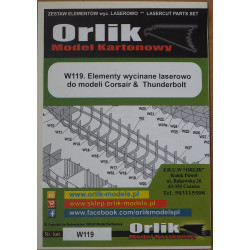
Publisher/ Manufacturer: “Orlik”. Poland
Scale: 1 : 50
Number of sheets: 12 x A4
Number of detail sheets: 7
Number of assembly drawings: 30
Difficulty: For any experience modelers.
Model’s dimensions: 204 mm x 250 mm x 90 mm and 220,5 mm x 244 mm x 89 mm
 Security policy
(edit with the Customer Reassurance module)
 Delivery policy
(edit with the Customer Reassurance module)
 Return policy
(edit with the Customer Reassurance module)
The revolutionary construction of the F4U “Corsair” was developed in 1938 in response to a request from the US Navy for a fast, carrier-based fighter. “Chance Vought” took up the challenge, planning to fit the most powerful engine, available at the time (the Pratt-Whitney “Double Wasp”) into the smallest possible fuselage cross-section. The key was to fit the cumbersome retractable landing gear into the W-shaped, swept wings, that became the aircraft's distinguishing feature. The prototype first flew on 29 May 1940, and the US Navy received the first serial “Corsair” on 31 July 1942. However tests, conducted by the US Navy on aircraft carriers, revealed some design flaws, as a result of which the first series of these fighters entered the Marine Corps escadres and operated from land bases. The first regiment to be armed with the F-4 was VMF-124 on Guadalcanal. It quickly became clear, that the new machine undoubtedly surpassed all enemy fighters, and in some respects even the F-6 “Hellcat”. However, at the same time, it was very difficult to pilot and required a lot of attention, when landing. Interestingly, only up to 20% of the “Corsair” missions took off from aircraft carriers, and for almost the entire war they remained mainly a Marine Corps machine. After the end of World War II, the F-4 “Corsair” remained in service and took part in the Korean War (1950-1953). Technical data (version F4U-4): maximal speed - 731 km/h, climb speed -: 19.7 m/s, maximal ceiling - 12649 m, maximal flight range - 1115 km, armament: stationary - 6 M2 machine guns (caliber 12.7 mm) and 4 20mm “Browning” cannons, hanging - up to 1800 kg of bombs.
Republic P-47 “Thunderbolt’ - a single-engine fighter and attack aircraft of American production, designed as a low-wing monoplane with a classic tail. Considered one of the best US fighters of World War II. The first prototype flight took place in 1941, serially produced in 1942–1945. The P-47 can be described as the workhorse of the US Air Force both in Europe and in the Pacific region. Although the 2000 h. p. R-2800 “Double Wasp” engine, supercharger, and exhaust system made the fighter very large and heavy, this was not an obstacle to achieving excellent results. The usefulness of the machine was so great, that it was used both for bomber escort and for bombing missions, in which the P-47 played a key role. The usefulness of the P-47 is also confirmed by the huge number of aircraft produced - 15,660, the D modification - as many as 12,602 - this is an absolute record, when it comes to the number of fighters, produced in one version. Another common version was the P-47N with a changed wing shape, larger fuel tanks and a more powerful engine. It was used both as a fighter and as a strike aircraft. Even after World War II, the “Thunderbolt” was one of the most popular American fighters until the early 1950s. Technical data (P-47D version): length - 11 m, wingspan - 12.42 m, height - 4.47 m, maximal speed - 697 km/h, climb rate - 15.9 m/s, maximal flight range - 2900 km, practical ceiling -13,100 m, armament: stationary - 8 12.7 mm M2 machine guns, suspended - up to 1100 kg of bombs or unguided rockets.
Excellently designed and fairly well-detailed models for modelers of any experience, only beginners and modelers with little experience should work under the supervision of a more experienced colleague, try not to rush, work patiently, carefully and attentively. Excellent detailing, although not maximal, but sufficient for 1 : 50 scale models. The textual instructions are quite extensive, separate for each model and quite detailed in Polish, the graphic instructions are quite extensive and perfectly explain the entire assembly process. There is a considerable reserve of colors. Details, that were left in the unpainted metal color on the original aircraft, are printed in the publication with "Metallic" type silver paint. For less experienced modelers it is recommended to make models with a retracted chassis, a simplified engine, without cabin detailing and with opaque cabin hood glasses.

You might also like
Publisher/ Manufacturer: “Orlik”. Poland
Scale: 1 : 50
Number of sheets: 12 x A4
Number of detail sheets: 7
Number of assembly drawings: 30
Difficulty: For any experience modelers.
Model’s dimensions: 204 mm x 250 mm x 90 mm and 220,5 mm x 244 mm x 89 mm