

Publisher/ manufacturer: “A. Halinski". Poland
Scale: 1 : 33
Number of sheets: 28 x B4
Number of pages with details: 17 3/4
Number of assembly drawings: 160
Difficulty: for intermediate and advanced modelers.
Model dimensions: 524,5 mm x 344 mm x 132 mm
 Security policy
(edit with the Customer Reassurance module)
 Delivery policy
(edit with the Customer Reassurance module)
 Return policy
(edit with the Customer Reassurance module)
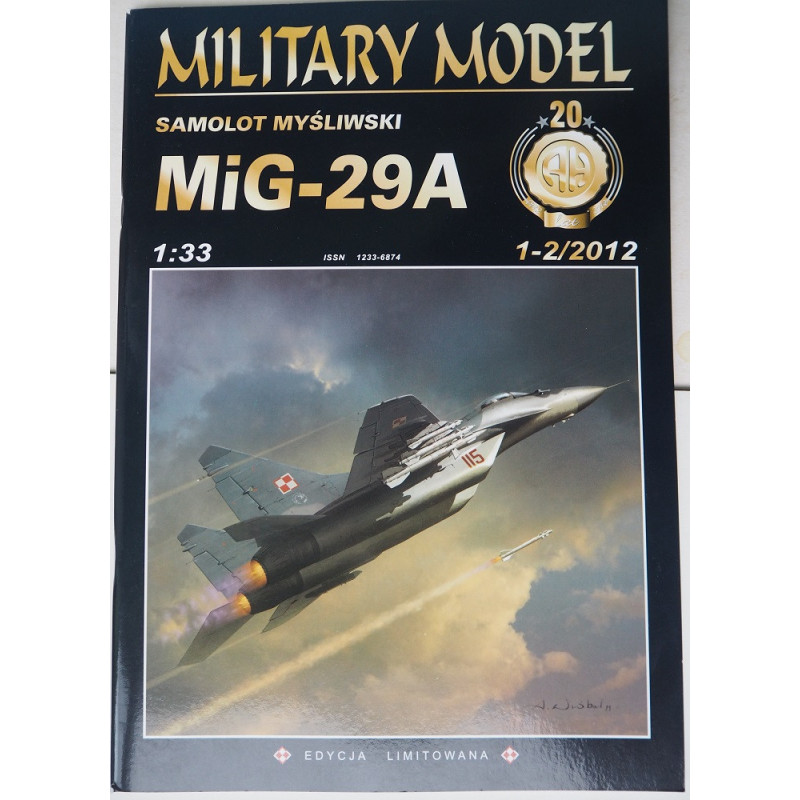
The MiG-29 (NATO: "Fulcrum") designed by the Mikoyan-Gurevich Design Bureau is a Soviet, twin-engine, 4th generation heavy front-line fighter with a trapezoidal wing. The number of more than 1,000 MiG-29s, produced from 1977 to 1992, alone proves the potential of this aircraft. In fact, it should be ranked among the 3 or 4 most important 4th generation fighters in the world, currently in active use. The MiG-29 was designed in the 1970s as a design, that could equal or even surpass the combat characteristics of the then hostile Western fighter aircraft. And it must be admitted, that it is in no way inferior to, for example, the F-16, and in many elements, such as a powerful twin-engine drive, it surpasses its American competitor. Since the MiG-29 was designed to be serviced as quickly as possible, even in the field, and by mechanics with minimal experience, any repair can actually be done in a flash. It is hard to imagine, but 5 mechanics are able to replace and test an engine in less, than an hour! The extraordinary capabilities of the "Fulcrum" do not end there. If necessary, even fully loaded, it can start taking off with one engine running, and start the other during takeoff or already in the air. The permanent armament of the MIG 29 is a 30 mm GSh-301 cannon, known for its accuracy. On the external suspension units, it is possible to hang AA-10, AA-11 or AA-8 air-to-air missiles, as well as a UB-32-57 cannon container or unguided, but larger S-8K missiles - for destroying ground targets. Not only the former Eastern Bloc countries operated these fighters, but also many other users, who appreciated its great potential. Several versions of this successful fighter were created. The most important of them, among others, are the first mass-produced MiG-29 ("Fulcrum-A") with the S-29 "Topaz" radar and the "OEPrNk-29" optoelectronic system. Another version is the MiG-29M ("Fulcrum-E") with the S-29M "Żuk" radar, which is characterized by a longer range and an improved control and targeting system. Instead of the RD-33, more powerful RD-33K engines were also used. An electronic flight control system was also used.
A super-complex, super-designed, super-detailed model for supermodelerss... It details everything, that can be depicted in a model of this scale: cockpit equipment, landing gear, its niches, armament and its suspension pylons, engine parts, visible through the intakes and exhausts, air brakes (can be closed or open), control planes separated from the main ones and can be made "working". There is even a "concrete" runway and steps for the crew to board the cockpits. Only - there is no stock of colors (Halinski is convinced, that they are not needed), although some can be "combined" from the glue-up boxes for other sides of the part. There are no textual instructions, but graphic ones - !!!!! - a whole B4 format page is used, just to depict the assembly of the pilot seats, there's no point in talking about anything else. The model recreates the appearance of a fighter jet of the Polish Air Force's from 1st Tactical Aviation Squadron, which participated in the NATO Air Policing mission to protect the airspace of the Baltic States since March 2006 and was based at Šiauliai Airport. Antiquarian publication.

You might also like
Publisher/ manufacturer: “A. Halinski". Poland
Scale: 1 : 33
Number of sheets: 28 x B4
Number of pages with details: 17 3/4
Number of assembly drawings: 160
Difficulty: for intermediate and advanced modelers.
Model dimensions: 524,5 mm x 344 mm x 132 mm