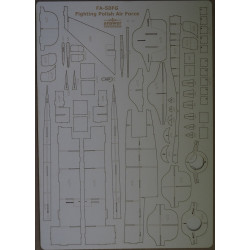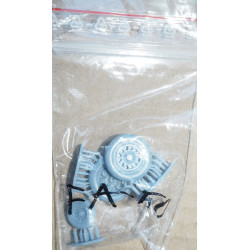


Publisher/ Manufacturer: "Answer. MS Model". Poland
Scale: 1 : 33
Number of sheets: 20 x A4
Number of sheets with details: 12
Number of assembly drawings: 55
Difficulty: For intermediate and advanced modelers.
Model dimensions: 393.5 mm x 278 mm x 145 mm
 Security policy
(edit with the Customer Reassurance module)
 Delivery policy
(edit with the Customer Reassurance module)
 Return policy
(edit with the Customer Reassurance module)
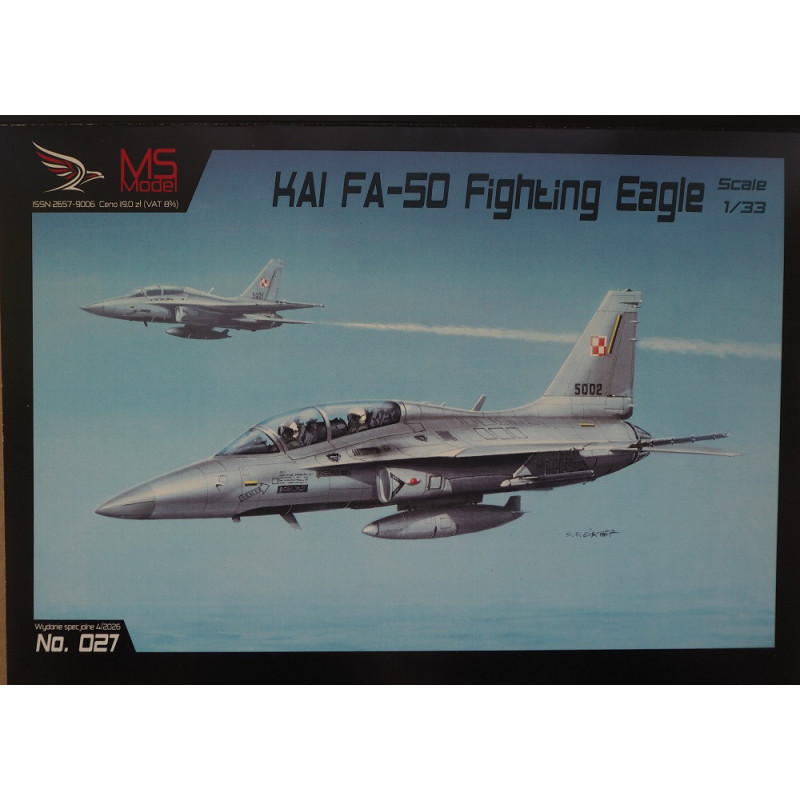
KAI T-50 “Golden Eagle” (Korean: RR “Goldeunigeul”) – a two-seat South Korean supersonic trainer aircraft, developed by “Korea Aerospace Industries”. The military variant of the KAI T-50 (FA-50) is a light combat aircraft. Development of the T-50 began in 1992, when “Samsung” conducted tests of a supersonic jet trainer, called the KTX-2. It was intended to be another step towards the independence of the country's aviation industry after the KTX-1 turboprop trainer, which first flew in December 1991. The KTX-2 was intended to replace the T-38 “Talon” and “Hawk”, and later the F-5 “Tiger II”. As the development costs were estimated to be high (totaling $2 billion), a strong partner was sought, and “Lockheed Martin” was chosen. However, this led to delays, and the project did not officially start until mid-1997. The financial costs were shared between “Lockheed Martin” (13%), “KAI” (17%), and the South Korean government (70%). “Lockheed Martin's” influence is evident in the aircraft's design, which resembles the F-16. On October 24, 1997, a contract was signed for the production of six prototypes (two of which were intended for static testing only). The design was suspended in August 1999, after which “KAI” was established in October 1999, and in February 2000 the aircraft was renamed the T-50. Production of the first prototype began in Sacheon in January 2001, and it was publicly unveiled on October 31, 2001, in the presence of President Kim Dae-jung. On August 20, 2002, the prototype, piloted by Lieutenant Colonel Cho Gwang-je, made its first 39-minute flight. The first flight of the second prototype took place on November 8 of the same year. On February 19, 2003, supersonic speed of Mach 1.05 was achieved for the first time. The prototype of the trainer/fighter-bomber variant, designated LIFT (Lead-in Fighter-Trainer), T-50B, A-50 or TA-50, first flew on 29 August 2003, and the fourth prototype on 4 September 2003. In late 2003, the South Korean Air Force placed an initial order for 25 aircraft, and on 30 August 2005, the first serial aircraft was delivered to the Sacheon “KAI” factory. The first aircraft was officially delivered to the South Korean Air Force on 29 December 2005, to a squadron in Gwangju. The first TA-50 rolled out of the factory on 24 January 2011. “Lockheed Martin” participated in the US Air Force's T-X program with a modified version of the T-50, which was designed to find a modern successor to the Northrop T-38 “Talon”. The “Lockheed Martin” version is designated the T-50A and first flew on 2 June 2016. This competition was later won by the Boeing T-7. A purely combat version, designated the FA-50 (equipped with an Elta AESA radar, among other things), was developed as a replacement for the F-5. The contract for this version was awarded in December 2008, and the first flight was scheduled for 2012. An order for 20 FA-50s was placed in early 2011, with deliveries scheduled for 2013–2014. The aircraft have been exported to the Philippines (12), Iraq (24), Malaysia (18), Indonesia, and Thailand. 48 aircraft of this type (12 FA-50GF versions and 36 FA-50PL) as a replacement for the MiG-29s, that have already ended their service and been transferred to Ukraine, were purchased by the Polish Military Aviation. After receiving this batch, talks began about a new order for them, but it is still being considered.
A small, beautiful, well-designed and richly detailed, rather complex model of an aircraft, operated by the Polish LWP, painted in standard NATO camouflage, for medium experience and experienced modelers. The model perfectly reproduces all visible exterior details, cockpit interior, landing gear, its niches, visible engine details, a wide selection of hung weapons, control plates - only separated from the main plates. There is no color reserve, the textual instruction in Polish is small, but perfectly complements the rather large exemplary graphic instruction.

You might also like
Publisher/ Manufacturer: "Answer. MS Model". Poland
Scale: 1 : 33
Number of sheets: 20 x A4
Number of sheets with details: 12
Number of assembly drawings: 55
Difficulty: For intermediate and advanced modelers.
Model dimensions: 393.5 mm x 278 mm x 145 mm