- New


Publisher/ Manufacturer: "Answer" - "MP Model". Poland
Scale: 1 : 33
Number of sheets: 8 x B4
Number of sheets with details: 5
Number of assembly drawings: 13
Difficulty: For intermediate and experienced modelers.
Model dimensions: 274 mm x 354 mm x 116 mm
 Security policy
(edit with the Customer Reassurance module)
 Delivery policy
(edit with the Customer Reassurance module)
 Return policy
(edit with the Customer Reassurance module)
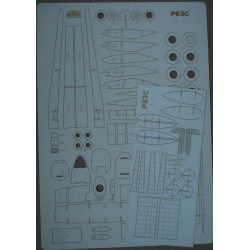
Bell P-63 "Kingcobra" - US-made fighter, successor to the P-39 "Aircobra". Although both aircraft look very similar, in fact the P-63 was a completely new design and the aircrafts did not have any common parts or components. Compared to its predecessor, the P-63 had much better high-altitude performance, largely due to a new turbocharged engine and a new laminar wing construction, but it did not match the performance of the already used P-51 “Mustang” and was not accepted into service in the US Army fighter units. Most of the production was exported to the USSR under “Lend-Lease”. The RP-63G version was originally designed as a flying target. Two P-63Cs were converted into prototypes of other versions. They were equipped with lights on the side of the fuselage and upper wing surfaces, that lit up, when hit, and the engine air intake was changed. 450 copies of this version were ordered. They were equipped with the “Allison” V-1710-135 engine, whose starting power reached 1200 h. p., and the compressor gear ratio was changed. Reinforced armor weighing as much as 952.5 kg was installed near the cockpit. But only 30 units were produced, and the rest of the order was canceled. In 1948 this version was renamed the QF-63G. All versions of the RP-63 reached a speed of about 482 km/h. Of the 3303 P-63s produced, 2397 aircraft were sent to the USSR under the “Lend-Lease” agreement; 21 of them were lost during transportation. Although the importance of “Lend-Lease” assistance is downplayed in the "official" history of the Soviet Union, in fact both the “Aircobra” and the “Kingcobra” proved themselves in the tactical conditions of the Eastern Front due to their powerful armament (cannon + machine guns). In addition, the "Kingcobras" proved to be excellent as an attack aircraft, often used as tank destroyers. After the war, these P-63s, many of which remained in the USSR Air Force, received the NATO code name "Fred".
A medium-size, beautifully silhouette, well-designed and richly detailed, rather complex model of an American fighter, that served in the US Air Force during World War II. The model is suitable only for medium-experienced and experienced modelers. The model perfectly reproduces all visible exterior details, landing gear, its niches, and cockpit equipment. There is a small supply of colors, the textual instruction in Polish is small and only describes the general outlines of the assembly process, but it perfectly complements the not very large, but quite informative and easy-to-read graphical instruction.

You might also like
Publisher/ Manufacturer: "Answer" - "MP Model". Poland
Scale: 1 : 33
Number of sheets: 8 x B4
Number of sheets with details: 5
Number of assembly drawings: 13
Difficulty: For intermediate and experienced modelers.
Model dimensions: 274 mm x 354 mm x 116 mm