

Publisher/ Manufacturer: "A. Halinski". Poland
Scale: 1 : 33
Number of sheets: 10 x B4
Number of sheets with details: 5 1/2
Number of assembly drawings: 86
Difficulty: For medium and experienced modelers.
Model dimensions: 273.5 mm x 300.5 mm x 79 mm
 Security policy
(edit with the Customer Reassurance module)
 Delivery policy
(edit with the Customer Reassurance module)
 Return policy
(edit with the Customer Reassurance module)
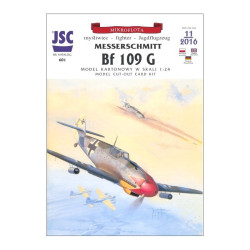
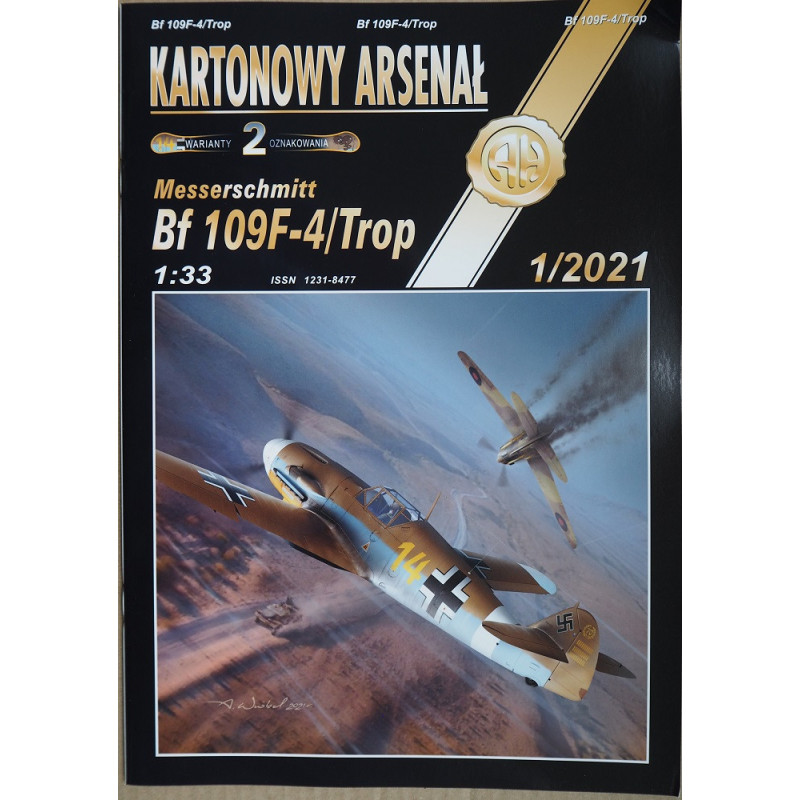
Messerschmitt Bf-109 – the German all-metal single-engine low-wing fighter with a classic tail. As time has shown, it was the main and most widely produced Luftwaffe fighter during World War II. The first flight of the prototype took place on 1935. May 29, serial production continued from 1936 to 1945. It is estimated, that a total of about 35,000 Messerschmitt Bf-109 fighters of all versions were produced, many of which ended up in the Czech and Israeli air forces after the war. The origins of the Bf-109 date back to a competition, announced by the Luftwaffe in 1933 for a new fighter. Competing with the He-112, the Bf-109 project initially lost, but due to the intrigues of Willy Messerschmitt, the project was allowed to continue and eventually won the competition, becoming the main fighter of the Luftwaffe. Several main variants of the Bf-109 were developed during production. The first pre-production series was the Bf-109B ("Berta") with different versions of the Junkers "Jumo" 210 (A or Da) engine. They were tested in Spain from 1937, during the Civil War. Another version was the Bf-109C ("Caesar"). They had a different engine, than the B version and more powerful armament, consisting of two 20 mm cannons and 2 HP 7.92 mm machine guns. These machines also fought in the skies of Spain. The third version - Bf-109D ("Dora") with a Junkers "Jumo" 210 Da or Daimler-Benz DB 600 engine. Widely used in the September 1939 campaign in Poland, but at the turn of 1939/1940 it was replaced by the E version. Bf-109E ("Emil") with a Daimler-Benz 601A or N engine was almost the most popular model. It was the first, to be equipped with a three-bladed propeller, instead of a two-bladed one. The Bf-109E fought in the French campaign, the Battle of Britain, in North Africa and on the Eastern Front. One of the later famous aces, Adolf Galland, also began his career in the cockpit of the Bf-109E. Another version was the Bf-109F ("Friedrich"), which, according to German pilots, was the most aerodynamically perfect. The shape of the fuselage, wing, and cockpit canopy changed significantly, but the engine remained the same, as in the E version. It entered service at the turn of 1940/1941. As the construction was improved, subsequent modifications of the Bf-109 were created, of which the G ("Gustav") version was produced in the largest number of copies. The most important change, which increased the effectiveness of the fighter, was the new 12-cylinder Daimler-Benz DB605A engine, developing 1475 h. p. power. The Bf-109G armament consisted of 2 x 13 mm machine guns, located in the fuselage in front of the cockpit canopy, and the MG151 20 mm or the heavier MK108 30 mm cannon. The last mass-produced version was the Bf-109K ("Kurfirst"), which entered production in October 1944. It was powered by the Daimler-Benz DB 605DB or DC engine. The Bf-109K was the fastest version, produced during World War II, reaching speeds of up to 730 km/h. Two other versions, the H and Z, were also produced, but these were very experimental versions and did not enter mass production. Subsequent engine and armament improvements made the Messerschmitt Bf-109 one of the most dangerous fighters of World War II, and at the same time demonstrated the great potential of Willi Messerschmitt's slightly angular aircraft.
A medium-complexity, well-designed and richly detailed model of World War II fighter aircraft for intermediate to advanced modelers. True, without detailing the cockpit equipment, making opaque cockpit hood windows, and retracted landing gear, this model can easily be handled by a beginner or inexperienced modeler, working under the supervision of a more experienced colleague. The models perfectly reproduce the cockpit equipment, landing gear, its niches, wing mechanization and exterior detailing. There are no color reserves. The textual instruction is not too extensive and explains only the most complex moments of assembling the model, while the graphical instructions are large, detailed, informative, and easy to read. From the publication You can make one of two (and both, if You use a printer) paint versions of the 109th model: WNr 10137 "yellow 14", which was flown by Ltn. Hans Joachim Marseille, or WNr 10271 "<II+-" from Staff Group II/JG 27, which was flown by Obltn. Otto Schulz.

Publisher/ Manufacturer: "A. Halinski". Poland
Scale: 1 : 33
Number of sheets: 10 x B4
Number of sheets with details: 5 1/2
Number of assembly drawings: 86
Difficulty: For medium and experienced modelers.
Model dimensions: 273.5 mm x 300.5 mm x 79 mm