

Publisher/ Manufacturer: "Answer" – "MP Model". Poland
Scale: 1 : 33
Number of sheets: 16 x B4
Number of sheets with details: 12
Number of assembly drawings: 37
Difficulty: For modelers of any experience.
Model dimensions: 222 mm x 274 mm x 90.5 mm and 176 mm x 247.5 mm x 72.5 mm
 Security policy
(edit with the Customer Reassurance module)
 Delivery policy
(edit with the Customer Reassurance module)
 Return policy
(edit with the Customer Reassurance module)
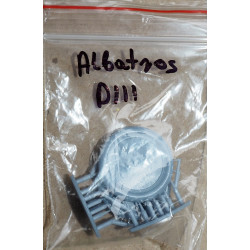
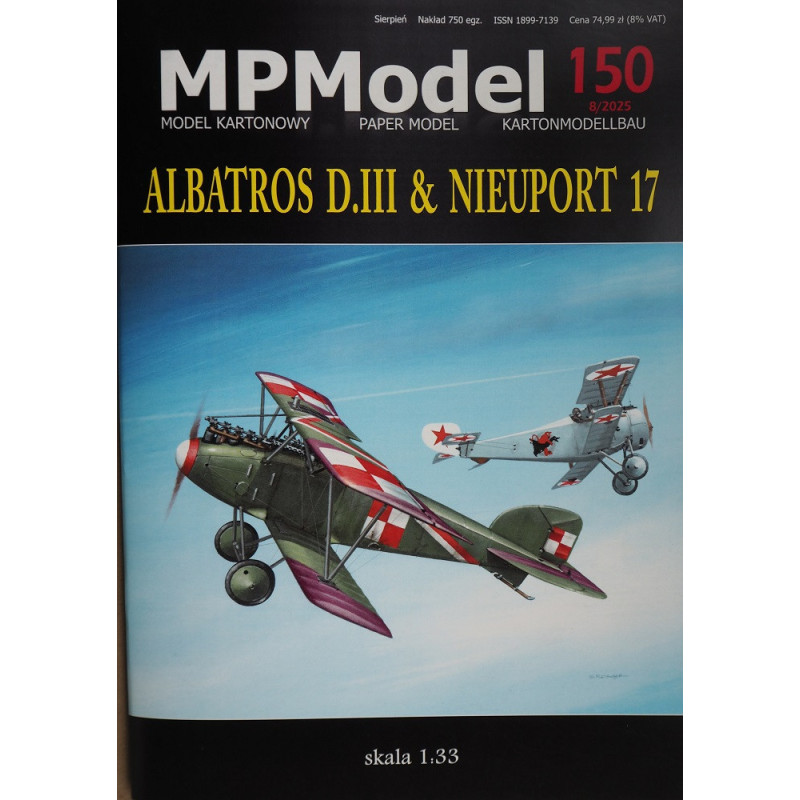
Albatros D. III – the German fighter – biplane, designed in 1916 and manufactured by the German "Albatros-Werke" GmbH in Berlin. One of the main German World War I fighters. In the first half of 1912 the engineer of the Albatros factory Robert Thelen, with the help of pilots, who flew the Albatros D. I and D. II fighters, began the construction of a new fighter for the German military aviation. According to the requirements, the aircraft had to be maneuverable, capable of rapid maneuvering in the vertical plane, had to have a high rate of climb and be resistant to overloads. The prototype took off for its first flight in September 1916. It turned out to be easy to control, maneuverable, durable and showed excellent flight characteristics. After making minor adjustments, serial production began in 1917. A total of 1,340 Albatros D. IIIs were produced, mostly at the “Ostdeutsche Albatros Werke’ factory in Pila. Improved versions of the Albatros D. III (Oef) were produced under license by the Austro-Hungarian factory “Oeffag”. From December 1916 these fighters began to be supplied to combat units on the Western Front. They surpassed Allied fighters in climb speed, but were inferior to them in maneuverability. In the first half of 1917 Albatrosses dominated against older Entente fighters, contributing significantly to British losses during the "Bloody April". Most of the best German aces of the time (Manfred von Richthofen, Ernst Udeth and others) fought on these planes. But in the second half of the same year, when Entente pilots began to fly new fighters, the Albatross advantage was first reduced, then completely disappeared. Albatros replaced the Fokker D. VII.
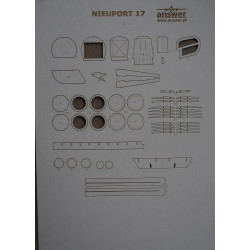
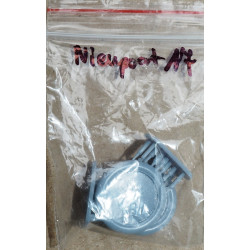
The Nieuport Nie-17 entered service in March 1916 as a continuation of the Nie-11, but quickly became the number 1 fighter of the French AF. They were also armed with them by the British RAF - its design significantly surpassed all British fighters of the time in its flight characteristics. The Nie-17 was in the arsenal of any fighter squadron and German pilots suffered greatly from them. At one time, the Germans even considered the possibility of producing equivalents of these aircraft - copies for their fighter units. This is how the “Siemens-Schuckert” D.I appeared, which had very similar flight characteristics and an engine of the same power, as the Nie-17. But the high production cost led to the fact, that only 95 of these "copies" were produced and they were never used in combat, but served only as training fighters. In 1917 the Nie-17 began to lose ground to German fighters on the battlefield, as a result of which the French headquarters ordered the construction of new fighters and thus the Nieuport Nie-24 and Nie-27 appeared, even the Nie-17 was used until the end of the war.
Small models of small fighters, well designed and richly detailed, of medium complexity. The models recreate the appearance of the fighters, used on both sides during the Bolshevik Russo-Polish War of 1919–1920: “Albatros” – Polish AF, Nie -17 – Soviet Russia. The models are quite simple, so they are suitable for modelers of any experience. Even a beginner modeler can perfectly master these models without any help from more experienced colleagues, but working in a company is always more fun and goes better. The models perfectly reproduce all visible external details, the chassis, cockpit equipment, control planes can be made both together and separated from the main planes (Nie-17 – only separate). Both models are printed in two kinds of printing – offset and chalk printing, where Albatros looks more realistic with offset, Nie – 17 – chalk (but this is just my opinion). However, we do not recommend chalk for beginner modelers – gluing it is much more complicated, than offset. There is a small supply of colors, the silver color of the airplanes - prototypes in the publication is printed with "Metalic" type silver paint, the textual instructions in Polish are small and only describe the model gluing process in general terms, but they perfectly complement the not very large, but quite informative and easy-to-read graphical instruction.

You might also like
Publisher/ Manufacturer: "Answer" – "MP Model". Poland
Scale: 1 : 33
Number of sheets: 16 x B4
Number of sheets with details: 12
Number of assembly drawings: 37
Difficulty: For modelers of any experience.
Model dimensions: 222 mm x 274 mm x 90.5 mm and 176 mm x 247.5 mm x 72.5 mm