

Scale: 1 : 33
Number of sheets: 10 x A4
Number of sheets with details: 5 1/3
Number of assembly drawings: 29
Difficulty: For intermediate and experienced modelers.
Model dimensions: 178 mm x 432.5 mm x 91 mm
 Security policy
(edit with the Customer Reassurance module)
 Delivery policy
(edit with the Customer Reassurance module)
 Return policy
(edit with the Customer Reassurance module)
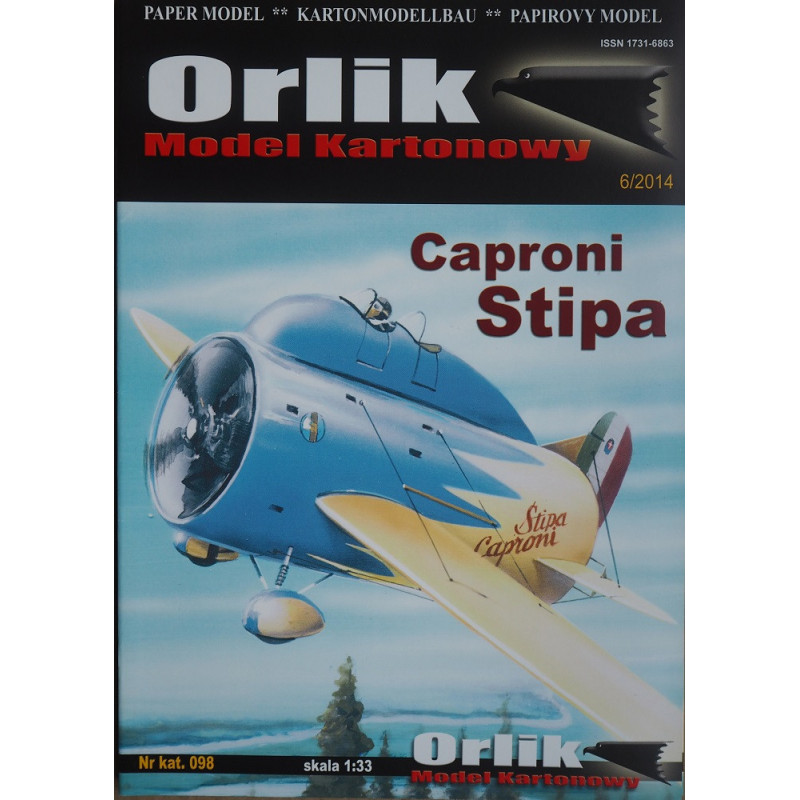
Caproni "Stipa" – the Italian experimental mixed-construction aircraft - monoplane with non-retractable landing gear. The aircraft is equipped with one de Havailland "Gipsy III" engine with a power of 120 h. p. The first flight of the prototype took place in 1932. This was the only copy of this very unusual aircraft. Caproni "Stipa" was created on the initiative of Italian aircraft constructor Luigi Stipa. In his plane he used a completely avant-garde solution - he placed a piston engine with a propeller inside the cylindrical fuselage of the aircraft, on top of it placed a small cockpit. The result is an aircraft, that looks like a flying barrel! Despite the unusual design, experimental flights of the Caproni "Stipa" confirmed many of the assumptions of its designer: first of all, the placement of the engine, along with the propeller, inside the fuselage improved its efficiency and effectiveness. The landing speed of the Caproni "Stipa" was very low and the climb rate was not bad. A major drawback of the aircraft was the high aerodynamic resistance and low maneuverability. Despite the fact, that the Italian Air Force was not interested in this construction, the aircraft itself, as well as the observations made during its flights, were used in the development of jet aircraft.
A small and well-designed and richly detailed model of a small aircraft is quite complex, although at first glance it does not seem so. Therefore, we recommend assembling it only to medium-experienced and experienced modelers. The model perfectly reproduces all visible exterior details, chassis, cabin equipment, control plates can only be made separated from the main plates. There is a fairly large colors reserve, the textual instruction in Polish is not the largest, but detailed and perfectly describes the entire process of assembling the model, the graphical instruction is also quite extensive, consistently arranged, informative and easy to read.

You might also like
Scale: 1 : 33
Number of sheets: 10 x A4
Number of sheets with details: 5 1/3
Number of assembly drawings: 29
Difficulty: For intermediate and experienced modelers.
Model dimensions: 178 mm x 432.5 mm x 91 mm