- New
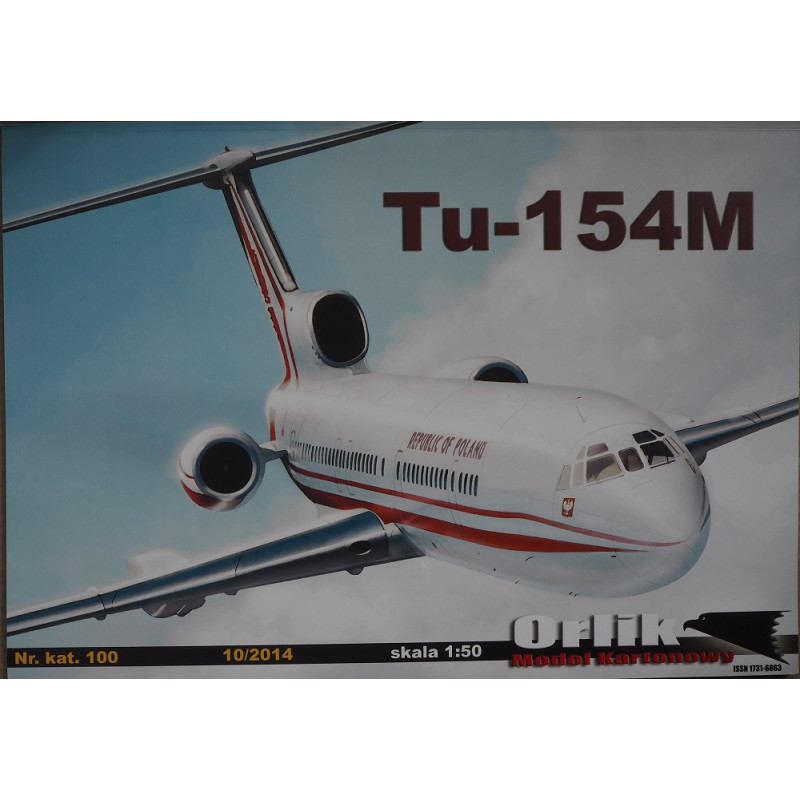


Publisher/Manufacturer: "Orlik". Poland
Scale: 1 : 50
Number of sheets: 26 x A3
Number of sheets with details: 19
Number of assembly drawings: 139
Difficulty: For medium and experienced modelers.
Model dimensions: 958 mm x 751 mm x 228 mm
 Security policy
(edit with the Customer Reassurance module)
 Delivery policy
(edit with the Customer Reassurance module)
 Return policy
(edit with the Customer Reassurance module)
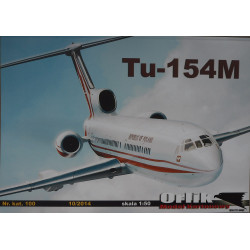
The Tupolev Tu-154 (NATO reporting name: Careless) was and remains a three-engine medium-class all-metal low-wing passenger aircraft, manufactured in the USSR, used in the USSR, later in Russia, as well as in other liberated states (at least two, only the Tu-154B version aircraft were also used by Lithuanian Airlines – LAL). The Tu-154M version is powered by three Kuznetsov NK-8 or Soloviev D30KU-154 engines. The first flight of the prototype took place in October 1968; it was serially produced from 1968 to 2001 and from 2003 to 2013. A total of about 950-1000 of this type of airliners were produced, of which about 100 are still in service (as of 2017). The Tupolev Tu-154 was designed to standardize “Aeroflot's” medium-range aircraft fleet and was to replace the Tu-104, An-10, Il-12 and Il-18 aircraft. It is widely believed ,that the Hawker Siddeley “Trident” design became the basis for the Tu-154. Despite the advantages of the machine (high flight speed, the ability to fly from airports with poor quality runways), the Tu-154 also has significant disadvantages: it is characterized by very high fuel consumption and more frequent, than average breakdowns, which, unfortunately, led to 67 crashes of this aircraft. During serial production several versions of the Tu-154 were created. The first was the Tu-154A with a new version of higher-thrust engines. The others were: a transport version (Tu-154S) and a passenger version with improved avionics (Tu-154B1 / B2). The last serially produced Tu-154M, which already had D30KU engines and a significantly greater flight range. The Tu-154M with tail number 101, was flown by many important representatives of the Polish Government, including the President of the Republic of Poland Lech Kaczyński. It crashed on April 10, 2010 near the Smolensk-Siewernyj airport. Among the victims of this disaster were many members of the Polish Government and the President himself.
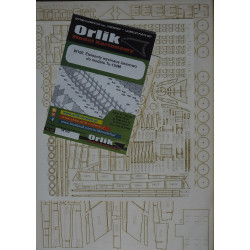
The model of a large aircraft is large and well-designed and richly detailed, quite complex. We recommend assembling it only to modelers with average experience and experienced. The model perfectly reproduces all visible external details, the landing gear, its niches, visible engine parts, cockpit and passenger cabin equipment (only a small part of all this will be visible through the 6 x 9 mm portholes), the control surfaces can be made both together with the main surfaces and separately from them. The color reserves are only narrow stripes at the edge of the sheet (and only in red). The publication is printed with offset printing, which makes the model less realistic, than chalk printing, but makes gluing much easier, because there is no need to look for suitable glues - almost any will work - and the model will be less affected by glue, applied in the wrong place (but still, as with all models, this should be avoided). The metal-colored details of the real aircraft are printed with "Metallic" type aluminum paint. The textual instructions in Polish are small and only a few of the most complex gluing moments, but the graphical instructions are very extensive, consistently arranged, informative and easy to read.

You might also like
Publisher/Manufacturer: "Orlik". Poland
Scale: 1 : 50
Number of sheets: 26 x A3
Number of sheets with details: 19
Number of assembly drawings: 139
Difficulty: For medium and experienced modelers.
Model dimensions: 958 mm x 751 mm x 228 mm