- New
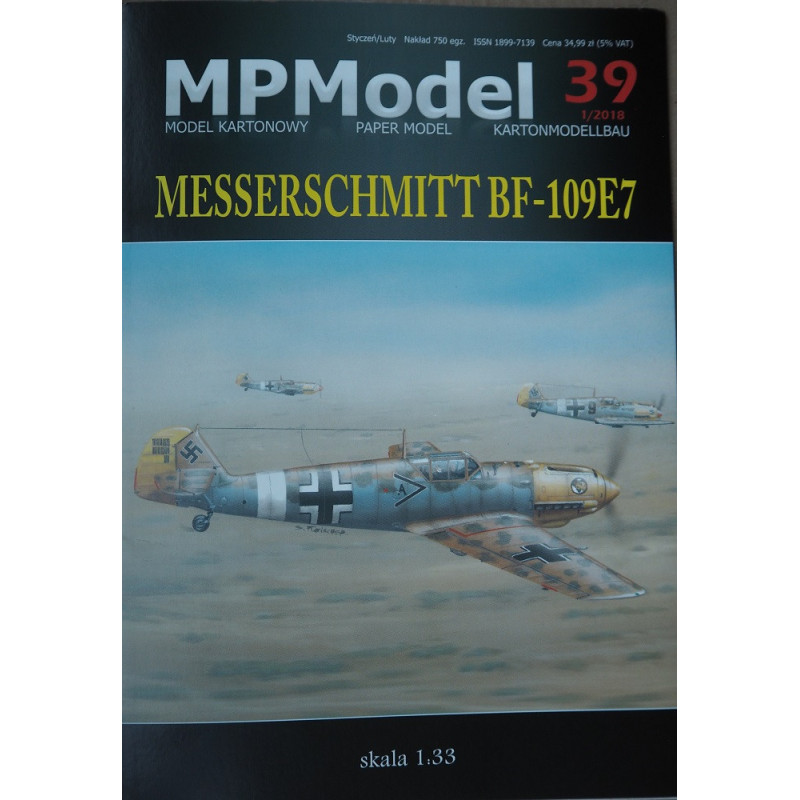


Publisher/ Manufacturer: “Answer” – “MP Model”. Poland
Scale: 1 : 33
Number of sheets: 6 x B4
Number of sheets with details: 3 1/4
Number of assembly drawings: 18
Difficulty: For modelers of any experience.
Model dimensions: 259 mm x 299 mm x 74 mm
 Security policy
(edit with the Customer Reassurance module)
 Delivery policy
(edit with the Customer Reassurance module)
 Return policy
(edit with the Customer Reassurance module)
In the early thirties of the 20th century, the RLM (Reichsluftfahrtministerium – German Ministry of Aviation) announced a competition for a fighter – a successor to the Arado Ar-68 and Heinkel He-51 biplanes. In the summer of the same year a group of constructors, led by Professor Messerschmitt and engineer Rethel, began work on a single-seat fighter project. It received the designation Bf-109. Four companies submitted designs for the competition, which submitted prototypes: Arado Ar-80V-1, Focke-Wulff FW-159V-1, Heinkel He-112V-1 and Messerschmitt Bf-109V-1. All prototypes, except the FW-159, were equipped with the best engines, available on the market at that time - the 695 h. p. British-made Rolls Rayce "Kastrel" V. Comparative tests of the prototypes took place at the end of October 1935 in Travemünde. The He-112 and Bf-109 were selected for further tests. Both fighters were free-floating low-wing monoplanes with retractable landing gear. Ultimately, the Messerschmitt’s project won, as it was easier to assemble and cheaper to produce. The company received a contract to produce 10 pre-series machines. After some improvements, the Bf-109 began serial production as a standard Luftwaffe fighter. The first combat experience was gained during the Spanish Civil War, where fighters of the B, C and D versions fought. The most important change made to the E version, was the installation of a more powerful Daimler-Benz DB-601 engine with direct fuel injection into the cylinders. These engines developed 1100 h. p. power. Fighters of this version also fought in the Spanish War, which became a testing ground for the new fighter. After further improvements, were made under the armament acceleration program, in March 1939 the machine was sent to serial production. The supply of serial machines to units began in early 1939. The initial armament of this version consisted of 4 MG-17s, which had already become traditional. After later experience, the two wing machine guns were replaced with MG FF cannons. The bomber version, the Bf-109E-1/B, could carry two 50 kg SC bombs, or one SC 250, weighing 250 kg. The E-1 version was already used in the German-Polish War in September 1939, later used in combat on the Western Front, where it was increasingly replaced by the newer and better armed E-3 and later versions. By the second half of 1940, the E-1 was rarely seen in a small number of combat units, mostly in training, or secondary, or even tertiary sectors of the front. A total of 30,573 Bf-109s were produced during the production period - the largest number of combat aircraft, used in World War II. Together with the licensed copies, produced after the war in Czechoslovakia (until 1948) and Spain (until 1958), the number of those produced exceeded 33,000.
A simple, well-designed and fairly well-detailed model for modelers of any experience. From the publication You can make a model of the Bf-109E-7 version of the fighter, which is quite colorful and presentable. The model perfectly reproduces the cockpit equipment, landing gear, its niches, an additional fuel tank, all exterior details, the control plates can be made both together and separately from the main ones. For advanced beginners and modelers with little experience are recommended to work under the supervision of a more experienced colleague, don’t rush and use all Your patience, diligence and attentiveness. There are no color reserves, the textual instruction in Polish is small in volume and only describes the gluing of the most complex nodes. The graphical instructions are small, but quite informative and easy to read.

Publisher/ Manufacturer: “Answer” – “MP Model”. Poland
Scale: 1 : 33
Number of sheets: 6 x B4
Number of sheets with details: 3 1/4
Number of assembly drawings: 18
Difficulty: For modelers of any experience.
Model dimensions: 259 mm x 299 mm x 74 mm