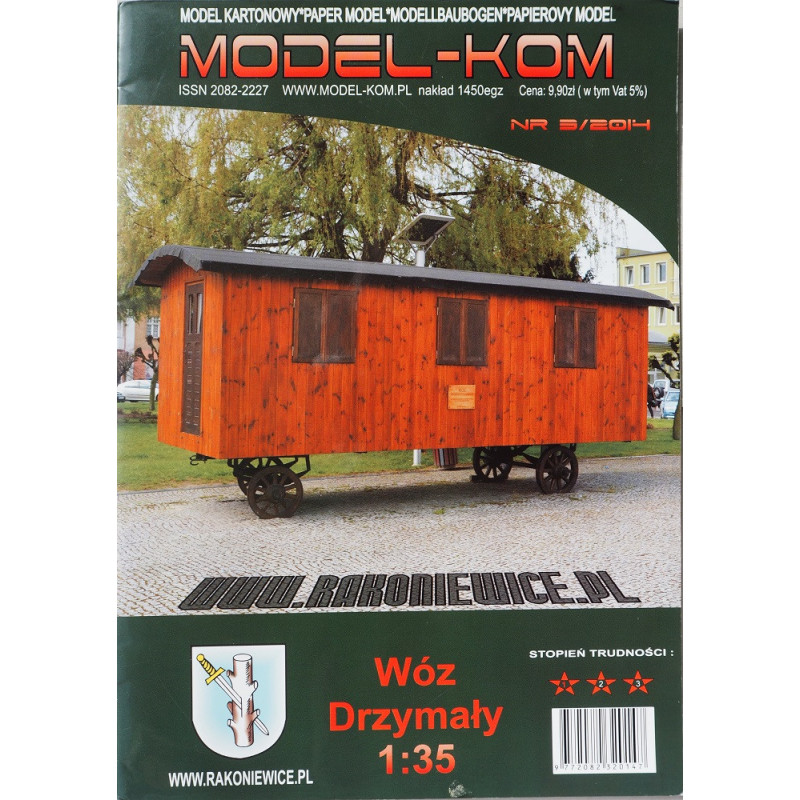


Publisher/ manufacturer: "Model-Kom". Poland
Scale: 1 : 35
Number of sheets: 6 x A4
Number of sheets with parts: 4
Number of assembly drawings: 11
Difficulty level: For beginners and inexperienced modelers.
Dimensions of the model: 185 mm x 72 mm x 100 mm
 Security policy
(edit with the Customer Reassurance module)
 Delivery policy
(edit with the Customer Reassurance module)
 Return policy
(edit with the Customer Reassurance module)
Michał Drzymała was born in Zdrój, Greater Poland. In 1881, he married a half-German woman, Józefa Vetter. From that moment on, he was forced to change his place of residence frequently in order to ensure stability for himself and his family. In August 1904, he bought a two-hectare plot of land in Podgradowice near Rakoniewice, near the Wolsztyn-Grodzisz railway line. He planned to build a house there. It seemed, that the family had fulfilled their dreams and would find peace. But all those dreams were far from the truth. Prussian law required the consent of the state administration for the construction of a building. The authorities implementing the Germanization policy selectively, used this provision to the detriment of the Polish population. In this situation, Drzymała bought a circus wagon in which he lived. Even... the Germans helped transport the wagon to the plot (they even helped buy a second wagon for Drzymała - his case was for them a symbol of the absurdity of the Prussian administration). When the authorities decided, that a carriage, that had been standing in one place for more, than a day, was a building, Drzymala moved his "apartment" to prove, that the carriage was not real estate. However, in 1910 he sold the land and moved to Cęgielsk near Rostarzewo. Drzymala's carriage became a symbol of the fight against Germanization during the partition of Prussia. Later, the Poles considered it a relic. In 1910, during the commemoration of the 500th anniversary of the Battle of Grunewald, it was exhibited in the Kraków Barbican. It was then moved to Wawel, where it stood until 1920. A year later, it was proposed to donate it to the National Museum in Poznań or the Warsaw Citadel, but due to lack of interest, it was decided to sell it at auction. The money received was to be used to produce photographic documentation and purchase works of art. Finally, on June 1, 1922, the carriage was sold for 80 000 Polish marks to Józef Butyński, who lives in Prąndnik in Czerwony. In the museum collection, in the department of crafts, material culture and militaria, there is a fragment of a wagon, described as a "Memorial plaque of the carriage of Mychał Drzymała". Drzymała himself and his case became famous all over the world. Unfortunately, by 1927 he was forgotten in Poland. Only President I. Mościcki invited him to his house (it is said, that he even kissed his hand in greeting). When he was noticed again, he received a life pension. He died without material worries. He was buried on April 29, 1937 in the Miasteczko Krajeńskie cemetery.
A small, simple, well-designed model for beginners and modelers with little experience. But this does not mean that it is not suitable for experienced modelers - they will always think of how to make a masterpiece out of a simple publication. The graphic instructions are small, but sufficient, the textual ones are also small, but perfectly complement the graphic ones. There are no reserves of colors and textures. There are silhouette models of two horses, Drzymala himself and his wife, but there is no horse harness equipment. And there would not be much space for them on the base from the publication...

Publisher/ manufacturer: "Model-Kom". Poland
Scale: 1 : 35
Number of sheets: 6 x A4
Number of sheets with parts: 4
Number of assembly drawings: 11
Difficulty level: For beginners and inexperienced modelers.
Dimensions of the model: 185 mm x 72 mm x 100 mm