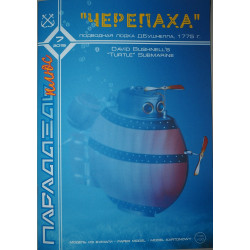
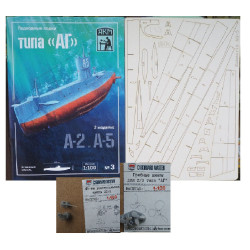
Publisher/ manufacturer: "Параллель плюс". Ukraine
Scale: 1 : 50
Number of sheets: 6 x A4
Number of sheets with parts: 3 1/2
Number of assembly drawings: 2
Difficulty level: For modelers of any experience
Dimensions of the model: 200 mm x 26 mm x 68 mm
 Security policy
(edit with the Customer Reassurance module)
 Delivery policy
(edit with the Customer Reassurance module)
 Return policy
(edit with the Customer Reassurance module)
The implementation of experimental design work on the APSS project was entrusted to the Leningrad organization "Ostechbiuro", and the building of two submarines was carried out by the "Sudomech" plant in 1935-1936. It was assumed, that the APSS submarine would be delivered to the combat zone by a heavy seaplane MK-1, designed by the Tupolev Design Bureau. After landing in the open sea, the crew of the aircraft was to independently lower the submarine into the water, and it, in turn, was to attack its target, according to one of two provided scenarios. In the first case, the APSS submarine could be controlled by its crew and could operate as a conventional submarine, armed with one 18-inch torpedo of the 1912 model. Having completed its combat mission, the APSS returned to its transport vehicle, which was to return the submarine to base by air. In the unmanned version, the APSS submarine itself was to perform the function of a radio-controlled torpedo, the commands of which were transmitted via an encrypted radio channel from a transport aircraft. To destroy the target, the submarine had 360-370 kg of explosives in the bow. The APSS submarine was manufactured at the "Sudomech" plant in two versions, and its tests continued until 1937 in the Gulf of Finland near the village of Lisiy Nos. The swimming and maneuvering characteristics of the APSS turned out to be acceptable, but the remote control equipment could not provide reliable communication with the autonomous underwater vehicle due to radio interference, loss of visibility and a number of other reasons. Later, due to unresolved difficulties with the radio control system, the Soviet Navy was forced to abandon further development of the APSS project. Finally, in 1937-1938. both submarines were dismantled for scrap.
Two small and simple, moderately designed and maximally detailed models of submarines for modelers of any experience. Only beginners and those with little experience are recommended to work under the supervision of a more experienced colleague. The models reproduce the appearance of both built vehicles. There are three torpedo options for each of them, and there is only one set of hull frame details. But is this an insoluble problem in our time?

Publisher/ manufacturer: "Параллель плюс". Ukraine
Scale: 1 : 50
Number of sheets: 6 x A4
Number of sheets with parts: 3 1/2
Number of assembly drawings: 2
Difficulty level: For modelers of any experience
Dimensions of the model: 200 mm x 26 mm x 68 mm