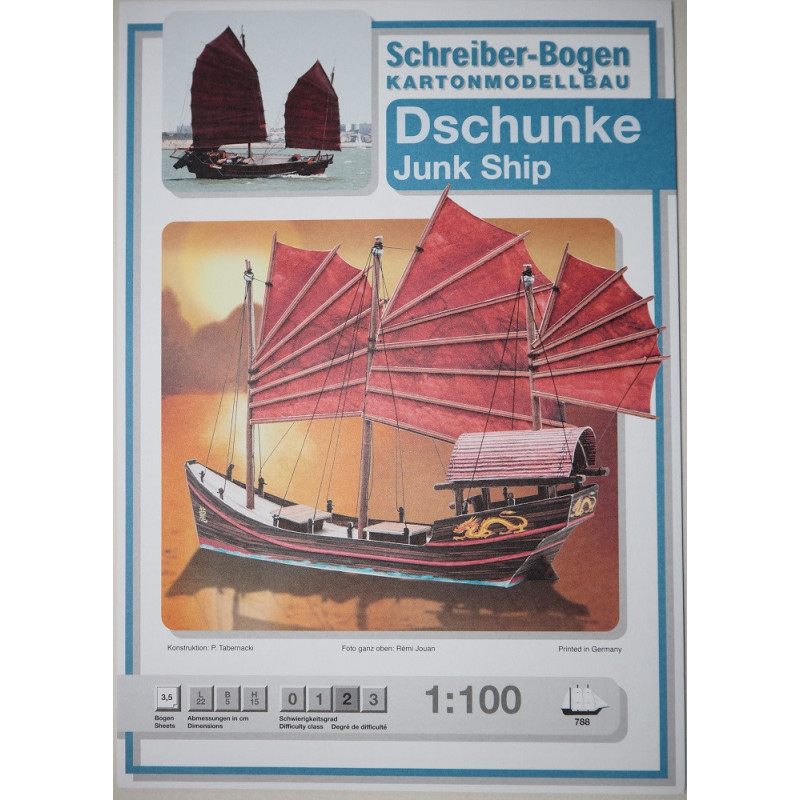


Publisher/ manufacturer: "Schreiber-Boggen". Germany
Scale: 1 : 100
Number of sheets: 8 x B4 (1 sheet of 1 mm cardboard)
Number of pages with details: 4
Number of assembly drawings: 10
Difficulty: For modelers of all experience.
Model dimensions: 220 mm x 50 mm x 150 mm
 Security policy
(edit with the Customer Reassurance module)
 Delivery policy
(edit with the Customer Reassurance module)
 Return policy
(edit with the Customer Reassurance module)
A junk is a flat-bottomed sail ship with a small draft, designed mainly for river navigation. The word junk comes from the Malay djong, which in turn comes from the Southern Minang word 船 (chûn), meaning "ship". A junk is distinguished by its wide, high-raised bow and stern and a low middle part. It has two to four (five) masts. The sails are quadrangular, woven from bamboo fibers and reinforced with horizontal battens. Each of the sails upfolds or unfolds like a blind. The junk is controlled by a rudder plate. It is up to 55 m long and up to 9 m wide. Junks is carried cargo. They are common in Southeast Asia and the Far East. In some regions of Vietnam, junks are also used as floating dwellings. It is not known exactly, when and where junks appeared. However, the origins are often associated with China, and they were already widely used during the Han dynasty. Used for military purposes in the early Middle Ages, they were already found in the waters of Indonesia and even Indian Ocean. Over time, junks began to be used for long sea voyages throughout East Asia. With the spread of steamships, junks retained their importance as a very maneuverable cargo ship. Large and small junks sailed for centuries on rivers, lakes and seas in Asia. Marco Polo, returning from China, also sailed on a junk.
A beautiful little model of a three-masted ship with characteristic sails. It is well designed and quite well detailed, but simple and therefore suitable even for beginners and modelers with little experience. Even will not need much advice of a more experienced colleague, when gluing it. The model without an underwater part, the basis with printed "sea waves" included. The graphic instructions are small, but quite detailed, the textual ones are quite large and detailed in English and German.

Publisher/ manufacturer: "Schreiber-Boggen". Germany
Scale: 1 : 100
Number of sheets: 8 x B4 (1 sheet of 1 mm cardboard)
Number of pages with details: 4
Number of assembly drawings: 10
Difficulty: For modelers of all experience.
Model dimensions: 220 mm x 50 mm x 150 mm