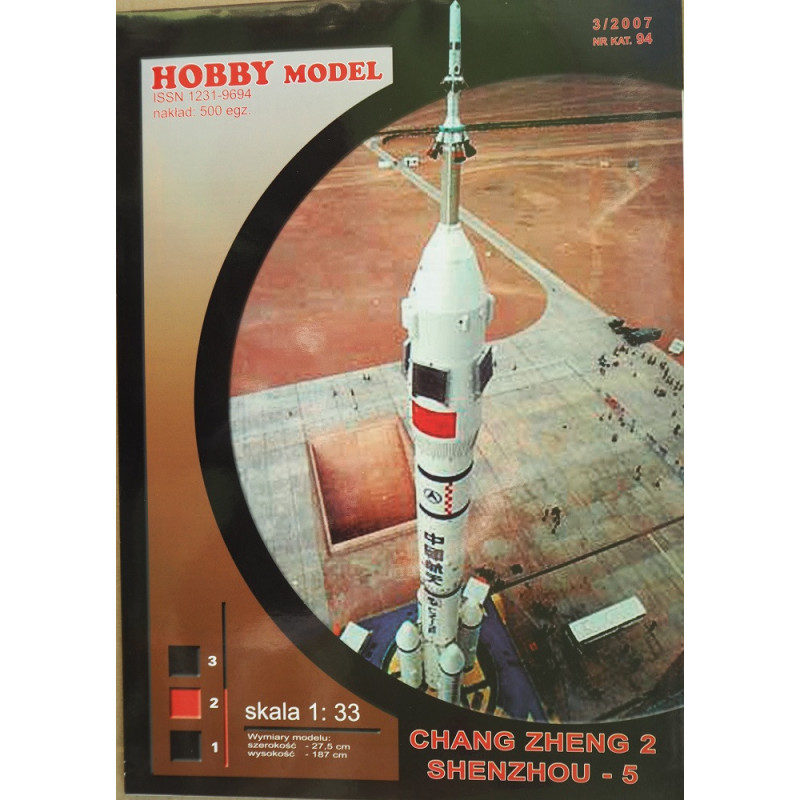


Publisher/ Manufacturer: "Answer. Hobby Model". Poland
Scale: 1 : 33
Number of sheets: 24 x A3
Number of sheets with details: 19 1/3
Number of assembly drawings: 7
Difficulty: For modelers of any experience.
Model dimensions: 275 mm x 275 mm x 1870 mm
 Security policy
(edit with the Customer Reassurance module)
 Delivery policy
(edit with the Customer Reassurance module)
 Return policy
(edit with the Customer Reassurance module)
"Chang Zheng 2" (Chinese: long-range) is the name of a family of modern Chinese rockets, designed to launch spacecraft and satellites into orbit. The first rocket of this family was launched in 1972, and the latest version ("Chang Zheng 2 F") was first successfully launched in 1999. The "Chang Zheng 2 F" rocket is 62 meters long, with a maximum diameter of 7.85 meters. It can launch a payload of 8.4 tons into orbit. The rockets of this family were developed by the CALT (China Academy of Space Technology) research center, with the exception of the “Chang Zheng 2 D” rocket, which was developed by the SAST (Shanghai Academy of Space Technology). However, all of them are based, in one way or another, on the technical solutions, used in China's first ballistic missile, the DF-5. "Shenzhou 8" - a Chinese unmanned spacecraft, launched into orbit in early November 2011. The ship was launched into space on a “Chang Zheng 2F” rocket - a carrier from the Jiuquan Cosmodrome. The main task of "Shenzhou 8" was a test flight and a practical test of the possibility of docking with the orbital module "Tiangong 1". The docking operation was carried out twice during the mission (on November 2 and 14, 2011), and both maneuvers were completely successful. Once, the “Shenzhou 8” undocked from the “Tiangong 1” module, and it was also successful. No less important was the fact, that “Shenzhou 8” successfully returned to Earth on November 17, 2011, after less than 17 days in space. The experience, gained from the operation and maneuvers of “Shenzhou 8”, had a significant impact on the construction and launch of the “Shenzhou 9” and “Shenzhou 10” spaceships, which have already made manned flights into space.
A huge, well-designed and sufficiently detailed model will appeal to modelers of any experience, except for complete beginners. The most difficult thing in this model is the size of the rocket itself and a significant number of large parts, the formation of which requires great care and absolutely does not tolerate hasty work. There is no colors reserves, the textual instruction in Polish, although there is, but only 5 general notes, the graphical instruction is also small, but it should be enough for good assembling of the model.

Publisher/ Manufacturer: "Answer. Hobby Model". Poland
Scale: 1 : 33
Number of sheets: 24 x A3
Number of sheets with details: 19 1/3
Number of assembly drawings: 7
Difficulty: For modelers of any experience.
Model dimensions: 275 mm x 275 mm x 1870 mm