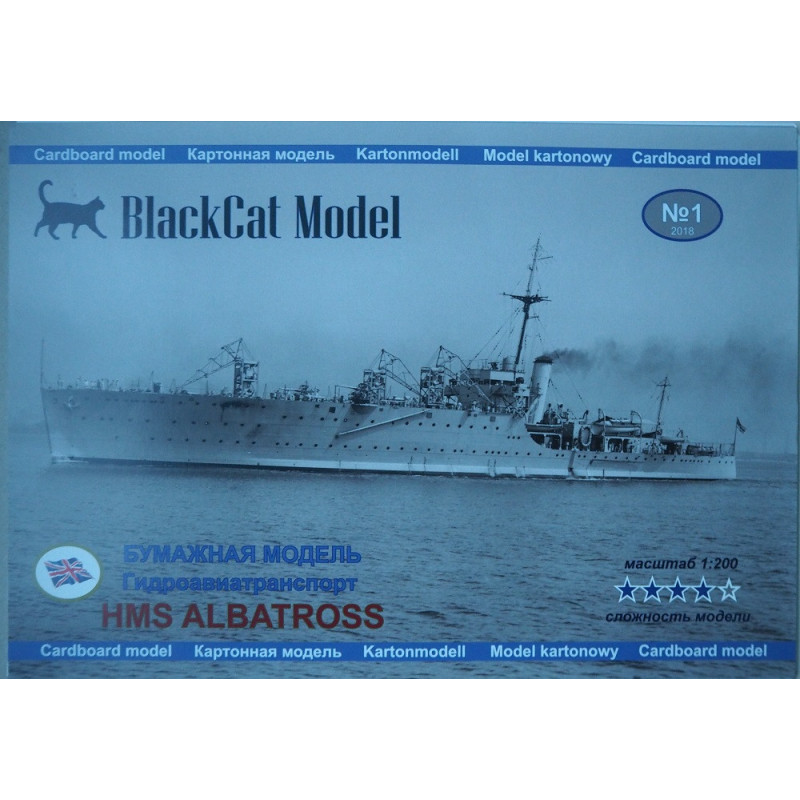


Publisher/ manufacturer: "Black Cat Model". Belarus
Scale: 1 : 200
Number of sheets: 16 x A3
Number of sheets with parts: 12
Number of assembly drawings: 66
Difficulty level: For medium experienced and experienced modelers
Dimensions of the model: 676 mm x 118,5 mm x 199 mm
 Security policy
(edit with the Customer Reassurance module)
 Delivery policy
(edit with the Customer Reassurance module)
 Return policy
(edit with the Customer Reassurance module)
HMS "Albatross" - Australian seaplane transport, also called a seaplane carrier, later transferred to the Royal Navy of Great Britain, where it was used as a floating workshop. Built at the Kakadu Island shipyard in 1928, entered service in early 1929. The ship had problems with the operation of seaplanes: the machines, with which it was to be armed according to the project, were removed from the armament lists even before the ship entered service, and the new type of aircraft could not be launched from the catapults of the "Albatross". In the end, aircraft, specially designed for the "Albatross", were accepted into service in 1933, but the ship rarely went to sea. After five years in reserve, the "Albatross" was transferred to the British Royal Navy as compensation for the cruiser "Hobart", intended for the Australian fleet. The British Navy did not really need a seaplane carrier, but the "Albatross" was remembered, when the British lost several aircraft carriers at the beginning of the Second World War, which needed to be replaced. Initially, the "Albatross" operated from bases in South Africa, from where she escorted convoys in the South Atlantic and participated in patrol missions. In mid-1942 the ship was transferred to the Indian Ocean. In late 1943 - early 1944 the ship was converted into a landing floating workshop. In June 1944, the "Albatross" took part in the Normandy landings, repairing damaged landing ships, barges and other vessels in the landing zones of "Sword" and "Juno". In October 1944, the "Albatross" was hit by a torpedo, but the ship did not sink and was towed to England for repairs. After repairs, which were completed in early 1945, the ship was used as a floating base for minesweepers and was transferred to the reserve after the war. In August 1946, "Albatross" was sold and then changed owners several times. In 1948 it was converted into a passenger ship and renamed "Hellenic Prince". The ship was chartered by the International Organization for Refugees and used to transport refugees from Europe to Australia. In 1953 it was used as a military transport to transport troops to Kenya, where the Mau-Mau uprising was breaking up at that time. A year later the ship was handed over for cutting.
A medium-sized, well-designed and richly detailed model for medium-experienced and experienced modelers. Where required, parts (or entire sheets) are printed double-sided, propellers and some parts are printed with metallic bronze paint. There are no color stocks. The graphic instructions are good, but they are slightly spoiled by the rather dark gray background, where You have to make an effort to see the black part numbers. The text instructions are just a few general notes.
You might also like
Publisher/ manufacturer: "Black Cat Model". Belarus
Scale: 1 : 200
Number of sheets: 16 x A3
Number of sheets with parts: 12
Number of assembly drawings: 66
Difficulty level: For medium experienced and experienced modelers
Dimensions of the model: 676 mm x 118,5 mm x 199 mm