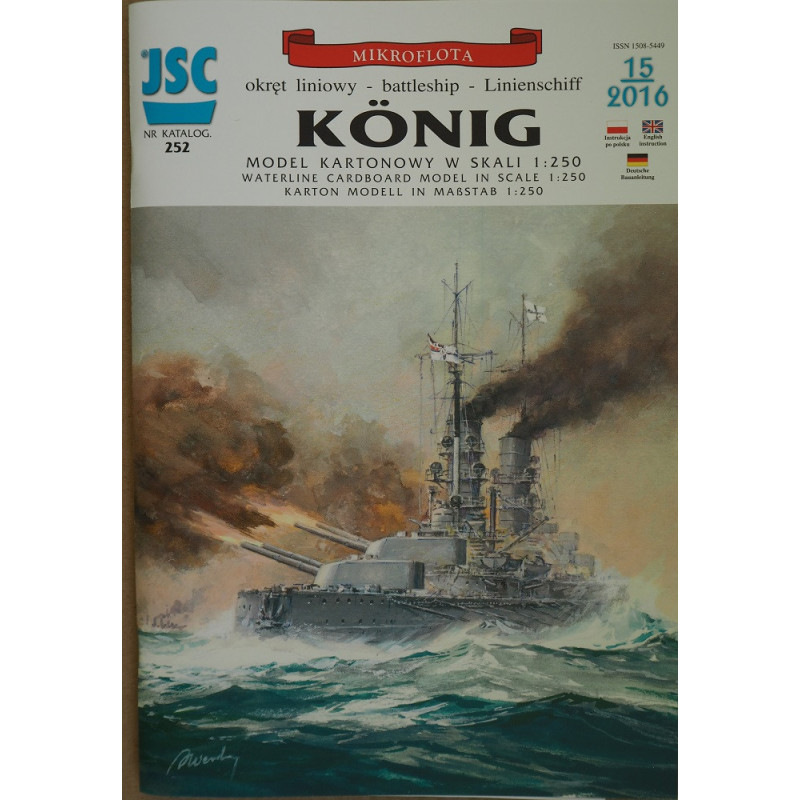


Manufacturer/ Publisher: "JSC". Poland
Scale: 1 : 250
Number of sheets: 25 x A4
Number of sheets with details: 15
Number of assembly drawings: 20
Difficulty: For medium and experienced modelers.
Model dimensions: 701.5 mm x 118 mm x 192.5 mm
 Security policy
(edit with the Customer Reassurance module)
 Delivery policy
(edit with the Customer Reassurance module)
 Return policy
(edit with the Customer Reassurance module)
Design of a new series of lineships began in 1909. Construction of "Konig" was scheduled for 1911 and began on November 10 of that year at the "Kaiserliche Werft" shipyard in Wilhelmshafen. The ship was launched on March 1, 1913, and entered service in the Kaiser's Navy on August 10, 1914. This series included 3 more ships: “Groser Kurfuerst”, “Markgraf” and “Kronprinz”. The ‘Konig”-type ships were a further development of the “Kaiser” series. The biggest change involved the arrangement of artillery: all main-caliber turrets were placed along the diametrical axis of the ship, the fifth turret was placed between the funnels, and the side turrets were abandoned altogether. The hull length was increased, and anti-aircraft artillery was installed from the very beginning, which was done for the first time in German lineships. The main caliber remained 305 mm, despite the fact, that 343 mm caliber guns had already become established on British lineships. Comparative firings showed, that the smaller-caliber German shells were much more effective, than the larger British ones. The “Konig”-type ships were to become a counterweight to the British “Iron Duke”-type battleships, armed with 10 x 343 mm guns. The Germans paid more attention to armor on their ships, than to the maximum caliber of their guns. This approach proved very successful in the Battle of Jutland, where the “Konig” was repeatedly hit by “Iron Duke” shells, but caused minimal damage. The “Konig”-type ships were to replace all other previous battleships in the German fleet. The cost of the ships was 45 million gold marks. Their armor weighed 10,283 tons, which was 40.5 percent of the design displacement. On March 5-6, 1916, it participated in the attack on the Hoofden region, and on April 25 covered the actions of cruisers near Lowestoft and Yarmouth. On May 31, “Konig”, with Vice Admiral Behnke flying the flag, led a squadron of battleships to the Battle of Jutland. All ships of this type participated in the main battle and were repeatedly hit by shells of various calibers, but they all remained in formation. Vice Admiral Behke was wounded in the battle. “Konig” was hit by 10 large-caliber shells and about 1,600 tons of water entered the ship through a hole in the bow, as a result of which the increased draft of the ship did not allow it to return to port by a shallower route. During the battle or from wounds after it, the ship's crew lost only 45 sailors. The battle damage was repaired at the “Kaiserliche Werft” shipyard in Kiel. The ship returned to the formation on July 21, 1916. On August 19, “Konig” participated in the attack on the east coast of England, on October 19 - in the attack on Dogger Bank. From October 11 to 19, 1917, the ship took part in the operation to occupy the Moonsund archipelago. October 17 "Konig" fire, launched during the capture of Orillia Island, was so powerful, that it severely damaged the Russian battleship "Slava", that its crew was forced to run aground. April 23, 1918 "Konig" participated in the raid on the northern regions of the North Sea. December 6, 1918 the ship, together with the remnants of the German fleet, was interned in Scapa Flow. By order of Admiral Reuter, all interned ships opened their kingstons on June 21, 1919 and were scuttled by their own crews. Later, the British tried to raise them, but this was only successful, if the ships were sunk at a depth of 30 m. And from deeper waters, ships began to be raised, having previously separated the pieces with the help of explosives, only in 1962, the metal was used to produce medical equipment and steel, suitable for shipbuilding.
A well-designed and well-detailed, complex model of medium size, intended only for medium-experienced and experienced modelers. The textual instructions in Polish, German and English are large, detailed and will definitely help You assemble this medium-sized model and will perfectly complement the medium-level graphical instructions. There is a considerable supply of colors, the sides have a reserve length in the middle, which is very good, when something does not fit - it is always easier to cut, than to "add".

Manufacturer/ Publisher: "JSC". Poland
Scale: 1 : 250
Number of sheets: 25 x A4
Number of sheets with details: 15
Number of assembly drawings: 20
Difficulty: For medium and experienced modelers.
Model dimensions: 701.5 mm x 118 mm x 192.5 mm