

Publisher/ Manufacturer: "PRO-Arte" – "Modelarstwo Kartonowe". Poland
Scale: 1 : 200
Number of sheets: 12 1/3x A4, + flags and sails,
Number of sheets with details: 7 1/3 x A4, + flags and sails,
Number of assembly drawings: 27
Difficulty: For modelers of any experience.
Model dimensions: 400 mm x 40 mm x 134.5 mm
 Security policy
(edit with the Customer Reassurance module)
 Delivery policy
(edit with the Customer Reassurance module)
 Return policy
(edit with the Customer Reassurance module)
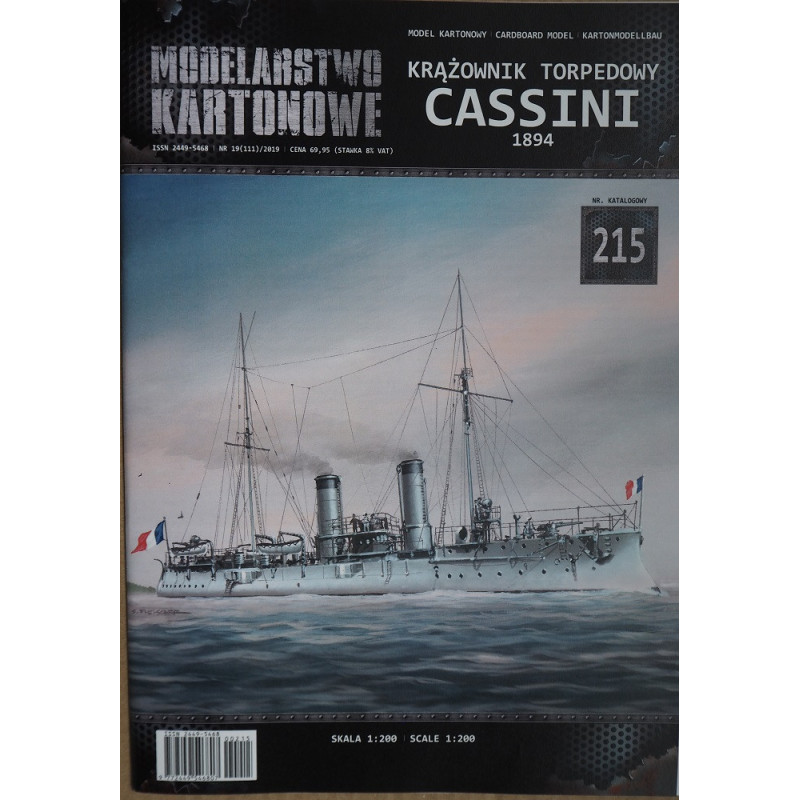
“Cassini” was the second torpedo cruiser, built for the French Navy in the 1890s and often classified as a torpedo gunboat or torpedo avizo. The “d'Iberville”-type ships were a modified version of the earlier torpedo cruisers, which were characterized by much higher speed. “Cassini” was armed with 2 x 450 mm torpedo tubes and one 100 mm gun for defense. In the 1880s the French Navy began building of a series of torpedo ships, armed with the new self-propelled Whithead mine. The first series of ships were relatively large, the next two classes were much smaller, and the” l'Iberville” class was a return to larger ships, but much faster. “Cassini” was built by the “Societe Nouvelle des Forges et Chattlers de la Mediterranee” at La Seyne sur Mer. The keel was laid in November 1892; he was launched on 5 June 1894. Although the ship was scheduled to be completed that same year, delays in the running trials of other ships delayed “Cassini's” running trials. The problems arose due to the very long French warship testing program, compared to the programs of other countries, as well as the fact, that recently a new type of boilers had been installed on ships, which required changes in the requirements for boiler rooms. The cruiser was completed the following year, and during the tests she reached a speed of 21.37 knots. However, during the tests the ship hit a floating object during the 24-hour maximum speed sailing tests. As a result, one of the propeller blades broke and repairs were required before the final tests. In 1897 “Cassini”, along with two armored cruisers and two torpedo boats, was assigned to the Cruiser division of the Northern Squadron. In July and August 1899 the ship took part in maneuvers. Later it was withdrawn from service to eliminate faults. Returning to service in 1900, the cruiser was included in the Northern Division and served there until 1901. That year, the annual fleet maneuvers took place from 3 to 28 July. During them, the Northern Division was directed south for joint operations with the Mediterranean Escadre. The ships of the Northern Division formed part of the enemy fleet, and their goal was to rendezvous with a German escadre attempting to contact their Italian allies. In August and September, the Northern Division conducted demonstration assault maneuvers. On 28 September, “Cassini” escorted a group of ships from Brest to La Rochelle. The ships simulated a harbor bombardment, neutralization of coastal defenses and a landing of 6,000 troops ashore. “Cassini” remained in service until 1902. In January of that year, he participated in training at Cherbourg along with submarines. The cruiser and the coast guard ships “Bouvines” and “Amiral Trehouart” simulated targets for the submarines “Morse”, “Narval”, “Tryton”, “Espadon” and “Francois”. “Cassini” managed to avoid “Morse's” attack, but immediately entered the range of “Francois”, which "sinked" the ship. Both coast guard ships were also recognized as "sinks" by submarines. In 1903 the cruiser was still part of the Northern Escadre, which took part in 6 months of training maneuvers. On 2 April 1903 “Cassini” and other ships of the Escadre took part in the welcoming ceremony of King of Britain George V, who arrived in Cherbourg on his yachts “Victoria” and “Albert”. In 1906 the ship took part in naval maneuvers, that began on 6 July. The participating Northern and Mediterranean escadres gathered in Algeria and took part in operations in the western Mediterranean. They ended on 4 August. In 1908 the cruiser was attached to a flotilla of ships, led by the new battleship “Vrite”, which sailed to the Baltic Sea and Russia. On that mission the ship escorted a battleship, carrying President Armand Falliere, and the escadre also included an armored cruiser and two destroyers. The group returned to Brest on 6 August. Later, “Cassini” was converted into a minelayer with 97 mines on deck. In August 1914 “Cassini” was assigned to the Mine Group, where she began World War I. “Cassini” initially operated with the entire fleet, escorting military convoys, transporting French forces from Africa. He continued in these operations until 23 September, when he was assigned to escort the battleship “Saint Louis” to Port Said in Egypt. Until mid-1915 the ship patrolled the Straits of Otranto and Corfu in the southern Adriatic. On 20 February 1917 “Cassini” was hit by a torpedo in the Strait of Bonifacio and sank.
A small, but well-designed and richly detailed model of a small ship, which will suit only medium-experienced and experienced modelers. Although, working under the supervision of a more experienced colleague and making a somewhat simplified model, even an advanced beginner and a modeler with little experience will cope with it perfectly. Just don't rush and do everything carefully and accurately. The model has a perfectly detailed hull, deck equipment, superstructures, artillery, other equipment. There is a small reserve of colors and textures, the flag and sails are printed on thin paper, single-sided printing (only flag) - both sides are printed on the same side and it needs to be glued by folding, or double-sided printing. Very beautiful and realistic texture of wooden decks - only maybe a bit dark. There are details of the model's keel block (stand). The textual instruction in Polish is very small - only a few sentences, but the graphical one is large, detailed, informative and perfectly readable.

Publisher/ Manufacturer: "PRO-Arte" – "Modelarstwo Kartonowe". Poland
Scale: 1 : 200
Number of sheets: 12 1/3x A4, + flags and sails,
Number of sheets with details: 7 1/3 x A4, + flags and sails,
Number of assembly drawings: 27
Difficulty: For modelers of any experience.
Model dimensions: 400 mm x 40 mm x 134.5 mm