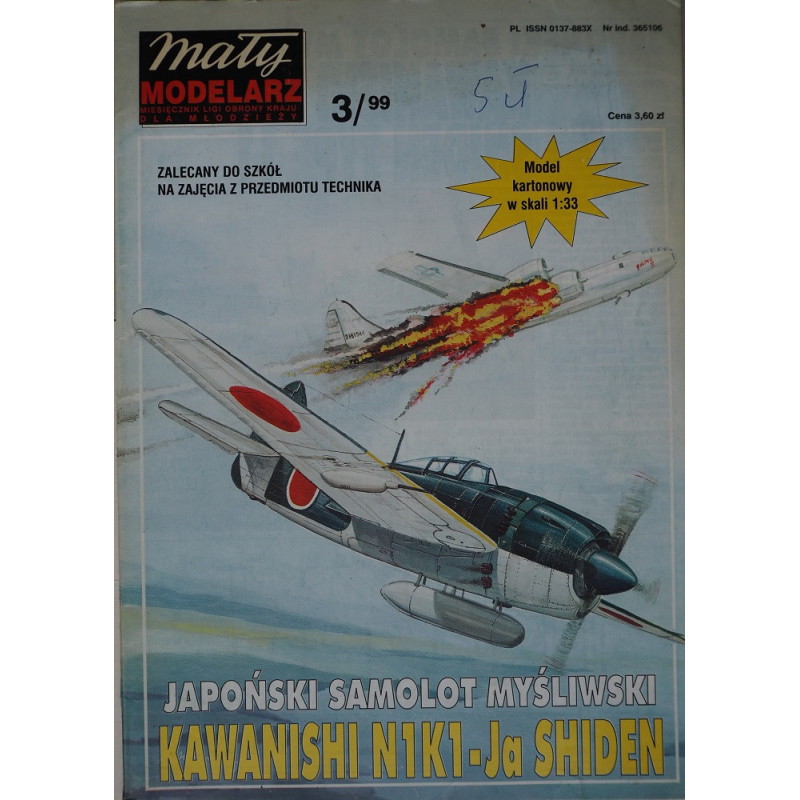


Publisher/ manufacturer: "Maly Modelarz". Poland
Scale: 1 : 33
Number of sheets: 8 x A4
Number of sheets with parts: 5
Number of assembly drawings: 11
Difficulty level: For modelers of any experience.
Dimensions of the model: 269 mm x 363,5 mm x 123 mm
 Security policy
(edit with the Customer Reassurance module)
 Delivery policy
(edit with the Customer Reassurance module)
 Return policy
(edit with the Customer Reassurance module)
The Imperial Japanese Navy's N1K1-Ja "Shiden" was an improved version of the Kawanishi N1K1 "Kyofu" seaplane and was unique in its origin among World War II fighter aircraft. In January 1942 "Kawanishi Aircraft" began work on adapting the "Kyofu" to take off from land airfields. The initiative, which was initially purely private, quickly received government approval and was designated the N1K1-J. The first prototype flew in December 1942. The entire aircraft remained the same, only acquiring a wheeled retractable landing gear and a tail wheel. The engine was also changed - instead of the Mitsubishi "Kasei" a smaller, but more powerful Nakajima "Homare" was installed. This change gave the aircraft greater speed and significantly improved its flight characteristics, but also caused problems. In order to fully utilize the engine power, it was necessary to install a larger diameter propeller, which required the use of a high landing gear (the aircraft had a wing, mounted in the middle of the fuselage). This created problems, when retracting the landing gear after takeoff. Kawanishi engineers used telescopic landing gear legs, but this design and engine failures were constant troubles, that haunted pilots, flying N1K1-J aircraft. All this was eliminated in the N1K2-J "Shiden-Kai" modification. In total, about 1000 fighters of this type were produced, which fought over the Philippines, Formosa, Okinawa and Honshu.
A simple, well-designed and fairly finely detailed fighter model, that will assemble any experience modeler. Only advanced beginners and modelers with little experience are recommended to work under the supervision of a more experienced colleague and not rush, work carefully and attentively. We also recommend, that those with little experience, make the model without cockpit equipment and with an opaque cockpit canopy and retracted landing gear, although it is worth trying to do all this - and maybe You will succeed... The model depicts a fighter from the Imperial Japanese Navy assault group "Tsukuba". There are no color reserves, the text instructions are medium in volume, but quite informative, the drawings complement it perfectly and both of these instructions perfectly illustrate the entire process of assembling the model. Antiquarian publication.

Publisher/ manufacturer: "Maly Modelarz". Poland
Scale: 1 : 33
Number of sheets: 8 x A4
Number of sheets with parts: 5
Number of assembly drawings: 11
Difficulty level: For modelers of any experience.
Dimensions of the model: 269 mm x 363,5 mm x 123 mm