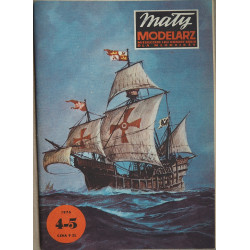
Publisher/ Manufacturer: "Maly Modelarz". Poland
Scale: 1 : 100
Number of sheets: 18 x A4
Number of sheets with details: 13
Number of assembly drawings: 11
Difficulty: For intermediate and advanced modelers.
Model dimensions: 375 mm x 150 mm x 365 mm
 Security policy
(edit with the Customer Reassurance module)
 Delivery policy
(edit with the Customer Reassurance module)
 Return policy
(edit with the Customer Reassurance module)
The galleon "Smok", also known as the Sigismund Augustus's Galleon, was the first ship, built for the Polish Navy. The name "Smok" is only a guess, as the ship had a dragon-shaped figurehead on the bow. It (along with two small auxiliary ships: a single-masted frigate and a boat - was ordered by King Sigismund II Augustus as the nucleus of the fleet. The ship was designed and built by the shipbuilder Domenico Zaviazello, brought from Venice, and his assistant Giocomo Salvadore. Jan Bąkowski, acting on behalf of the Maritime Commission, carried out the general economic management of the building. The keel was laid on 21 June 1570 in Elblag. The work was suspended for the winter, from 25 November 1570 to March 1571. The ship was launched on 14 June 1571. On 15 March 1572, Bąkowski paid for the building costs, and during that period Zaviazello left Poland, but the finishing work continued under the supervision of Salvadore. However, the ship was never completed, most likely due to the death of Sigismund II Augustus. 7 July 1572, when work was suspended. The ship also did not receive the planned guns, although they had already been purchased. According to one version, the galleon was later burned during the Gdańsk attack on Elbing in 1577. However, according to more recent finds, the galleon was towed down the Elbing River and escaped destruction. During the towing, its masts were cut off. The unfinished galleon was finally dismantled in 1584–1588. The fate of the two auxiliary ships built is unknown. However, it is known that both were used in 1572. The appearance, exact dimensions and equipment of the "Smok" are unknown.
A small, but rather complex, well-designed and fairly well-detailed model for medium-experienced and experienced modelers. However, the model is not so complex, that it could not be assembled by an advanced beginner modeler, working under the supervision of a more experienced colleague. Color reserves not included, where needed, the details are printed double-side printing, the textual instruction are quite extensive and informative, the graphical ones could be better, but these should be enough for good gluing of the model. Antiquarian publication.

Publisher/ Manufacturer: "Maly Modelarz". Poland
Scale: 1 : 100
Number of sheets: 18 x A4
Number of sheets with details: 13
Number of assembly drawings: 11
Difficulty: For intermediate and advanced modelers.
Model dimensions: 375 mm x 150 mm x 365 mm