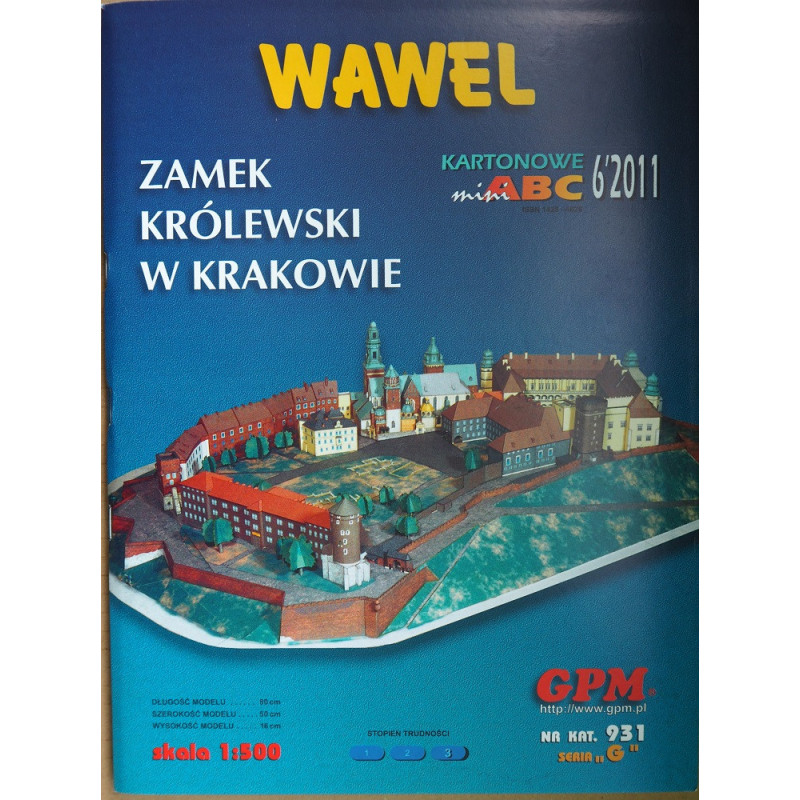


Manufacturer/ Publisher: "GPM". Poland
Scale: 1 : 500
Number of sheets: 40 x B4
Number of sheets with details: 32
Number of assembly drawings and photos: 85
Difficulty: For medium and experienced modelers.
Model dimensions: 800 mm x 500 mm x 160 mm
 Security policy
(edit with the Customer Reassurance module)
 Delivery policy
(edit with the Customer Reassurance module)
 Return policy
(edit with the Customer Reassurance module)
Wawel is a hill and architectural complex in Krakow, the former residence of the Polish kings. The castle, palace and Cathedral are located on a hill on the left bank of the Vistula, 228 m above sea level. Together with the Old Town of Krakow, Wawel is on the UNESCO World Cultural Heritage List. According to legend, a dragon, lived in the caves of Wawel Hill, which was cunningly defeated by the knight Krakus. The city of Krakow was founded on this site, named after the knight. People have lived on Wawel Hill and in the caves of the hill since the Paleolithic. The settlement grew, because it was at the crossroads of important trade routes. Salt was mined in Wieliczka, located near Wawel, since the Stone Age. From late antiquity to the early Middle Ages, Wawel was the center of the West Slavic tribe of the Vysławs, especially after the Vysławs created the first state entity in the territory of present-day Lesser Poland around the 6th century. Archaeological excavations show, that a fortified settlement of the Vysławs existed on the site of Wawel as early as the 11th century. Waclaw II began building brick fortifications in 1290–1300, and in the 14th century Casimir III rebuilt the hill fortifications in the Gothic style. Around 1340, the castle and city walls were connected. After the fire of 1499, Alexander Jagiellon began rebuilding Wawel, and these works reached their greatest extent under the reign of Sigismund the Old. A new fire in 1595 partially destroyed the castle. In 1609, Sigismund Vasa rebuilt it, but after that the importance of the castle decreased. Nevertheless, the coronation of Polish kings took place in the castle. In 1655–1657, Wawel was plundered, and in 1702, it was burned by the Swedes during the Northern War. In 1724–1728, attempts were made to reconstruct the complex, but after Poland lost its independence, Wawel became the barracks of the Austrian army and was poorly maintained. In 1905, the castle was returned to the city, restoration work began and a museum was established. Currently, the castle houses an exhibition dedicated to the lives of Polish kings - living quarters, a coronation hall, an armory and a treasury. The cathedral is home to the Polish and Lituanian rulers – Stephen Báthory and others, the most famous poets – Adam Mickiewicz, Juliusz Slovacki, Cyprian-Kamil Norwid, as well as political figures – Tadeusz Kościuszko, Józef Pilsudski, Józef Poniatowski, Władysław Sikorski, Lech Kaczyński. The complex of buildings reflects a thousand-year history of building. There are buildings of various architectural styles – Romanesque, Gothic, Renaissance and Baroque. The most important surviving architectural monuments are: the Royal Wawel Castle, Wawel Cathedral, numerous Gothic and Romanesque towers and bastions, four Gothic, Renaissance and Baroque gates, 19th century barracks buildings, the castle wall and other defensive structures, the foundations of many Romanesque and Gothic churches, the foundations of Renaissance farm buildings.
A huge, perfectly designed and richly detailed Royal residence with all the defensive fortifications, access roads and the hill itself. It is clear, that such a monster is "bitten" only by medium-experienced and experienced modelers, but even they will have something to shake their brains and hands. There are no reserves of colors and textures, the textual instructions in Polish are very extensive and informative, the graphical ones are also very extensive and informative, consisting not only of assembly drawings, depicting each step, but also of photos, that complement them. There are also two Big-Big sheets with details of the model base.

Manufacturer/ Publisher: "GPM". Poland
Scale: 1 : 500
Number of sheets: 40 x B4
Number of sheets with details: 32
Number of assembly drawings and photos: 85
Difficulty: For medium and experienced modelers.
Model dimensions: 800 mm x 500 mm x 160 mm