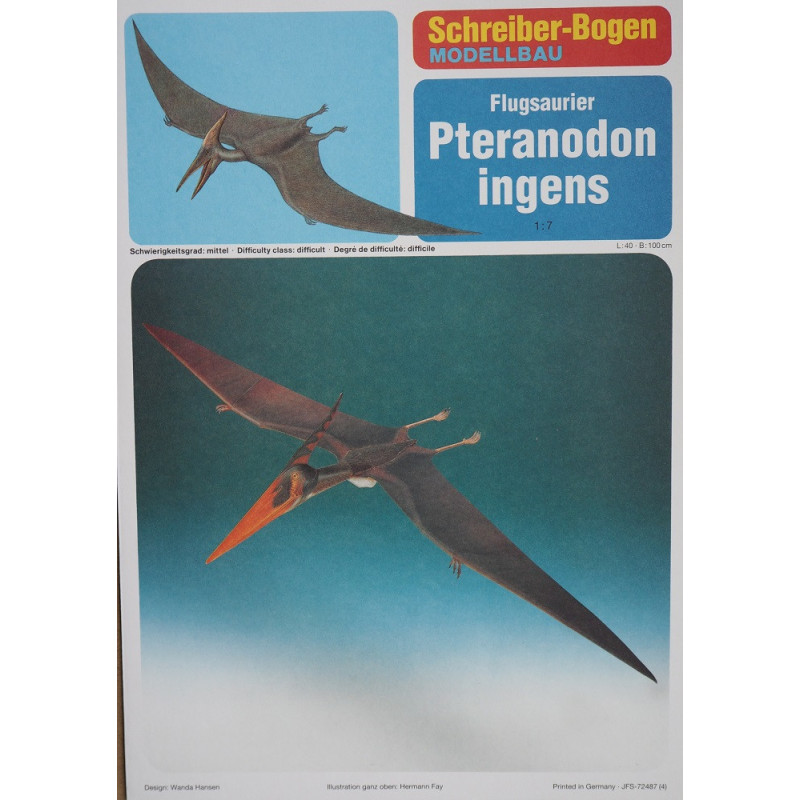


Publisher/ Manufacturer: "Schreiber-Bogen Kartonmodelbau". Germany
Scale: 1 : 7
Number of sheets: 9 x A4 ( 1 sheet A4 – 1 mm cardboard)
Number of sheets with details: 7 x A4,
Number of assembly drawings: 2
Complexity: For modelers of any experience.
Model dimensions: 400 mm x 1000 mm x 150 mm
 Security policy
(edit with the Customer Reassurance module)
 Delivery policy
(edit with the Customer Reassurance module)
 Return policy
(edit with the Customer Reassurance module)
Pteranodon (Greek for “toothless wings”) is an extinct genus of flying pterosaur reptiles belonging to the suborder Pterodactylus. It lived in the Upper Cretaceous period, approximately 86–84.5 million years ago. Its first fossils were discovered in 1870. in western Kansas. They were only studied six years later by palaeontologist Othniel Marsh, who named the newly discovered pterosaur Pteranodon longiceps. Pteranodon was a reptile, but not a dinosaur - by definition, all dinosaurs belong to the Saurischia and Ornithischia groups, which pterosaurs do not belong to. Despite this, it is often incorrectly described as a dinosaur. Size: Wingspan: up to 7 m, weight: 20 kg. Pteranodon was one of the largest flying reptiles. Although, its body was no larger, than a turkey, it had powerful wings, the wingspan of which could reach up to 7 m. Distribution: North America. Pteranodon fed almost exclusively on fish, as evidenced by the numerous fossilized fish bones found, where the reptile's stomach probably once was. Its lifestyle was probably similar to that of modern albatrosses. Like them, the pteranodon spent most of its life at sea, fishing and, like albatrosses, gliding using air currents, which allowed it to fly long distances without wasting energy on flapping its wings. It probably only returned to land to breed.
A large, fairly simple, but perfectly reproducing the appearance of this scarecrow model, intended for modelers of any experience, even complete beginners. The assembly of the model is concisely explained in a small textual instruction in German. The graphical instruction is only two drawings, but they are quite enough for assembling the model, as they are quite easy to red. Of course, there is nothing to talk about any color reserves in this publication, but it is completed with a 1 mm thick A4 cardboard sheet for gluing the frame details. The technology for drawing details has been solved in an interesting way: the contours of the detail, bending lines, and cutouts are printed on one side of the sheet, while the texture of a larger area of the detail is printed on the other.

Publisher/ Manufacturer: "Schreiber-Bogen Kartonmodelbau". Germany
Scale: 1 : 7
Number of sheets: 9 x A4 ( 1 sheet A4 – 1 mm cardboard)
Number of sheets with details: 7 x A4,
Number of assembly drawings: 2
Complexity: For modelers of any experience.
Model dimensions: 400 mm x 1000 mm x 150 mm