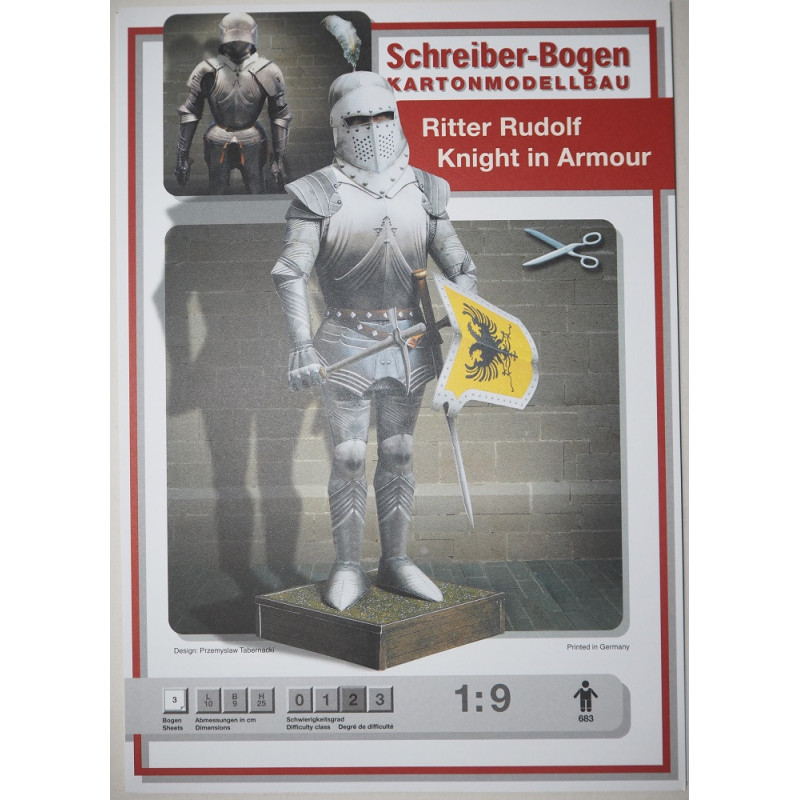


Publisher/ manufacturer: "Schreiber-Boggen". Germany
Scale: 1 : 9
Number of sheets: 7 x B4 (1 sheet of 1 mm cardboard)
Number of pages with details: 4
Number of assembly drawings: 22
Difficulty: For modelers of all experience..
Model dimensions: 100 mm x 90 mm x 250 mm
 Security policy
(edit with the Customer Reassurance module)
 Delivery policy
(edit with the Customer Reassurance module)
 Return policy
(edit with the Customer Reassurance module)
The German word for knight is "Ritter", and in the Middle High German language it originally meant simply "Reiter" (rider), used in the Middle Ages for heavily armored warriors on horseback. These knights were usually nobles. The first knights appeared in the 8th century after the wars with the Moors in France. They had to provide better defense, because the army of commoners, which had been common until then, was no longer effective enough. During the wars with Hungary, Henry I ordered the creation of an official army of knights with the Imperial Edict of Worms. This also led to the construction of more castles. Knights soon spread throughout Europe. In the late Middle Ages, to be accepted as a knight, one had to be a descendant of the nobility. In addition, a person also had to have certain qualities and be well educated. Some men were knighted for special services, but this was usually compared to an order. To become a knight, a boy had to start learning certain rules at the age of seven, and this lasted for several years. At the prince's court, the future knight learned everything about the customs and manners of the court, as well as received the intellectual and religious education that was customary at that time. The most important were legends, biblical stories and music. However, learning to read and write was not necessary at that time. Also, great attention was paid to physical training. The rules provided instructions on riding and the use of weapons. At the age of fourteen, the boy began to prepare for the duties of a squire. The knight was assigned a squire who was to serve him. At the age of twenty-one, after successful training, he was ordained a knight. The knight's armor consisted of several layers: over the underwear made of wool or linen, the knight wore a chain mail shirt made of small metal rings. On top of this, armor was worn that covered the entire body from head to toe, including the arms. The helmet often had a removable visor with air holes to protect the face. The knight fought with a spear, sword and battle axe, and defended himself with a shield. The first firearms came into use in the 14th century. As a result, armor had to be made thicker and thicker. The more new weapons were created, the less mobile the knights became. Because of the armor, which weighed up to 25 kg, they often had to be put on a horse. That is why such armor was used only in tournaments. Lighter armor was worn during battle. In the late Middle Ages, princes and kings wanted to be more independent of their subjects and had mercenary armies, which included well-organized infantry. In this way, chivalry lost its importance and was gradually abolished. Many knights were able to adapt to the new conditions and became mercenaries. Others became robber barons out of financial necessity.
This model recreates the appearance of a 15th century knight. It is not very complicated, but quite well designed and moderately detailed, suitable even for beginners and modelers with little experience. But it is recommended for them to work under the supervision of a more experienced colleague. Several parts are printed double-sided, You can choose one of two versions of the knight's face and one of three versions of the shield. There is 1 sheet of cardboard (1 mm thick) for gluing the parts.

Publisher/ manufacturer: "Schreiber-Boggen". Germany
Scale: 1 : 9
Number of sheets: 7 x B4 (1 sheet of 1 mm cardboard)
Number of pages with details: 4
Number of assembly drawings: 22
Difficulty: For modelers of all experience..
Model dimensions: 100 mm x 90 mm x 250 mm